The McDonough Meteorite — a cherry‑tomato‑sized fragment that crashed through a Georgia homeowner's roof on June 26, 2025 — has been identified as an L‑type ordinary chondrite roughly 4.56 billion years old. Analyses indicate it likely broke from a larger parent asteroid about 470 million years ago. Observations of the bolide and recovered fragments provided trajectory and velocity data that can inform models of atmospheric breakup and planetary defense. The team will submit the proposed name McDonough Meteorite to the Meteoritical Society's Nomenclature Committee.
Daylight Impact: 4.56‑Billion‑Year‑Old 'McDonough Meteorite' Pierces Georgia Living Room
A Meteorite Older than Earth Crashed Into a HouseRafael Ben-Ari - Getty Images
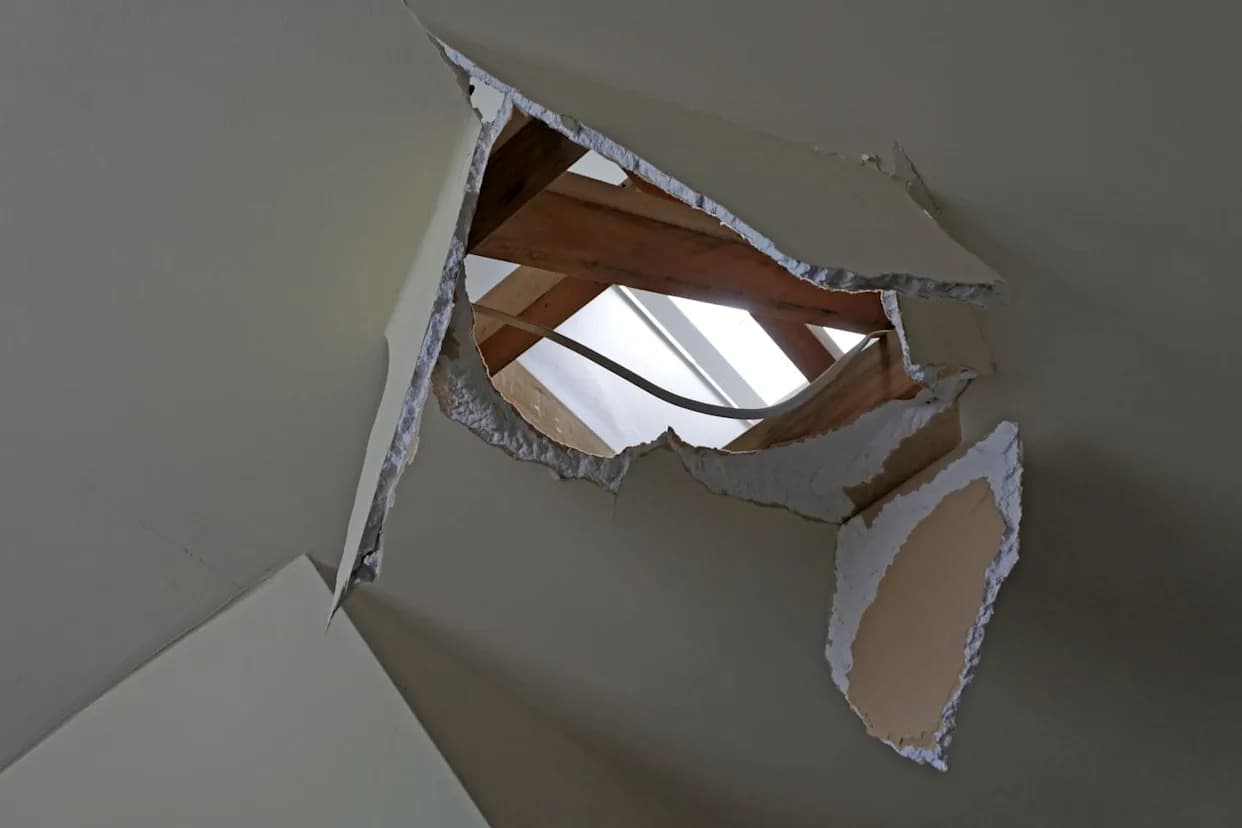
On the afternoon of June 26, 2025, a glowing object streaked across the sky over Georgia and South Carolina, producing repeated sonic booms. A cherry‑tomato‑sized fragment from that fireball punched through the roof and an HVAC duct of a home in McDonough, Georgia, dented the living‑room floor and kicked up a cloud of dust — narrowly missing the homeowner by about the length of an average sedan.
University of Georgia planetary geologist Scott Harris obtained fragments and dust from the scene. Microscopic and imaging analyses showed the rock shattered during atmospheric entry rather than arriving intact. By tracking the bolide as it burned from atmospheric friction and examining surviving pieces with optical and electron microscopy, researchers reconstructed aspects of its trajectory and physical history.
Ancient Origins: The specimen has been identified as an L‑type ordinary chondrite, a common class of stony meteorites rich in rounded mineral grains called chondrules — once molten droplets in the early solar system. Chemical and textural evidence indicate the fragment likely separated from a much larger parent asteroid about 470 million years ago. That parent body appears to have formed roughly 20 million years before Earth, giving this rock an age of approximately 4.56 billion years — slightly older than our planet (Earth ≈ 4.54 billion years).
Energy and Velocity: Although small (about the size of a cherry tomato), the fragment still carried substantial kinetic energy on impact. Harris noted in a University of Georgia video release that pieces of the bolide may have been traveling at many hundreds of meters per second — and, during earlier stages of atmospheric entry, potentially up to about one kilometer per second — speeds sufficient to pulverize some wood paneling and penetrate structural materials. (Atmospheric deceleration and fragmentation mean terminal speeds for surviving fragments can vary widely.)
Scientific Value and Planetary Defense: Meteorites that strike Earth are typically fragments of fractured asteroids from the main belt between Mars and Jupiter. Collisions in that region can nudge pieces into Earth‑crossing orbits. Because the McDonough event was observed as a bright bolide and recovered quickly, it provides unusually precise trajectory and velocity data for a fragment recovered so close to a person. Researchers say those measurements can help refine models of how incoming space rocks break up and decelerate — information that is useful for planetary defense planning.
Naming and Next Steps: The team — including collaborators at Arizona State University — plans to submit their findings and the proposed name McDonough Meteorite to the Nomenclature Committee of the Meteoritical Society for publication in the Meteoritical Bulletin.
Context: L‑type ordinary chondrites are relatively common, but incidents where fragments land so close to people are rare. Notable past examples include a 2021 meteorite that landed on a bed in British Columbia and the 1954 Sylacauga (Ann Hodges) case, in which a fragment struck a woman and left a bruise; that specimen is now in the Alabama Museum of Natural History.
With improving observation networks and growing public attention, more falling space rocks are being seen and recovered. The McDonough event is both a vivid reminder that meteorites reach the ground and a valuable data point for scientists studying the hazards and history of near‑Earth impacts.
Help us improve.