A 12th‑century Crusader sword was discovered off Israel’s Mediterranean coast by University of Haifa graduate student Shlomi Katzin after he chased away divers he suspected of looting. The Israel Antiquities Authority authorized a professional excavation, and researchers used a hospital CT scan to examine the corroded iron core without removing marine encrustation. Scanning revealed a fractured blade and only a small remnant of the iron core, but the one‑handed design suggests it likely belonged to a Frankish Crusader. Further study is ongoing; Katzin had previously found a similar sword in 2021.
Graduate Student Spots a Second 12th‑Century Crusader Sword Off Israel’s Coast
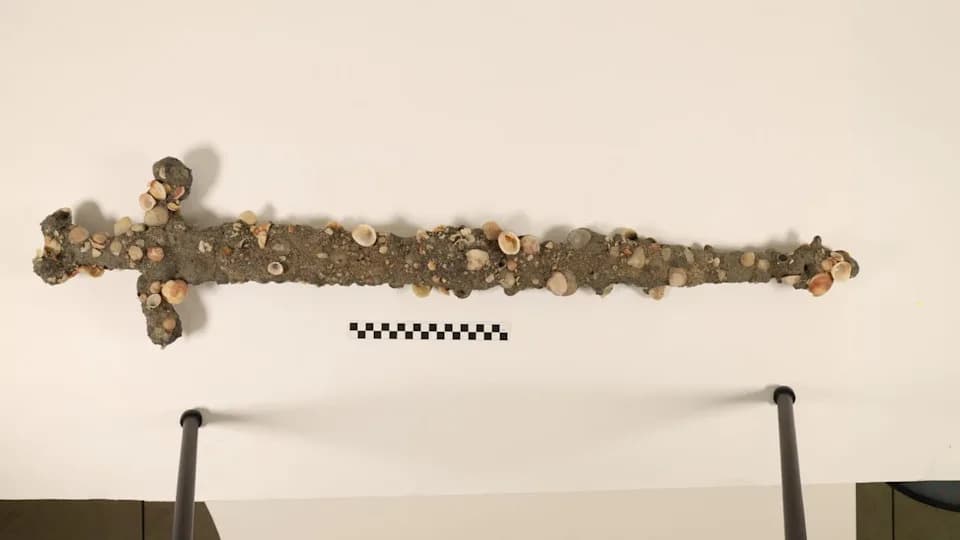
This 12th-century sword was found by a graduate student and studied via a hospital CT scan. . | Credit: Yoav Bornstein, University of Haifa
A 12th‑century sword from the Crusader era has emerged from centuries of burial in sand and marine encrustation off Israel’s Mediterranean shore after University of Haifa graduate student Shlomi Katzin noticed its hilt protruding from the seabed.
Discovery and Recovery
Katzin, who studies maritime civilizations, encountered a group of divers using metal detectors while swimming and—fearing looting—sent them away. Soon after, he spotted the sword’s hilt in the sand and recognized the piece from a similar find he made in 2021. He reported the discovery to nautical archaeologist Deborah Cvikel at the University of Haifa, who notified the Israel Antiquities Authority. The authority granted permission for a professional underwater excavation.
Scientific Examination
The roughly 3‑foot (1‑meter) weapon underwent noninvasive analysis using a hospital CT scanner so researchers could examine its interior without removing the heavy marine encrustation that had grown on the iron core. The scan showed severe corrosion: the blade was fractured and only a small remnant of the original iron remained. Nonetheless, the sword’s construction indicates a one‑handed design consistent with Crusader weaponry, and researchers say it likely belonged to a Frankish knight.
"This is an extremely rare find that sheds light on the Crusader presence on the coasts of the country," said Deborah Cvikel. She noted that only a handful of comparable Crusader‑period swords are known in Israel and that the discovery improves understanding of medieval maritime anchorages and the lives of warriors in the region.
During the Crusades (A.D. 1095–1291), papally sanctioned knights from Western Europe fought campaigns in the eastern Mediterranean for control of the Holy Land. Objects such as swords and shields provide tangible evidence of the era’s violent conflicts and the material culture of those who fought.
Context and Ongoing Research
Medieval swords were typically recycled because metal was valuable, so archaeologists infer that weapons found in the sea were most likely lost in maritime accidents or combat—events that could have been catastrophic for their owners. Researchers are continuing to study the sword’s construction, corrosion patterns and any trace materials that might shed light on where and how it was used.
The find adds to a small but growing body of maritime archaeological evidence for Crusader activity along the Mediterranean coast and highlights how chance discoveries by trained observers can preserve important cultural heritage.
Help us improve.