Key test for any Ukraine peace deal: Russia must return abducted Ukrainian children. Tens of thousands are unaccounted for, and roughly 1.6 million children live under occupation where Russian authorities run indoctrination and assimilation programs. The current 20-point framework mentions abducted children only briefly and lacks an operational plan for identification, return and reintegration. Without verifiable returns and dismantling of assimilation systems, any settlement will struggle to be credible, durable or accepted by Ukrainians.
No Credible Peace in Ukraine Until Russia Returns Abducted Children — A Fundamental Test
Every meaningful peace process begins with a basic credibility test: before borders are frozen, guarantees granted, or sanctions eased, negotiators must be confident that the parties can and will meet the most fundamental obligations that peace requires.
In Ukraine, that test is clear: will Russia return the Ukrainian children it has taken?
Secretary of State Marco Rubio recently told a Senate hearing that the territorial status of Donbas is the last unresolved issue in peace talks. That assertion risks creating false hope and overlooks an issue that resonates across the American public and among faith and humanitarian groups — the return of Ukrainian children who have been abducted, forcibly relocated, or subjected to systematic assimilation.
This is not a marginal humanitarian concern. It is a direct measure of whether Russia intends to abide by any settlement. Tens of thousands of Ukrainian children remain unaccounted for after being taken into the Russian Federation or placed under Russian control. An estimated 1.6 million children live in temporarily occupied territories where Russian authorities have built extensive systems of indoctrination, militarization and legal erasure.
With limited humanitarian pressure on the Kremlin, Moscow no longer needs mass relocations to sever children from their homeland. These practices have been institutionalized: schools, youth organizations, citizenship rules and social services now reflect and reinforce assimilation efforts.
Yet the 20-point peace framework being developed by Ukraine, the U.S. and allied partners contains only a single brief reference to abducted children and lacks an operational plan for identifying, returning or reintegrating them. That omission is not technical; it reflects an assumption that accountability for this crime can wait until after a deal is signed. That assumption is dangerous.
The return of abducted children is not a maximalist demand. It is a clear, verifiable and morally unambiguous obligation under international law. Unlike many complex territorial or security provisions, the return of children can be independently monitored and confirmed: either children are brought home, or they are not.
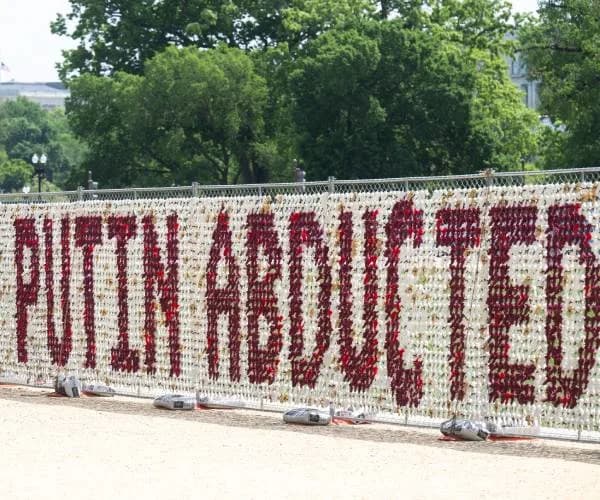
Moscow continues to deny that Ukrainian children are being held unlawfully, despite extensive documentation, survivor testimony, and International Criminal Court arrest warrants for President Vladimir Putin and for Russia’s commissioner for children’s rights, Maria Lvova-Belova.
If Russia refuses even to acknowledge this crime, there is little reason to believe it will comply with more complex or politically costly provisions of any peace agreement.
Russia’s policies toward Ukrainian children are systematic and strategic. Through forced legal-status changes, reeducation programs, military training and coerced adoptions, the Kremlin is attempting to reshape the identities and loyalties of a generation. Children are being taught that Ukraine does not exist, that their families abandoned them, and that Russia is their true homeland — a homeland they should be prepared to defend.
Any settlement that leaves these systems intact embeds the causes of future conflict into the structure of peace. A deal that ignores the indoctrination and militarization of children does not end the war; it defers it. Worse, allowing these practices to stand would normalize population transfer and identity-destruction as acceptable tools of statecraft, weakening international protections against atrocity.
Accountability and negotiation are not mutually exclusive. Upholding the law for crimes against children is not an obstacle to peace but part of its durable architecture. Practical measures — independent monitoring, a clear operational plan for identification and return, and funded reintegration programs — can be built into negotiations as trust-building mechanisms.
Finally, any agreement must be sustainable inside Ukraine. Ukrainians are being asked to consider painful compromises after years of existential war; abandoning abducted children would make national acceptance of any settlement far more difficult. Bringing captive Ukrainians home is not only a legal and moral imperative — it is one of the few measures likely to help build domestic consent for peace.
Peace cannot rest on promises alone. It must begin with proof. Until Russia returns the children it has taken and dismantles the systems designed to erase those who remain under occupation, no settlement can be considered credible, durable or just.
Kristina Hook is a nonresident senior fellow at the Atlantic Council and an assistant professor of conflict management at Kennesaw State University.
Help us improve.