Researchers at TU Wien cooled rubidium-87 atoms to 30–70 nK and confined them in a one-dimensional, ~100 μm trap. Despite frequent head-on collisions, mass and energy currents remained sharply defined rather than diffusing, producing behavior likened to a quantum Newton’s cradle. Using tilted traps, density-imbalance releases, and a physics-informed neural network, the team observed ballistic-like transport and Drude-weight signatures that explain why the cloud resists ordinary thermalization. Results appear in Science.
Quantum Newton’s Cradle: Ultracold Atoms Carry Energy Without Resistance

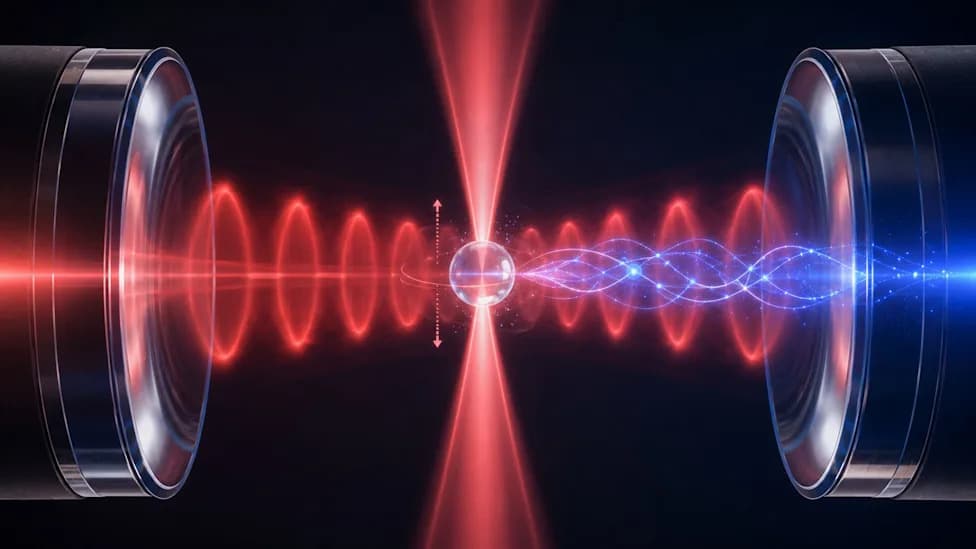
Physicists observe nearly perfect ballistic transport in a one-dimensional ultracold rubidium gas. (CREDIT: AI-generated image / The Brighter Side of News)
Researchers at TU Wien have engineered a nearly frictionless quantum system in which mass and energy flow persist without the usual decay. Using an ultracold gas of rubidium-87 confined to a one-dimensional line, the team observed long-lived currents that survive many collisions—behavior they liken to a quantum Newton’s cradle.
How the Experiment Worked
The experiment used roughly 87Rb atoms cooled to 30–70 nanokelvin and trapped by magnetic fields generated from an atom chip. Tight confinement in two directions restricted motion to a single line about 100 micrometers long; optical potentials sculpted with a digital micromirror device gave precise control over the shape of the trap. In this geometry atoms can collide only head-on, which dramatically changes how momentum and energy are exchanged.
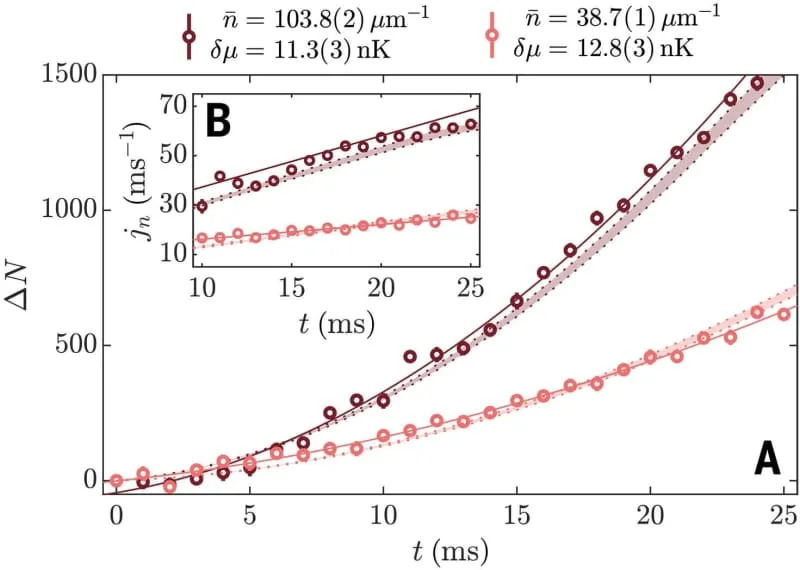
Particle flow in response to constant external force. (CREDIT: Science)
Surprising Transport Behavior
Instead of showing ordinary diffusion—where motion spreads out and degrades—the atomic cloud maintained sharply defined flows even after many collisions. Frederik Møller of the Atominstitut at TU Wien described the result as a suppression of diffusion: the cloud’s mass and energy currents continued to propagate rather than smear into random motion. The team compared the effect to a Newton’s cradle, where momentum is transferred between particles without dissipating into chaos.
Probes and Measurements
The researchers probed transport with two complementary protocols. In one, they tilted the trap to apply a constant force along the line (analogous to an electric field) and tracked the growing particle current by measuring the imbalance between the trap’s left and right halves. In the other, they prepared two halves of the cloud at different densities, removed the barrier, and watched two waves travel outward from the center. Rather than scale with the square root of time (diffusion), the profiles collapsed when plotted versus distance divided by time—signaling ballistic-like scaling.
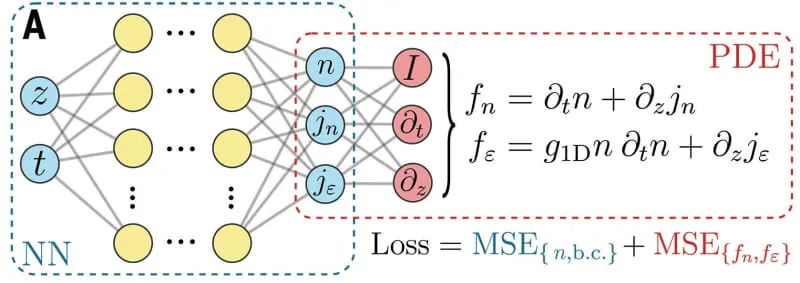
Extracting bipartition currents with physics-informed neural networks. (CREDIT: Science)
Because imaging destroys the gas, direct current measurements were challenging. To reconstruct particle and energy currents from the destructive density snapshots, the team trained a physics-informed neural network that enforces conservation of mass and energy (the continuity equations). With only density data as input, the network reliably inferred the local particle and energy currents and confirmed the absence of diffusive scaling.
Why Thermalization Fails Here
The persistence of currents stems from the integrable character of the one-dimensional gas. Integrable systems host many conserved quantities that restrict how energy and momentum redistribute, preventing ordinary thermalization. The TU Wien experiments also revealed dispersive shock–wave features—rarefaction waves and traveling density peaks—consistent with Whitham theory and predictions from generalized hydrodynamics.
Broader Significance
Measuring a finite Drude-weight–type response and observing long-lived ballistic currents in a controlled quantum platform gives experimental access to transport phenomena that are hard to isolate in solids. These results provide benchmarks for many-body theory and generalized hydrodynamics, and they shed light on how resistance can emerge—or be suppressed—in quantum systems. The full findings are published in Science.
Help us improve.