Two dorsal fins found on beaches of Bering Island bore tooth rakes that genetic testing identified as coming from southern resident orcas. Researchers argue the marks are consistent with attacks by mammal‑eating Bigg's orcas and suggest occasional predation could favor the residents' large, cohesive family groups as a defense. Experts caution scavenging or intergroup aggression could produce similar marks, so cannibalism remains a provisional interpretation.
Tooth‑Marked Orca Fins on Russian Beaches Suggest Occasional Cannibalism — Could Predation Explain Tight‑Knitted Pods?

New findings suggest killer whales may participate in cannibalism. | Credit: Sergio Amiti via Getty Images
Researchers have recovered two dorsal fins from orcas on Russian beaches that bear tooth rakes consistent with attacks by mammal‑eating killer whales. Genetic tests identified both victims as southern resident orcas, a fish‑eating population that ranges near Washington State and British Columbia. The findings, published Feb. 24 in Marine Mammal Science, raise the possibility that occasional predation by Bigg's orcas helps explain why some orca populations travel in unusually large, close family units.
Two Marked Fins Found On Bering Island
In August 2022, Sergey Fomin of the Pacific Institute of Geography (Russia) found a bloodied dorsal fin on Bering Island that was scored with parallel tooth marks, often called rake marks. Two years later, in July 2024, he discovered a second similarly marked dorsal fin from a young male. Genetic analysis showed both fins belonged to southern resident orcas.
What The Marks Might Mean
The pattern of marks resembles damage known from attacks by Bigg's orcas (mammal‑eating ecotypes sometimes referred to as Orcinus orca rectipinnus). Filatova and colleagues suggest Bigg's orcas may occasionally attack and partly consume other orcas, discarding low‑value parts such as dorsal fins. They propose that this rare predation could select for the residents' large, tightly bonded family groups as an anti‑predator strategy.
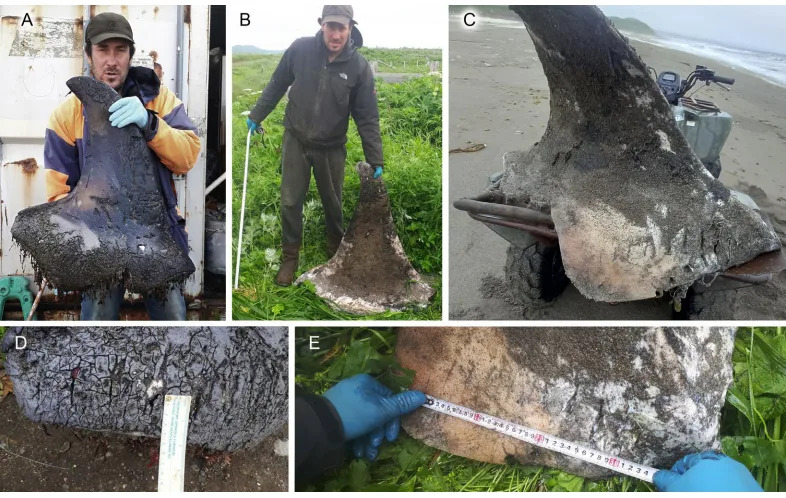
The researchers found the orca dorsal fins, which appeared to have been cannibalized, in 2022 and 2024. | Credit: Filatova et al., Marine Mammal Science, 2026,CC BY-NC-ND 4.0
"So, it looks like this defense strategy is really working," said Olga Filatova, a whale researcher at the University of Southern Denmark, describing observations of Bigg's individuals avoiding areas while residents were present.
Caveats And Alternate Explanations
Other experts urge caution. Luke Rendell (University of St Andrews) noted that tooth marks on carcasses are interesting but do not yet provide a complete explanation for the social evolution of fish‑eating orcas. Michael Weiss (Center for Whale Research) pointed out the marks could also stem from scavenging on floating carcasses or from aggressive interactions between resident groups, rather than direct predation.
Filatova acknowledged scavenging cannot be fully ruled out, but argued that fresh killer whale carcasses usually sink and only resurface after days of decomposition, making scavenging less likely in these cases. She also noted that wounds from resident‑on‑resident fights typically appear on the sides of animals rather than on dorsal fins.
Broader Context
Orcas display striking ecological and social variation: the fish‑eating residents (often highly site‑faithful and socially cohesive) and the mammal‑eating Bigg's orcas (more transient and group‑flexible). Filatova speculates predation pressure from interactions between lineages may have favored the residents' cohesive social structure tens of thousands of years ago, though this remains a hypothesis pending further evidence.
Bottom line: Two tooth‑marked dorsal fins provide compelling, if provisional, evidence that mammal‑eating orcas sometimes attack other orcas. The observation supports a plausible hypothesis linking predation pressure to resident orcas' tight social bonds, but alternative explanations and limited sample size mean more data are needed.
Help us improve.