
Congress is divided over whether U.S. military action in Venezuela could be used by China to justify moves against Taiwan. Democrats, led by Rep. Gregory Meeks, warn Beijing might seize the precedent, while Republicans such as Rep. Brian Mast and Rep. Young Kim counter that the operation was a targeted law-enforcement mission tied to criminal charges. Experts say U.S. assertions about Maduro’s legitimacy could be framed by Beijing as a legal rationale for intervention in its own region. The Senate advanced legislation to limit further U.S. military action in Venezuela, though House timing remains uncertain.
U.S. Operation in Venezuela Fuels Congressional Debate: Could China Cite It to Justify Moves on Taiwan?

Chinese President Xi Jinping on March 23, 2019, in Rome, Italy.
Lawmakers in Washington are sharply divided over whether recent U.S. military action in Venezuela could be used by Beijing as a precedent to justify future moves against Taiwan. The dispute highlights a broader partisan split in Congress over how to compare U.S. use of force with actions taken by authoritarian governments.
Lawmakers' Positions
Rep. Gregory Meeks (D-N.Y.), the top Democrat on the House Foreign Affairs Committee, warned that China might seize on the U.S. operation as a rationale for its own actions. "They are looking at this, and they can justify what they're doing because it's the exact same thing that the United States is doing," Meeks said.
House Foreign Affairs Committee Chairman Brian Mast (R-Fla.) acknowledged that Beijing could use the episode rhetorically but argued the two situations are fundamentally different. "China might try to use any rhetoric anytime, any place. That wouldn't be surprising," Mast said. "It’s apples to oranges." Republicans emphasize that the U.S. action in Venezuela was a narrowly targeted law-enforcement operation rather than an attempt to deny recognition of a foreign government.
Expert View
Clark Summers, a professor of international relations at Belmont Abbey College, says the U.S. position on Nicolás Maduro’s legitimacy creates a complex precedent. "At the same time that the U.S. asserts a legal authority to take action with regard to Venezuela, that largely becomes a two-edged sword in that Beijing can assert the same basic right of intervention within its own sphere of influence," Summers said. He added that China could point to such precedents when arguing that the use of force is justified under international law.
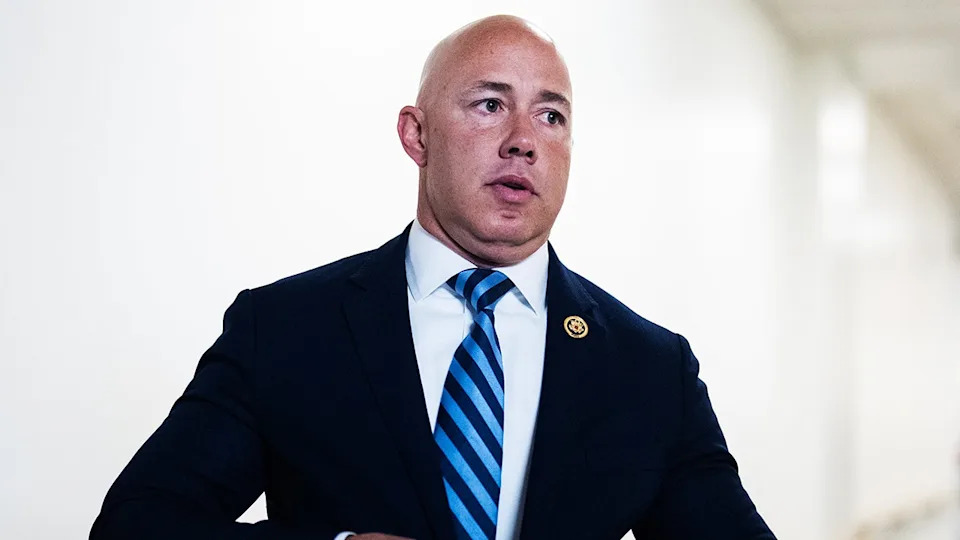
Rep. Brian Mast, R-Fla., leaves a meeting of the House Republican Conference in the U.S. Capitol on May 22, 2024.
Republican Framing
Other Republicans rejected comparisons between the U.S. operation and the actions of China or Russia. Rep. Young Kim (R-Calif.), chair of the House Subcommittee on East Asia and the Pacific, described the Venezuela mission as a law-enforcement action tied to criminal charges against Maduro. "[Maduro] is indicted for drug trafficking, causing and moving drugs into the United States, killing hundreds and thousands of American lives," Kim said. "This was a law enforcement operation, precise, targeted, very successful, very limited." Mast echoed that characterization, saying the U.S. conducted a law-enforcement function rather than acting to remove recognition of a government.
Democratic Concerns
Democrats remained skeptical that the two cases are easily separated. Meeks argued that using U.S. power to pull other countries closer to American interests can resemble the logic of authoritarian interventions, drawing a comparison to Russian justifications for the invasion of Ukraine. Rep. George Latimer (D-N.Y.) warned that the Venezuela operation could weaken U.S. moral standing when responding to future aggression: "What’s our moral standing when Russia goes into Ukraine, as China may yet go into Taiwan? They’ll look at us and say, ‘What did you do in Venezuela?’"
Regional Tensions
Beijing, under President Xi Jinping, maintains that Taiwan is part of China and has repeatedly used military drills and pressure to press that claim; officials and analysts say Beijing could use any perceived precedent to justify coercive steps. U.S. lawmakers recently raised alarms after China fired rockets into waters near Taiwan during military exercises.
Legislative Response
On Thursday, senators voted to advance legislation intended to restrict further U.S. military action in Venezuela by the Trump administration. It is unclear when or whether the House will take up the measure.
Bottom line: The episode has exposed a sharp divide in Washington over whether U.S. actions set dangerous precedents abroad or represent narrowly tailored law-enforcement measures — a debate with significant implications for U.S. credibility and how rivals like China might frame their own uses of force.
Help us improve.





















