
China has condemned recent U.S. naval operations and tanker interceptions near Venezuela as violations of international law, while using the episode to criticize U.S. global leadership. Beijing released a new Latin America policy paper shortly after the U.S. updated its National Security Strategy, signaling continued engagement in the region. The dispute carries practical stakes — China has taken a large share of Venezuelan oil exports and Venezuelan crude made up roughly 5% of China’s imports last month — but analysts say China is unlikely to respond with military force. Instead, Beijing appears to be leveraging the crisis to shape global narrative and protect its regional ties.
China Condemns U.S. Blockade Of Venezuela — And Sees Strategic Upsides In Trump’s 'Gunboat Diplomacy'

A US military helicopter flies over the Panama-flagged Centuries, which was intercepted by the US Coast Guard in the Caribbean Sea on December 20. - Department of Homeland Security/Handout/Reuters
China has publicly condemned the United States’ stepped-up military pressure on Venezuela and the recent U.S. interceptions of tankers linked to Caracas, calling the actions a violation of international law. At the same time, Beijing appears ready to exploit the episode politically — arguing it undermines U.S. claims to global moral leadership and offering itself as an alternative partner for Latin America.
What Washington Has Done
The White House has framed its operations as part of President Donald Trump’s declared “total and complete blockade” of sanctioned vessels around Venezuela. U.S. naval and maritime actions — including the interception of tankers such as the Hong Kong-registered Centuries — aim to choke economic lifelines to the Nicolás Maduro regime and to interdict shipments alleged to be tied to sanctions busting or illicit activity.
Beijing’s Response
Beijing’s official and state-backed media responses have been emphatic. Chinese diplomats called the interdictions “seriously violating international law,” and state media editorials said U.S. actions put Washington “in opposition to global moral standards.” At the U.N. Security Council, China’s representative urged restraint and defended national sovereignty.
“We oppose all forms of unilateralism and bullying,” Chinese officials told Venezuelan counterparts in recent diplomatic exchanges.
Strategic Messaging
Chinese analysts and commentators are using the episode to make two linked arguments: first, that the United States is reviving a 19th-century, Monroe Doctrine-style posture that asserts hemispheric prerogatives; and second, that such a posture reveals the limits or contradictions of U.S. global leadership. Beijing’s timing — releasing its first new policy paper on Latin America and the Caribbean in nearly a decade shortly after the U.S. National Security Strategy — signals an attempt to present China as a reliable partner for the region’s governments.
Economic Stakes
The dispute also has practical consequences. Analysts say that in recent months roughly 80% of Venezuela’s oil exports were destined for China, and data firm Kpler reported that Venezuelan crude represented about 5% of China’s total oil imports in the most recent month. The interception of vessels tied to Venezuelan shipments therefore hits an industry and supply stream important to Beijing.
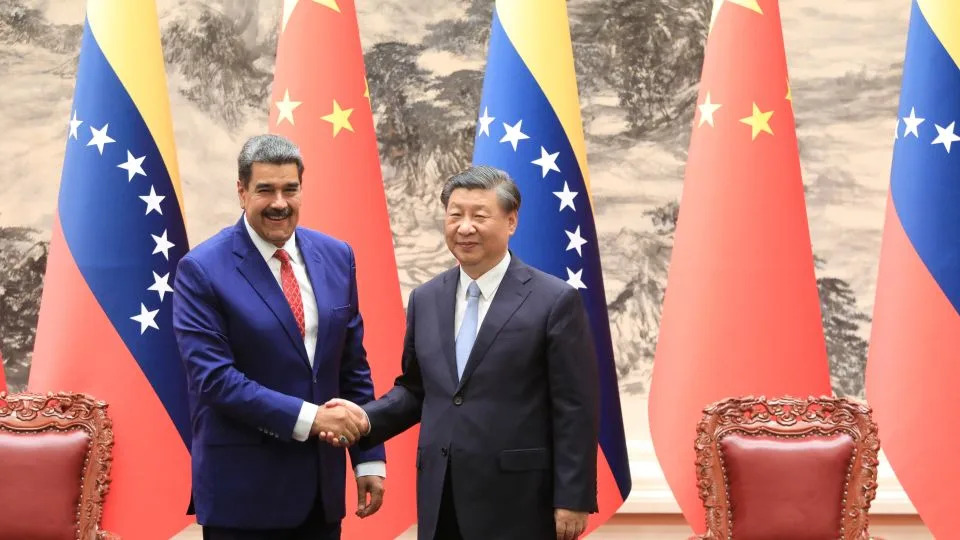
Venezuela's President Nicolas Maduro meets with Chinese leader Xi Jinping at the Great Hall of the People in Beijing in 2023. - Miraflores Palace/Reuters
How Far Will China Go?
Despite sharp rhetoric, most experts judge China unlikely to back Venezuela with military force. Instead, Beijing appears focused on diplomatic support, public messaging, and assessing how a heightened U.S. focus on the Western Hemisphere might change American engagement elsewhere — especially in East Asia, where China’s priorities include consolidating influence and pressuring Taiwan.
Chinese state media have even carried warnings from government-affiliated scholars that a large-scale U.S. maritime invasion could risk a “second Vietnam War,” rhetoric intended less as a prediction than as a deterrent and propaganda tool to underscore the costs of escalation.
Broader Implications
The episode sits at the intersection of great-power rivalry, regional influence, and energy security. The Trump administration’s updated National Security Strategy explicitly retools the Monroe Doctrine to prioritize denying non-hemispheric competitors control of strategically vital assets in the Americas. Beijing’s counter-message emphasizes sovereignty, solidarity with the Global South, and continued economic engagement through loans and infrastructure projects.
Analysts inside and outside China remain divided about whether the U.S. posture represents a durable retrenchment or a temporary refocusing. Even if Washington concentrates more on its hemisphere in the short term, Beijing is unlikely to interpret that as a permanent green light; rather, it will press its strategic advantages while continuing to fight for the global narrative.
Conclusion
In sum, China’s reaction combines genuine economic concern with a carefully calibrated political strategy: condemn U.S. maritime pressure, defend sovereignty and international law, and use the incident to argue for an alternative global order more favorable to Beijing. The net result is a diplomatic tilt toward Venezuela and Latin America that is assertive in rhetoric, cautious in military terms, and ambitious in long-term influence.


