
Florida's Space Coast is set to be the center of major space activity in 2026, with NASA's Artemis 2 circumlunar crew mission and SpaceX's planned Starship V3 among the headline events. Crew rotations to the ISS, an anticipated uncrewed Boeing Starliner test, and multiple commercial robotic lunar landers will add to a busy launch schedule. Blue Origin and Amazon Leo also plan continued launches from Cape Canaveral, reinforcing the region's role in both government and commercial spaceflight.
Florida's Space Coast Poised To Lead a Historic 2026 in Spaceflight

Four astronauts will venture around the Moon on Artemis II, the first crewed mission on NASA's path to establishing a long-term presence at the Moon for science and exploration through Artemis. The 10-day flight will help confirm systems and hardware needed for early human lunar exploration missions.
If 2025 felt like a landmark year for rockets and celestial exploration, 2026 could be even bigger — and much of it will launch from Cape Canaveral along Florida's Space Coast. From NASA's return to crewed lunar missions to new commercial milestones, the coming year promises a dense manifest of flights, tests and robotic deliveries that could shape the next decade of space activity.
Key Missions and Programs to Watch
Artemis 2: Crewed Circumlunar Flight
As soon as February, Artemis 2 may carry four astronauts — NASA's Reid Wiseman, Victor Glover and Christina Koch, plus Canadian Space Agency astronaut Jeremy Hansen — in an Orion capsule atop NASA's Space Launch System from the Kennedy Space Center. The roughly 10-day circumlunar mission is designed to test systems and procedures that will support a future crewed lunar landing under Artemis 3 and broader plans for a sustained human presence on the Moon.
SpaceX Starship V3: Moving Toward Orbit and Refueling
SpaceX plans to introduce a new iteration of its massive Starship in 2026, often referred to as Version 3 (V3). The company aims for V3 to demonstrate orbital flight and in-space refueling — capabilities considered essential for longer missions and deep-space ambitions, including refueling in orbit for lunar or Mars-bound flights.
Crew-12: ISS Rotation
Early in the year — around Feb. 15 — a SpaceX Crew-12 mission is expected to launch on a Falcon 9 from Kennedy Space Center carrying four crewmembers (including two NASA astronauts not yet publicly named). Their Dragon capsule will dock with the International Space Station and replace the Crew-11 team for an approximately six-month expedition of science and station upkeep.
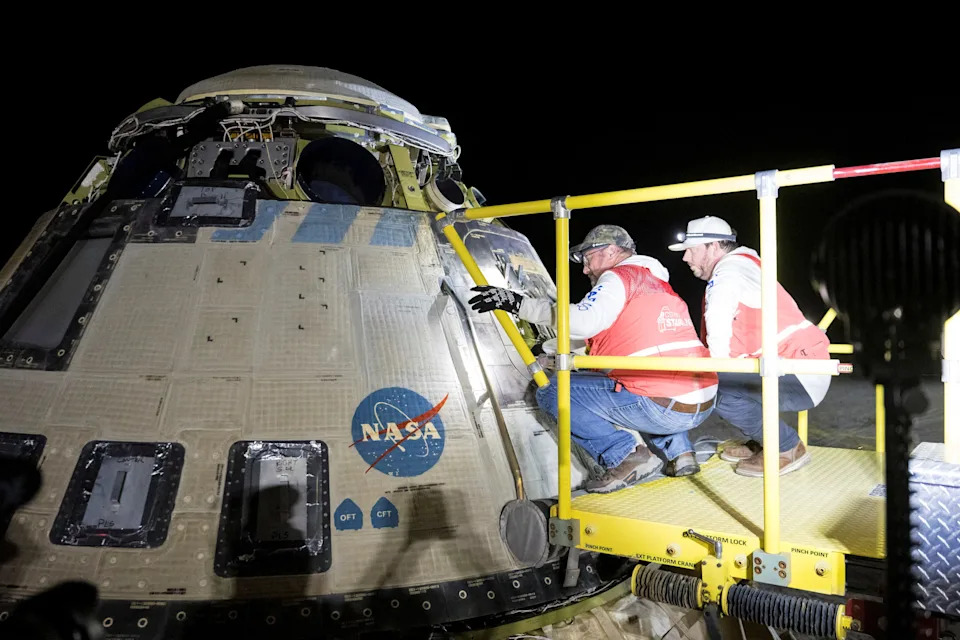
Boeing and NASA teams work around NASA's Boeing Crew Flight Test Starliner spacecraft after it landed Sept. 2024 uncrewed, at White Sands, New Mexico.
Boeing Starliner: Uncrewed Test Return
After a troubled crewed test flight in June 2024, Boeing and NASA are working toward an uncrewed Starliner flight to the ISS as soon as April 2026. The uncrewed test would be another step to demonstrate the vehicle's readiness following technical problems that affected the earlier crewed mission.
Robotic Lunar Landers: Commercial Teams Return
Robotic lunar activity will continue in 2026. In 2025 the U.S.-built Blue Ghost (Firefly Aerospace) and Intuitive Machines' Athena lander both reached the Moon, and NASA has contracts with multiple U.S. companies — including Firefly, Intuitive Machines, Blue Origin and Astrobotic — for additional lander deliveries and science payloads in 2026.
Blue Origin and Amazon Leo
Blue Origin had an active 2025 with New Glenn and New Shepard flights. In 2026 expect more suborbital New Shepard passenger missions and further activities around the heavy-lift New Glenn as the company seeks certification to support national security payloads. Separately, Amazon's satellite program, now branded Amazon Leo, has deployed 180 of a planned 3,000 broadband satellites from Florida as it builds out a global constellation.
Why It Matters
2026 could be a defining year: NASA’s Artemis efforts may return humans to lunar vicinity for the first time since Apollo, commercial vehicles are pushing toward routine orbital operations and refueling, and multiple robotic and crewed missions from Florida will test the resilience of a growing, mixed public-private space ecosystem. Together, these flights will influence lunar exploration plans, low-Earth orbit operations and the future roadmap for Mars missions.
Editor’s Note: Dates and mission plans are subject to change as agencies and companies adjust schedules for technical, safety, or programmatic reasons.


