
The man accused in the Bondi Beach massacre allegedly trained with his father in rural New South Wales and recorded videos outlining their motives, police say. Officers shot and wounded the suspect at the scene and killed his father; the suspect was later transferred from hospital to prison. Four improvised explosive devices were thrown but failed to detonate, and the suspect faces 59 charges including 15 counts of murder and a terrorism charge. The attack, described as antisemitic and timed at the start of Hanukkah, prompted New South Wales to propose stricter firearms laws, including a citizenship requirement for licences.
Bondi Beach Suspect Trained With Father, Recorded Justification Video, Police Say

Security officers gather near a gate at Bondi Beach in Sydney, Sunday, Dec. 21, 2025, ahead of a ceremony to mark the National Day of Reflection for victims and survivors from the Bondi shooting on Dec. 14. (AP Photo/Mark Baker)(ASSOCIATED PRESS)
Australian police documents released Monday allege that the man accused of killing 15 people at Sydney’s Bondi Beach practised with firearms alongside his father in rural New South Wales and recorded video statements explaining their motives.
The documents were made public after 24-year-old Naveed Akram appeared by video from a Sydney hospital, where he was being treated for an abdominal wound sustained during the Dec. 14 attack. Police say officers shot and wounded Akram at the scene; his father, 50-year-old Sajid Akram, was killed by police.
Alleged explosives and weapons: Police say the attack began when the two men threw four improvised explosive devices toward a crowd gathered at Bondi Beach for an annual Jewish event. None of the devices detonated. Investigators described them as three aluminium pipe bombs and a tennis-ball device filled with black powder, an explosive and steel ball bearings — which police called "viable" IEDs.

People attend a ceremony to mark the National Day of Reflection for victims and survivors, at Bondi Beach in Sydney, Sunday, Dec. 21, 2025, following the Bondi shooting on Dec. 14. (AP Photo/Mark Baker)(ASSOCIATED PRESS)
Charges and motive: Authorities have charged Naveed Akram with 59 offences, including 15 counts of murder, 40 counts of causing harm with intent to murder related to the wounded survivors, and one count of committing a terrorist act. Police allege the assault was antisemitic and timed to coincide with the start of an eight-day Hanukkah celebration. Investigators say the pair subscribed to an ideology linked to Islamic State and condemned "the acts of Zionists" in video footage recovered from Akram's phone.
Training and planning: Police statements indicate the father and son practised firing shotguns and moving in a tactical manner on a grassland area in October and that they recorded videos in which they recited political and religious statements and purportedly explained their justification for the attack. Authorities say there is evidence the attack was meticulously planned over many months.
Aftermath: At Bondi, a spontaneous memorial near the Bondi Pavilion that had grown after the massacre was removed as the beach returned to more normal activity; part of the memorial will be preserved by the Sydney Jewish Museum. Funerals for victims continued, including a service for 27-year-old French national Dan Elkayam in the Sydney suburb of Woollahra. Health officials said 13 people injured in the attack remained in hospital before Akram's transfer to prison.
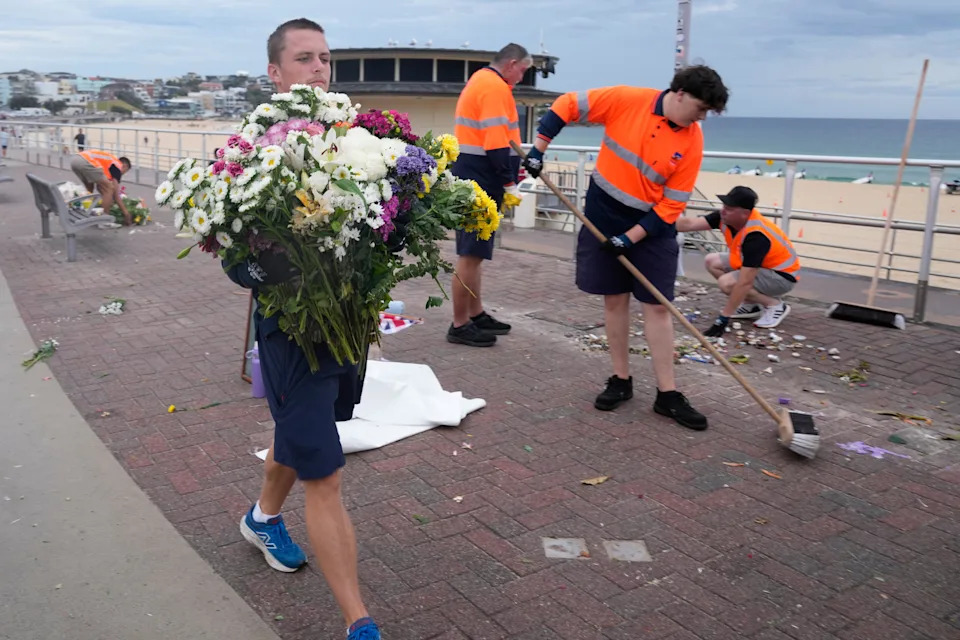
Workers gather floral tributes, messages of support and items left as a memorial is dismantled in Sydney, Monday, Dec. 22, 2025, a week after an attack on a Jewish festival that left 15 dead. (AP Photo/Rick Rycroft)(ASSOCIATED PRESS)
Policy response: In response to the massacre, the New South Wales government introduced draft gun laws described by Premier Chris Minns as among the toughest in Australia. Proposed measures include requiring Australian citizenship to qualify for a firearms licence (a change that would have excluded Sajid Akram, an Indian citizen with permanent residency) and limiting recreational shooters to a maximum of four guns. Police records show Sajid Akram lawfully owned six rifles and shotguns.
"There is evidence that the Accused and his father meticulously planned this terrorist attack for many months," the police statement said.
The investigation remains ongoing as authorities continue to examine the scope of planning, the sources of weapons and explosives, and any wider networks that may have been involved.
Help us improve.





















