
Benin has returned to relative normality after a short-lived coup attempt was defeated by loyalist forces with decisive support from the Nigerian Air Force. Key sites — including state television and the presidential palace — were reclaimed and President Patrice Talon vowed to hold perpetrators accountable. The incident underscores wider regional instability, the strategic importance of Cotonou's port, and uncertainty ahead of presidential elections scheduled for next April.
Benin Stabilizes After Failed Coup as Nigeria's Intervention Raises Regional Stakes

Benin’s President Patrice Talon in Cotonou, on August 1, 2022 [File: AFP]
The Dantokpa market in Cotonou has largely returned to its usual bustle just days after a short-lived attempt to overthrow Benin's government. Shoppers and cart-pushers squeezed through narrow lanes as traders reopened stalls, a visible sign that daily routines are resuming after the brief but intense crisis.
What Happened
On Sunday morning a group of soldiers seized the national television station and announced the removal of President Patrice Talon. The mutiny was swiftly crushed by forces loyal to the president, with decisive support from the Nigerian Air Force. Pro-government troops surrounded a base where the plotters had taken refuge and the coup leaders retreated from both the state TV building and the presidential palace.
'For the moment, everything is back to normal. And that's very good for the country and we are happy,' said small-scale trader Abel Ayihuonsou, reflecting the relief felt by many residents.
By Sunday afternoon the interior minister said the Beninese army leadership had 'foiled the attempt.' That evening President Talon appeared on state television, pledged to punish those responsible and urged citizens to resume their daily activities.

People walk at the Dantokpa market, two days after the country’s armed forces thwarted the attempted coup against the government, in Cotonou [Charles Placide Tossou/Reuters]
Regional Response and Reaction
While France and Ivory Coast offered support, it was Nigeria's rapid military intervention — including deployment of fighter jets — together with loyalist Beninese forces that played the most visible role in stopping the rebellion. The African Union, the Economic Community of West African States (ECOWAS), and other international bodies praised efforts to restore order.
However, Nigeria's action drew criticism at home from citizens who questioned why airpower was available to help a neighbour but seemed insufficient to address banditry and armed groups within Nigeria's own borders.
Wider Implications
The failed coup comes at a fragile moment for West Africa. Several countries in the region have experienced military takeovers in recent years — including Niger, Burkina Faso, Mali, Chad, Guinea and, most recently, Guinea-Bissau — and three of those states have formed the Alliance of Sahel States (AES), a confederation that has strained ECOWAS unity.
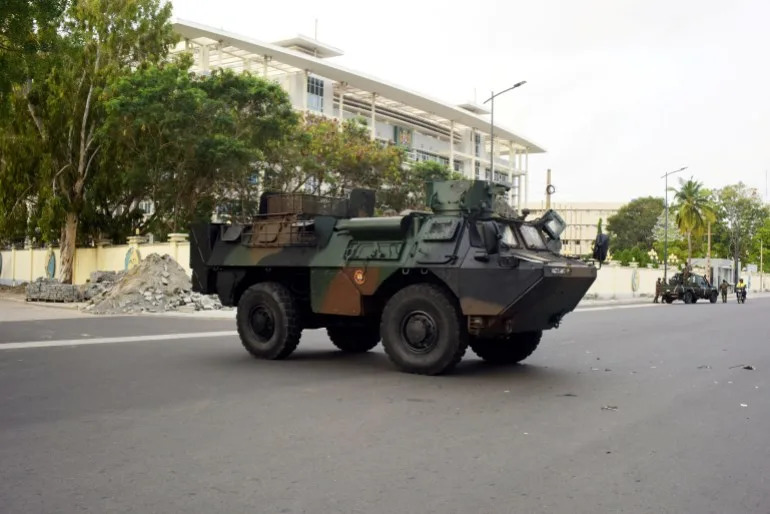
Military armoured vehicles take position in front of the headquarters of Benin’s radio and television station, a day after the country’s armed forces thwarted an attempted coup against the government of Benin’s President Patrice Talon [Charles Placide Tossou/Reuters]
Analysts warned that a successful takeover in Benin could have further weakened ECOWAS and risked Benin joining the AES, deepening regional division. The government says the plot was domestic in origin but has not ruled out foreign involvement.
'But if investigations allow us to trace it back to a foreign country or foreign forces that contributed to it, we will also, within the framework of international cooperation, express our disapproval and condemnation to those actors,' said government spokesman Wilfried Leandre Houngbedji.
Economic and Political Consequences
The coup's reverberations extend beyond politics. Benin is a vital maritime hub for the region — particularly for landlocked Niger, which has relied on the port of Cotonou for imports and exports. Relations between Niamey and Cotonou soured after Niger's 2023 military takeover and subsequent ECOWAS sanctions; Niger has since rerouted supplies via Togolese ports, increasing costs and logistical complexity.
President Talon survived the attempt and is completing his second term. Presidential elections are scheduled for next April. Although Talon is not standing, critics say his government has weakened the opposition, potentially benefiting the ruling party's candidate. It remains unclear how long Nigerian jets and ECOWAS forces will remain deployed to deter further unrest.
Outlook
For many in Benin and across West Africa, the failed coup is a stark reminder that democratic stability can be fragile. With a recent wave of coups across the region, officials and citizens alike face uncertainty over how to safeguard democratic institutions and regional trade routes in the months ahead.


