
Greg Morrison, 63, had nearly half his skull replaced by a custom 3D-printed implant after repeated surgeries for a brain bleed and an unrelated tumor left his bone fragment collapsing. Neurosurgeon Nitesh Patel worked with MedCAD to design a patient-specific polymer prosthesis from Morrison's CT scans. The implant was fitted during his fourth operation, restored protection and cranial contour, and Morrison recovered without complications. Tailored 3D cranial implants are increasingly used to treat trauma, tumors, and infections and are expanding into many other medical implants.
I Lost Nearly Half My Skull — A Custom 3D-Printed Implant Saved My Life

I Survived Losing Nearly Half My SkullCOURTESY OF HACKENSACK MERIDIAN HEALTH
Greg Morrison, 63, spent decades as a systems engineer. Today, nearly half of his skull is a custom 3D-printed implant that restored protection, shape, and his confidence after multiple brain surgeries.
How It Started
Just over two years ago Morrison noticed an unfamiliar pressure in his head. His wife drove him to a New Jersey hospital, where scans revealed a brain bleed — a rare complication from a blood-thinning medication he had been taking for a heart rhythm condition. He was airlifted to Hackensack Meridian Jersey Shore University Medical Center for emergency care.
Multiple Surgeries, Complications, and a Collapsing Skull
Neurosurgeon Nitesh Patel, MD, removed a section of Morrison's skull to relieve dangerous intracranial pressure. After a repair using plates and screws, additional imaging found an unrelated growing brain tumor that required another operation. Reopening the skull several times left the bones unable to fuse back together. Without normal blood flow, a large fragment began collapsing inward; screws bent and loosened, leaving the brain exposed to infection and vulnerable to even moderate trauma.
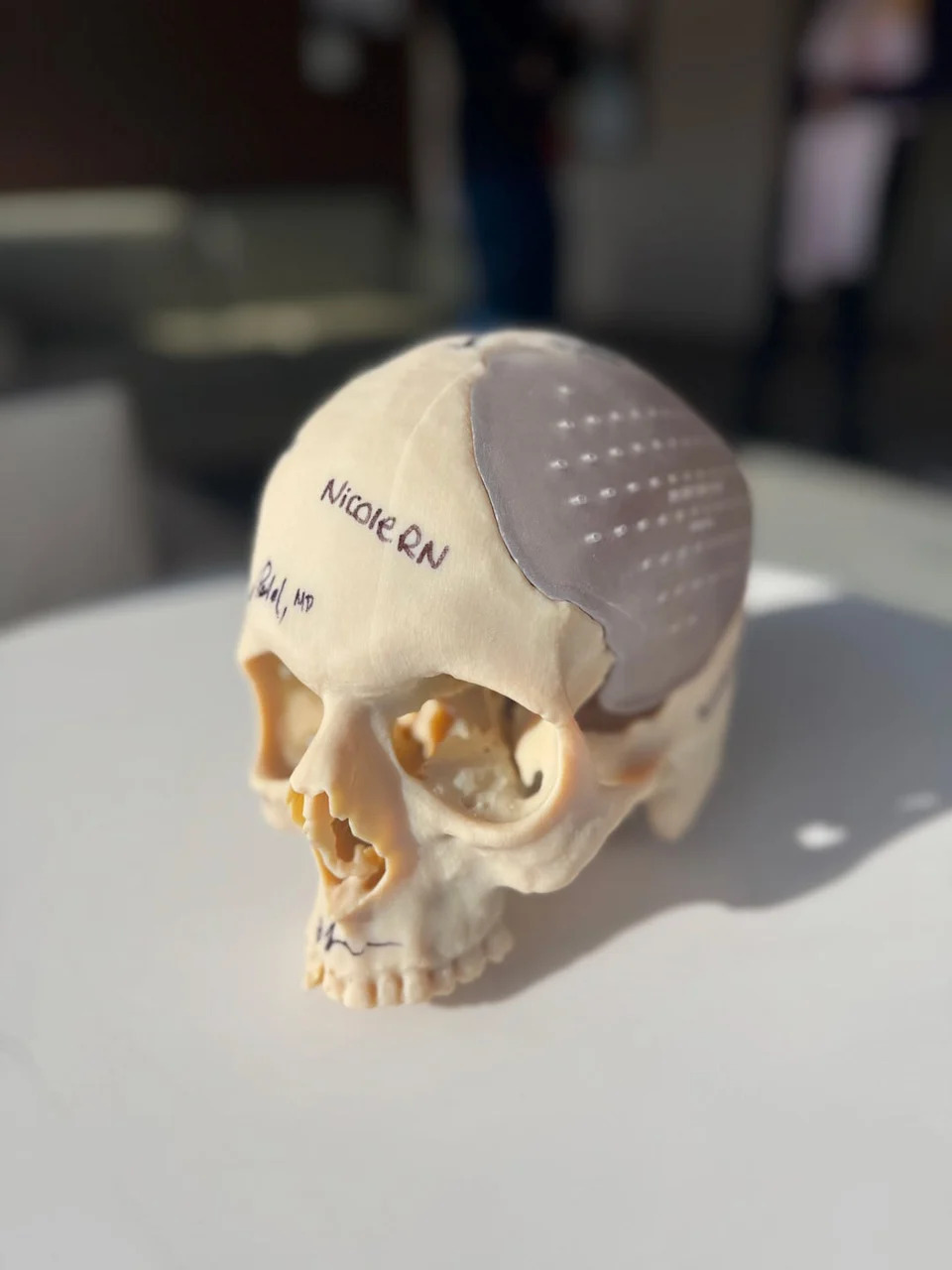
When his skull wasn’t healing after brain surgery, Greg Morrison got a 3D-printed piece.Courtesy: Hackensack Meridian Health
'You have to replace it with something. You can't walk around with a crater on your head,' says Dr. Patel.
A Patient-Specific 3D Solution
A standard mesh implant would not recreate the contours of Morrison's damaged skull, which extended from the crown down the left side near his ear. Dr. Patel proposed a custom solution: use Morrison's CT scans to design a patient-specific implant. The scans were sent to MedCAD, a company that creates tailored cranial and facial implants from medical imaging.
MedCAD produced a 3D model and mock-up that Dr. Patel reviewed and refined. The mock-up, later signed by nurses and doctors as a keepsake, guided production of a final implant printed from a strong polymer engineered to mimic many mechanical properties of healthy bone.
Surgery and Recovery
During Morrison's fourth operation the failing bone fragment was removed and the 3D-printed implant was secured with screws, using familiar surgical fixation techniques. The procedure went smoothly and Morrison recovered without complications. He credits daily activity, including weightlifting three times a week, and his wife's relentless support for his strong recovery. He now works three part-time jobs and says, 'I don't even know it's there anymore.' The implant is undetectable beneath his scalp and has restored both protection and contour.
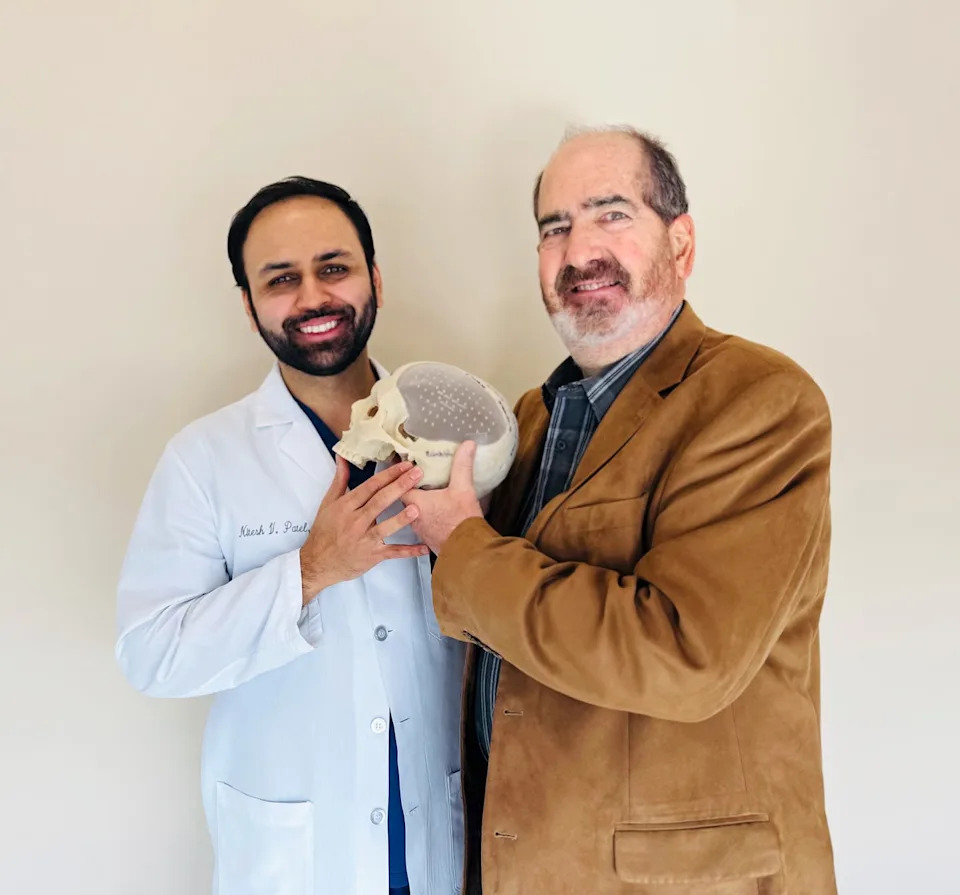
He and his doctor, Nitesh Patel, hold the model the printing company sent—which Morrison had signed by those who cared for him.COURTESY OF HACKENSACK MERIDIAN HEALTH
Why This Matters
Patient-specific cranial implants like Morrison's can be lifesaving for people whose skull integrity is compromised by bleeds, tumors, infections, or trauma. Dr. Patel reports similar successes, including reconstructing the orbital area after removing a tumor behind a patient's eye to restore the space and appearance behind the eyeball.
Broader Innovations
Beyond cranioplasty, researchers and manufacturers are expanding 3D printing into many medical domains: custom jaw reconstructions, joint components for hip, knee, and ankle, heart valves, and tiny bones in the middle ear. Patient-specific manufacturing promises better anatomical fit, faster recoveries, and improved cosmetic and functional outcomes.
Publication note: This story appears in the November/December 2025 issue of Men's Health as part of a series on life-saving medical breakthroughs.


