The article follows Quadaire Patterson and Virginia organizers pushing to end gubernatorial control over restoring voting rights for people with felony convictions. A proposed constitutional amendment on the November ballot would declare voting a fundamental right and automatically restore voting rights upon release from incarceration. The change targets a Jim Crow–era provision and aims to address stark racial disparities: in 2024 an estimated 264,000 Virginians were disenfranchised, about 121,000 of them Black. Supporters say the amendment guarantees consistent restoration; opponents say it is too broad for serious violent offenders or those still under supervision.
Virginia Voters Could End a Jim Crow–Era Felony Voting Ban — Black Virginians Lead the Push
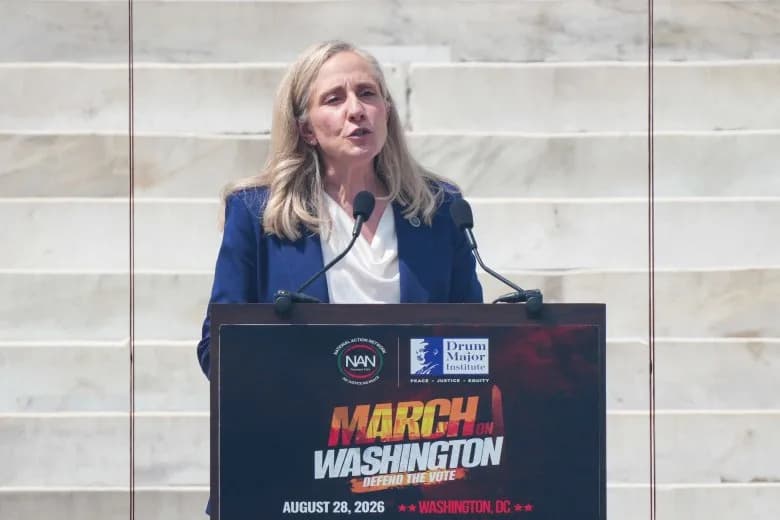
Virginia Gov. Abigail Spanberger, shown speaking during a "Defend the Vote" rally at the Lincoln Memorial in Washington in August, has restored the right to vote for 100,000 Virginians who were formerly incarcerated. (Ken Cedeno/AFP via Getty Images)
RICHMOND, Va. — Within days of leaving prison in 2024, Quadaire Patterson applied to have his voting rights restored. After roughly two years of waiting with no progress, he checked Virginia's online restoration portal in August and found his status had shifted from "denied" to "pending." Shortly afterward it read "approved." A document his wife sent confirmed that Gov. Abigail Spanberger had restored voting rights to him and roughly 100,000 other Virginians.
But Patterson and advocates say the fight to secure voting access for people with felony convictions is far from finished. Virginia is one of three states where the governor controls the restoration of voting rights for people convicted of felonies — a system shared with Iowa and Kentucky. Unlike Iowa and Kentucky, which have standing executive measures that broadly restore voting privileges for certain groups, Virginia offers no guaranteed, automatic restoration upon release from prison.
What Voters Will Decide
This November, Virginia voters will consider a proposed constitutional amendment that would declare voting a fundamental right and require automatic restoration of voting rights for people with felony convictions upon release from incarceration. If approved, the amendment would remove the need for gubernatorial approval and lock that change into the state constitution.
Personal Stakes
"I've rejoined society. I can say that I have full citizenship," Patterson, 38, told Capital B. He spent 16 years of a 20-year sentence for robbery, and while incarcerated he founded Brilliance Behind Bars, an organization that supports people inside and those returning home. Getting his vote back has sharpened his focus on the November ballot — and on preventing any future governor from deciding who can vote.
Sheba Williams, a Richmond-based organizer who leads Nolef Turns, recalls being barred from the 2008 presidential moment even as she registered voters and knocked doors. A 2004 embezzlement conviction she maintains was wrongful left her disenfranchised for nine years until her rights were restored in 2013 under then-Governor Bob McDonnell, who streamlined the process for many nonviolent felons. Williams founded Nolef Turns in 2016 to help people returning from prison re-engage civically.
Scope And Racial Disparities
The burden of felony disenfranchisement in Virginia falls heavily on Black residents. The Sentencing Project estimated that 264,000 Virginians were disenfranchised because of felony convictions in 2024; about 121,000 of those people — nearly half — were Black. Put another way, an estimated one in ten Black Virginians of voting age was disenfranchised in 2024, a rate about 3.5 times higher than among non-Black Virginians. Black people make up roughly 18% of Virginia’s population but nearly 52% of its prison population.
Arguments For And Against
Supporters argue the amendment would correct a persistent, racially disparate injustice rooted in the state's history and would create a stable, uniform rule that does not shift with the politics of any given governor. Opponents, primarily Republicans in the General Assembly, contend that automatic restoration is too broad because it would apply regardless of the seriousness of the crime and could take effect while someone remains under parole or probation supervision.
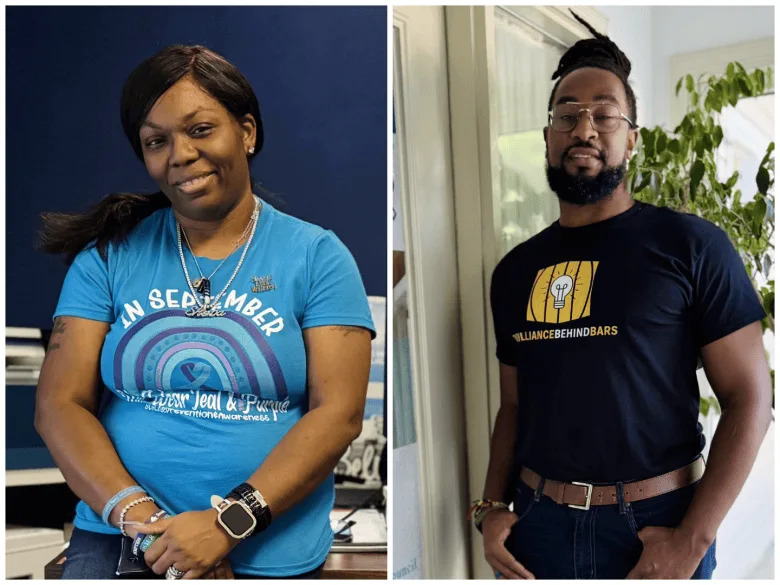
Sheba Williams and Quadaire Patterson are emphasizing the importance of voting. "Getting people to pay attention — that's the work," Williams said. (Brandon Tensley/Capital B)
"There are violent felons, murderers, people who snuff out the rights of others to ever be able to do anything again in this lifetime, who should be exempted," Republican Del. Eric Phillips said during a January House debate.
Advocates counter that automatic restoration on release respects the principle of reintegration and that states can and do maintain other criminal-justice restrictions (such as limits on holding certain public offices) where appropriate.
History And Legal Scrutiny
The lifetime felony disenfranchisement rule traces to the 1901–1902 Virginia constitutional convention, when white leaders imposed poll taxes, literacy tests and a felony ban designed to suppress Black voting power. Future U.S. Sen. Carter Glass made the convention’s racial purpose explicit when he said the gathering aimed "to discriminate to the very extremity of permissible action under the limitations of the federal Constitution, with a view to the elimination of every Negro voter who can be gotten rid of, legally."
Virginia replaced the 1902 constitution in 1971, but the felony disenfranchisement provision persisted. This January, a federal judge found that Virginia's rigid disenfranchisement regime continued to violate the terms of its readmission to the Union.
Path To The Ballot
Changing the state constitution is deliberately slow. An amendment must pass both chambers of the General Assembly, survive an intervening House of Delegates election, pass both chambers again and then be approved by voters. The restoration amendment cleared the General Assembly in 2025 and passed again this January, sending the question to voters this fall.
Democratic state Sen. Mamie Locke, the main Senate sponsor of this year's measure, said the effort stretches back more than a decade and builds on earlier work by the late state Sen. Yvonne Miller. Advocates and lawmakers refined their approach in recent years to argue not only for restoration but also for recognizing voting as a fundamental right within the state constitution.
Outreach And The Work Ahead
Groups like Nolef Turns are preparing both for the campaign and for sustained civic education after any approval. Williams emphasizes that constitutional change removes one legal barrier, but restored voters will still need outreach to understand and exercise their rights.
"Getting people to pay attention — that's the work," Williams said. For Patterson, who said the day his restoration was approved he felt compelled to act — "It's time to go vote" — the November election is now a chance to make restoration automatic and permanent.
Reporting for this article included interviews with formerly incarcerated Virginians, organizers and state lawmakers. All facts and quotes are retained from original reporting.
Help us improve.