Researchers in Sydney report that sulphur-crested cockatoos not only solve complex problems but also teach techniques to one another, forming what resembles an urban bird culture. Early summer 2026 field work around the Royal Botanic Garden used paint marks, feather sampling and lightweight GPS tracking to monitor individuals such as a bird nicknamed Watermelon. The birds have learned to open containers, twist fountain handles and access garbage, and these behaviours spread via social learning across roosting networks. Because Australian cities are only about 240 years old and cockatoos can live 50–60 years, scientists can observe cultural traits emerging across a few generations in near real time.
Sydney Cockatoos Are Building an Urban Bird Culture — And Teaching Each Other to Thrive
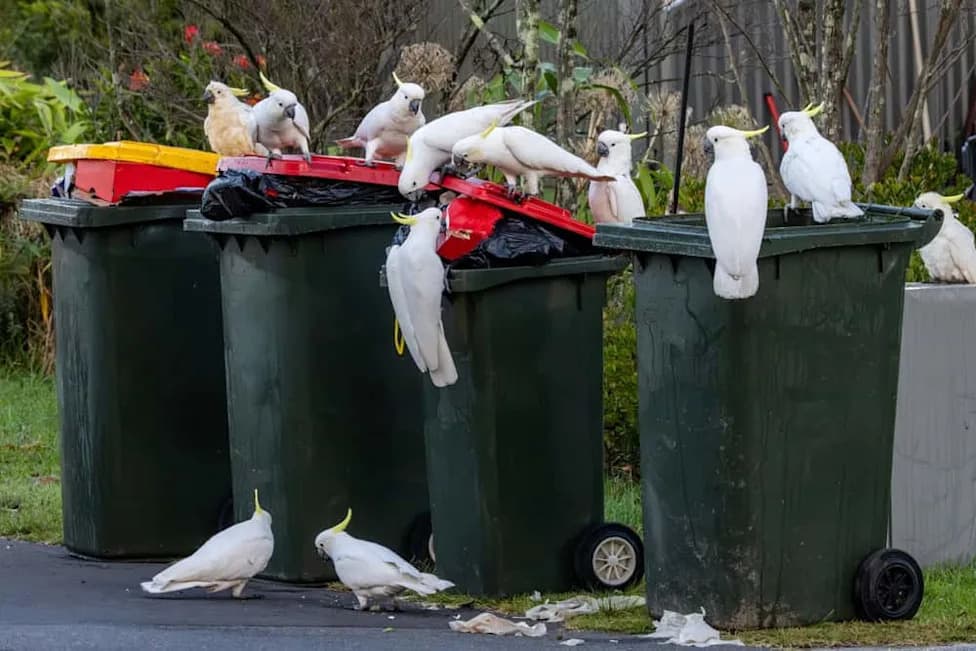
Australian Sulphur-crested Cockatoos scavenging on rubbish bins© Ken Griffiths/Shutterstock.com
Groundbreaking research in Sydney shows that sulphur-crested cockatoos (Cacatua galerita) do far more than demonstrate individual intelligence: they transmit skills and innovations across groups in ways researchers describe as cultural.
Brains, Curiosity and Urban Problem-Solving
Sulphur-crested cockatoos belong to the parrot family, one of the most cognitively advanced groups of birds. Their brains are large and highly developed for birds; in some studies, parrots show neuron counts and problem-solving abilities that are comparable, in important ways, to those of primates such as capuchins and macaques. That neural power helps cockatoos process information quickly and tackle complex tasks.
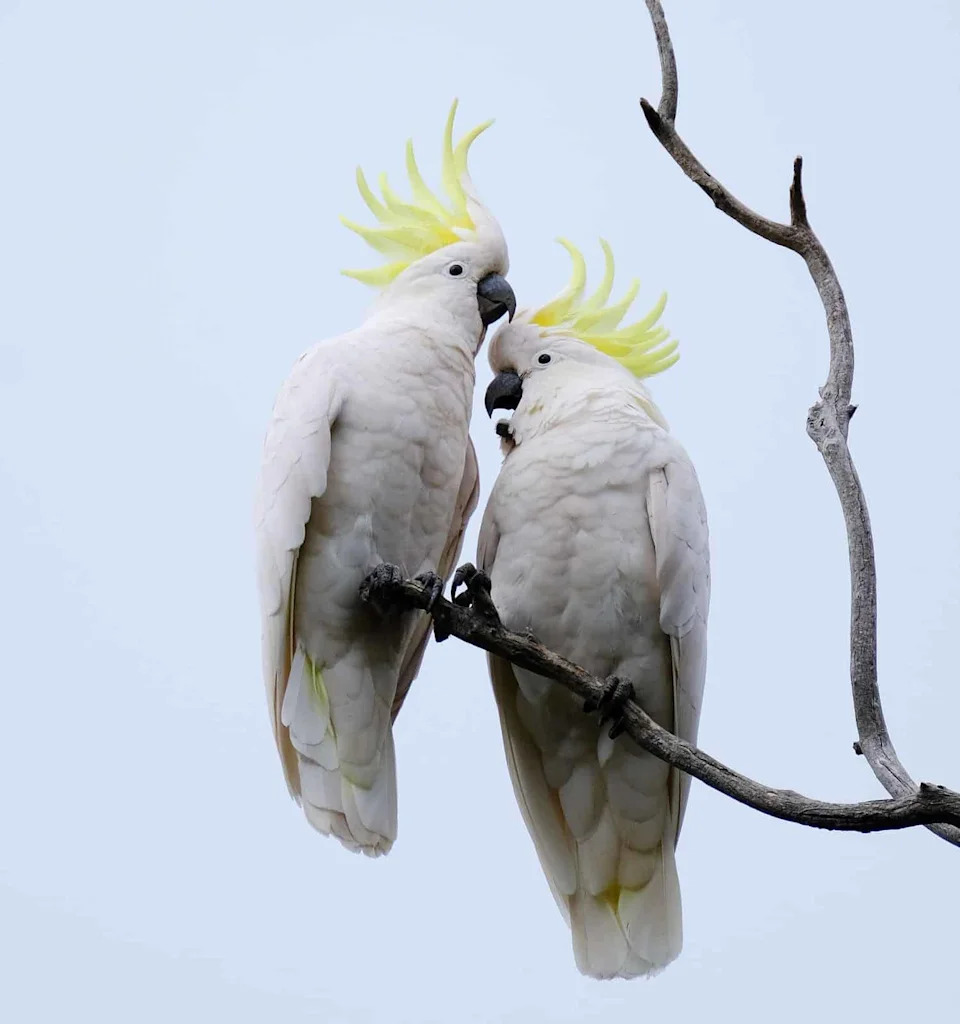
Sulphur-crested cockatoos are intelligent birds.©Wirestock Creators/Shutterstock.com
In western Sydney and other urban areas, that intelligence is on public display. Cockatoos have learned to twist the handles of drinking fountains, lift lids on municipal garbage bins, and open containers designed to hold food. While their natural diet includes seeds, nuts, fruits, roots and bulbs, urban birds readily exploit human food and waste when opportunities arise.
How They Learn — And Spread — New Behaviors
Researchers have documented not only individual ingenuity but also the spread of those innovations through social networks. Field studies and video analysis show cockatoos learning by watching others: an individual masters a technique and birds in nearby roosts adopt it after observing the successful demonstrations. Because cockatoos move between roosting communities, techniques can travel across the city.

Cockatoos live at the Royal Botanic Garden near the Sydney Opera House.©Lithuaniakid/Shutterstock.com
Social learning is defined as learning through the observation of, or interaction with, other individuals or their products — a concept central to the researchers' findings.
Field Methods and a Few Famous Birds
In early summer 2026, a team of evolutionary biologists studied cockatoo groups around Sydney, including a focal population at the Royal Botanic Garden beside the Sydney Opera House. To track and test individuals, researchers used small dabs of paint for visual ID, collected feather samples, and fitted lightweight GPS transmitters. They also presented problem-solving tasks in the field — transparent boxes, levers and twistable compartments — to observe motor skills and innovation. One habituated bird in the study, nicknamed Watermelon, learned to open an octagonal plexiglass compartment, pull a lever and twist a base to retrieve nuts.
Why Cities Make a Useful Natural Laboratory
Urban environments are relatively recent in evolutionary terms. Australian cities are roughly 240 years old, while sulphur-crested cockatoos can live 50–60 years, so only a few cockatoo generations have experienced city life. That compressed timescale lets scientists watch adaptations and cultural transmission emerge in near real time.
Implications and Human-Wildlife Interactions
The findings highlight both the adaptability of cockatoos and the management challenges this creates. When people try to deter birds by weighting bin lids or jamming hinges, cockatoos often find workarounds, scattering refuse and heightening human–wildlife conflict. At the same time, these behaviors reveal the social mechanisms — curiosity, behavioural flexibility and dense social networks — that let innovations spread quickly among urban wildlife.
Understanding these processes can help city planners and wildlife managers design better interventions that reduce conflict while acknowledging cockatoos' complex social lives and learning abilities.
Help us improve.