The Salinas Valley—John Steinbeck's inspiration for East of Eden—still produces major portions of the nation's lettuce and strawberries, but many residents say the American dream is slipping away. A Brookings study found Salinas the least affordable U.S. city for the middle class: nearly 60% of middle-class households cannot cover basic needs, and Latino middle-class families are especially strained. A 2024 rent-stabilization law has split the city as leaders debate how to balance tenant protections with incentives for new housing amid limited land and rising mortgage costs.
The American Dream Wilts in Salinas Valley: Fields of Plenty, Homes Out of Reach
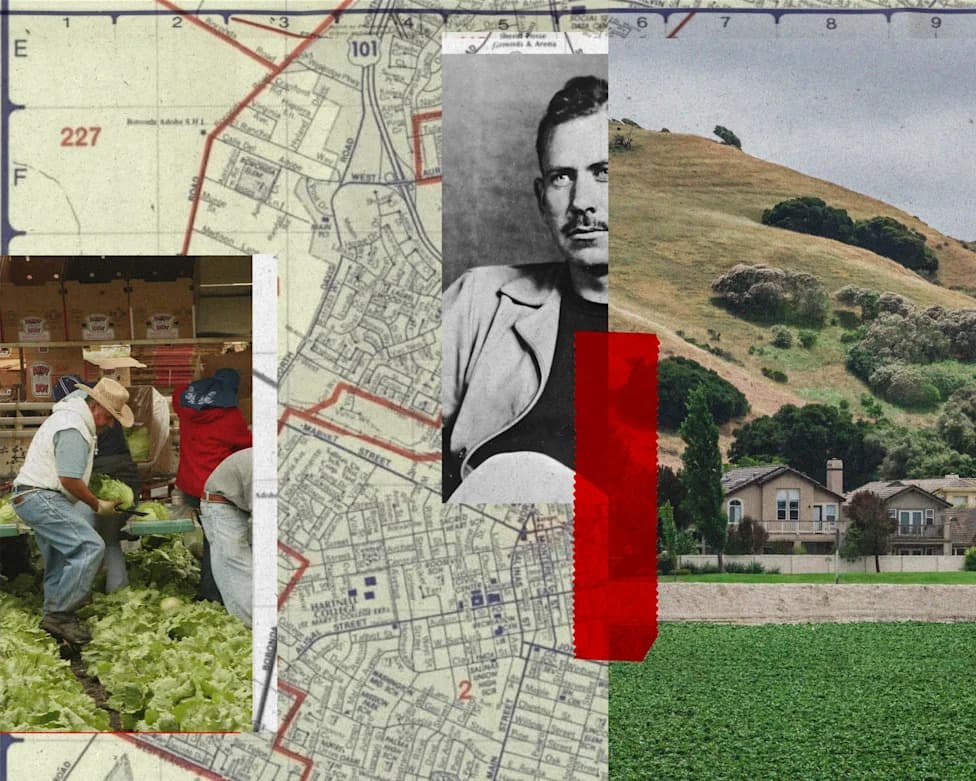
'This will be a valley of great richness one day,' Steinbeck wrote in East of Eden. 'And happy people will live here, thousands and thousands.'Composite: Rita Liu/The Guardian/Getty Images/Monterey county
Nestled between two mountain ranges on California's central coast, the Salinas Valley—often called the "salad bowl of the world"—still produces huge shares of the nation's lettuce and strawberries. Yet the promise of upward mobility that inspired John Steinbeck's stories feels increasingly distant for many who live and work there.
Steinbeck's Legacy: Plenty of Land, Not Plenty of Opportunity
"This will be a valley of great richness one day," Steinbeck wrote in East of Eden. "And happy people will live here, thousands and thousands."
Steinbeck also captured the valley's contradictory reality: fertile land and hard-working communities alongside entrenched low wages and limited economic mobility. That tension persists in Salinas today, where agricultural abundance coexists with an affordability crisis that disproportionately squeezes the middle class and Latino households.
A Strained Middle Class
A Brookings Institution analysis named Salinas the least affordable U.S. city for the middle class (the middle 60% of earners). In the Salinas area, households earning roughly $38,000–$193,000 face steep costs: nearly 60% of middle-class households cannot cover basic necessities—about double the national rate. Latino middle-class families, who make up roughly 40% of the middle class in Salinas, are hit hardest: nearly three-quarters struggle to afford everyday expenses.
Residents say homeownership—the modern symbol of the American dream—is increasingly out of reach. Nationally, about half of renter households and a quarter of homeowners spend more than 30% of income on housing; in Salinas the problem is amplified by local dynamics.
Life on the Ground: Stories from Residents
Gaye Freedman, 75, moved to Salinas in 2017 to be near family. A retired educational psychologist, she now works part time and—with her husband—earns roughly $75,000 a year while paying $1,850 for a one-bedroom apartment. After rent and medical costs, groceries and car repairs leave little room for savings. "This is the first time in my life I've actually had to think about what I'm cooking," she says.
Salvador Herrera, a 52-year-old former construction worker who lives on disability, describes multi-family overcrowding and weeks when he has only $50 for groceries for his children. "Everything's changed. Especially the housing, it's way too expensive. And the pay is cheap nowadays," he says.
Politics and Policy: Rent Stabilization and a City Divided
The Salinas City Council passed a rent-stabilization ordinance in 2024 capping annual increases on certain multifamily units at either 2.75% or 75% of inflation, whichever is lower. Tenants say the cap has saved them thousands. But a new council later voted to repeal the law, arguing it could discourage investment and new construction. Advocates gathered enough signatures to force a referendum this November, so the caps remain in effect until voters decide.
Supporters point to hardship-exemption processes for landlords; opponents worry prolonged caps will reduce property upkeep or push owners to sell—potentially driving rents higher.
Why Housing Is Tight
Salinas' proximity to Silicon Valley exposes it to Bay Area housing pressures, while surrounding farmland constrains buildable land. A 2008 plan to add 11,500 units stalled after the Great Recession and construction has since lagged—worsened by the Covid pandemic and rising mortgage rates. With median household income in Salinas just under $90,000 compared with roughly $150,000 in nearby San Jose and San Francisco, supply shortfalls and cost pressures bite harder here.
Higher borrowing costs—mortgage rates recently surpassed 7%—and uncertain financing keep many developers on the sidelines, limiting new market-rate housing that could help alleviate pressures.
Responses and Hopes
Local officials are pursuing job-creation strategies and stepped-up homebuyer assistance: the city recently approved a down-payment assistance program for first-time buyers. Mayor Dennis Donohue expresses cautious optimism, while acknowledging it may take time to restore affordability. "I'm the mayor of the hometown of John Steinbeck," he says. "If any city should know how to tell a story, it should be this one. I'm confident the city, the book, will have a happy ending." He adds that he cannot say how long it will take.
As voters weigh the rent-stabilization referendum and local leaders push for more housing and economic opportunities, Salinas stands at a crossroads familiar to many American cities: balancing tenant protections with incentives for new supply, while trying to preserve the community that feeds the nation.
Help us improve.