Overview: New York City's new antisemitism plan expands grants and security funding while rejecting the IHRA definition and defending protest rights. The article welcomes civil-rights protections but warns the plan's framing may fuel communal fear and that routing services through nonprofits risks undermining public accountability. It urges the Left to prioritize shared humanity, strengthen public institutions, and pursue universal structural solutions rather than identity-based remedies.
Rejecting Communal Fear: A Skeptical Look at NYC’s New Antisemitism Plan
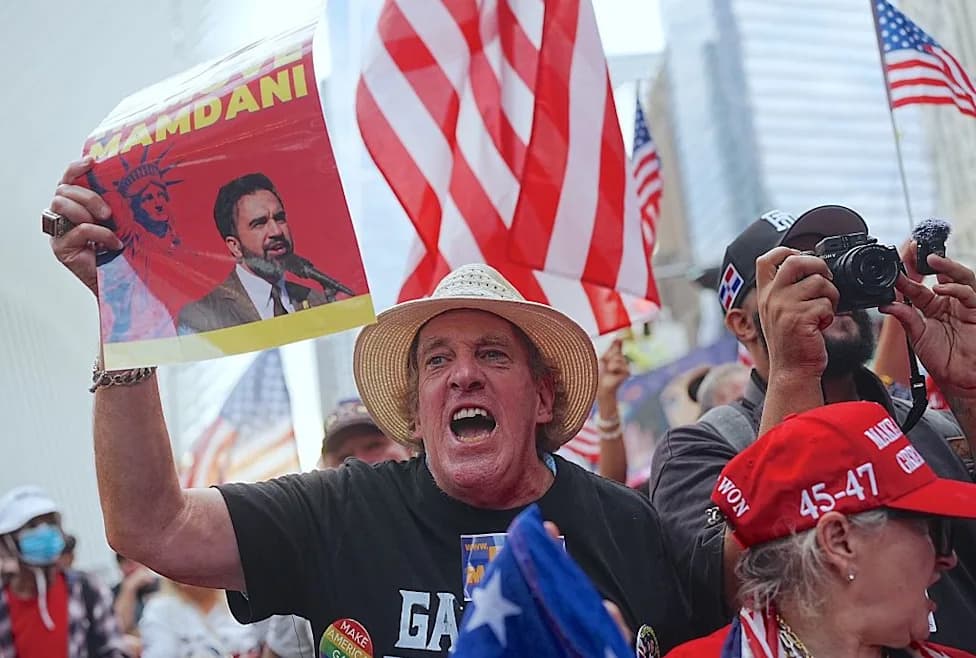
Zohran Mamdani's strongest answer to his critics is the universalism that helped elect him. (Selcuk Acar / Anadolu via Getty Images)
New York City unveiled a municipal strategy to confront antisemitism just days after Israeli Prime Minister Benjamin Netanyahu used his United Nations address to call Assemblymember Zohran Mamdani "the antisemitic mayor of New York," claiming that many Jews no longer feel safe in the city. The plan pledges expanded education, enhanced victim support, and public funding for security at synagogues and other houses of worship across the five boroughs.
What the Plan Does
The proposal, produced by the Mayor's Office to Combat Antisemitism, convenes an interagency task force spanning schools, police, civil-rights units, and other municipal agencies. It doubles the Partners Against Hate grants to $6.4 million and allocates $1 million for security at nonprofits and houses of worship. The report explicitly defends the right to protest and declines to adopt the International Holocaust Remembrance Alliance (IHRA) working definition of antisemitism. It also emphasizes civil-rights enforcement and Jewish American history education.
Reasons to Support—and Reasons to Worry
On principle, socialists and progressives should oppose antisemitism and support vigorous enforcement of civil-rights laws. Assemblymember Mamdani's public condemnation of antisemitism is consistent with those values, especially given the politically motivated attacks that have conflated his support for Palestinian rights with hostility toward Jews.
Yet three concerns merit careful scrutiny: the plan's framing of Jewish insecurity, its outsourcing of work to third-sector organizations, and the potential for a politics of communal fear to be weaponized against the Left.
‘‘A policy that treats every incident as proof of a communitywide siege risks amplifying identity-based fear and diverting attention from universal, structural remedies.’’
Data, Reporting, and Moral Panic
Public debates have a way of conflating different measures: incident tallies from advocacy groups, police-recorded hate crimes, and surveys of communal anxiety all capture different phenomena. For example, the Anti-Defamation League's 2021 audit documented a 34 percent rise in antisemitic incidents but also noted that new reporting partnerships increased the number of recorded events—making it difficult to distinguish rising prevalence from increased reporting.
A useful parallel is the "Stop Asian Hate" mobilization during the COVID-19 pandemic. Advocacy groups reported roughly 11,000 incidents to Stop AAPI Hate between March 2020 and December 2021; about 16 percent were physical assaults. NYPD-recorded Asian-targeted hate crimes rose from 28 in 2020 to over 100 in 2021. Those numbers are serious, but the public conversation often turned individual tragedies into evidence of an all-encompassing social emergency, obscuring structural fixes that could have prevented some high-profile harms.
Outsourcing, Nonprofits, and Public Capacity
The new plan channels significant funds through nonprofits to provide security, education, and victim services. Some recipients, such as the Jewish Community Relations Council of New York, explicitly lobby for support of Israeli policies and oppose boycott campaigns—activities that many on the Left would not want taxpayer dollars to subsidize. Even when nonprofits focus strictly on survivor support and prevention, routing core public responsibilities through private intermediaries raises questions about transparency, oversight, and long-term capacity.
New York's recurring model—fund social needs via contracted nonprofits rather than building public delivery systems—has produced documented conflicts of interest and oversight failures in programs like the shelter system. A socialist administration should instead invest in staffed public institutions with transparent budgets and measurable outcomes to perform civil-rights enforcement, public education, and survivor assistance.
Politics, Identity, and the Left’s Response
There is a strategic as well as moral argument for resisting a politics of communal fear. When political debate starts from the premise "as a Jew" or "as a Muslim," it narrows moral imagination and accepts communal boundaries around rights. The Left should reassert shared humanity and universal protections while recognizing the particular harms different communities face.
This does not mean ignoring or minimizing antisemitism. It means addressing hate and threats concretely—prosecuting crimes, funding survivor services, improving public safety infrastructure—without reinforcing an apparatus that privileges brokered communal representation over direct public provision.
Conclusion
New York's antisemitism plan contains defensible elements—defending protest, rejecting the IHRA definition, and emphasizing civil-rights enforcement. But its rhetoric around communal insecurity and its reliance on a nonprofit delivery model risk amplifying identity-based fear and legitimizing privatized solutions. The Left's better path is to oppose antisemitism vigorously while building public capacity, advancing universal solutions to social insecurity, and organizing on class-based solidarity that preserves individuals' freedom to relate to their identities as they choose.
This article originally appeared in Jacobin, a democratic socialist magazine, and has been edited for clarity and flow.
Help us improve.