There is no federal requirement in the U.S. for websites to verify visitors' ages, so individual states have adopted a variety of age-verification measures. Reclaim The Net reports 43 states with measures on record and 29 with at least one law in force (Sept 28, 2026); RecordingLaw.com counts 27 states under a narrower definition (Aug 13, 2026). Verification methods range from self-declared birthdates to government ID uploads and AI facial estimation, and courts have already altered enforcement in several states. Platforms serving multiple states must prepare for differing rules and monitor litigation closely.
US Age-Verification Laws: 29 States Report Enforceable Rules — What It Means for Sites and Users

Image: Deposit Photos
No federal law requires websites to verify a visitor's age before granting access to online material. In the absence of a uniform federal standard, states have moved to fill the gap with a patchwork of laws and regulations that vary considerably in scope and enforcement.
Snapshot
As of Reclaim The Net's tracker update on September 28, 2026, 43 states have some form of age-verification measure on record and 29 of those states report at least one law that is currently in force. A narrower compilation by RecordingLaw.com — focusing only on enacted adult-content age-verification statutes — listed 27 states as of August 13, 2026. Those two counts use different definitions and therefore measure different sets of laws.
Which States Are Counted Under The Narrower Definition
The 27 states identified by RecordingLaw.com under its stricter definition are: Alabama, Arizona, Arkansas, Florida, Georgia, Idaho, Indiana, Iowa, Kansas, Kentucky, Louisiana, Mississippi, Missouri, Montana, Nebraska, North Carolina, North Dakota, Ohio, Oklahoma, South Carolina, South Dakota, Tennessee, Texas, Utah, Virginia, West Virginia, and Wyoming.
How Platforms Verify Age
When you encounter age checks online, platforms may use one or more of the following approaches:
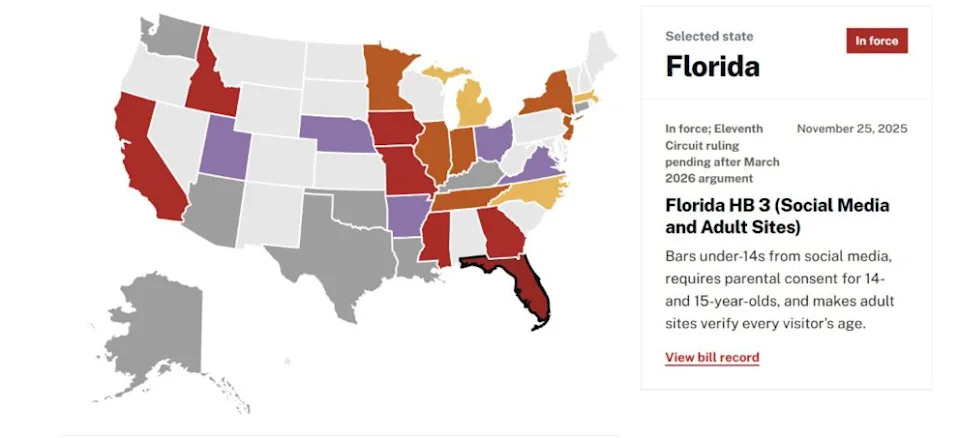
reclaimthenet.org
- Government ID Submission — upload of a passport, driver’s license or similar document;
- AI-Based Facial Age Estimation — automated analysis of a submitted image to estimate age;
- Self-Declared Date Of Birth — the lowest-friction option, relying on user honesty;
- Parental Identity/Consent Verification — methods to confirm a parent or guardian’s approval;
- Anonymous Verification — an option required under Florida’s model that lets users verify age without sharing identifying documents.
Florida And The Role Of Courts
Florida’s statute targets sites that “knowingly and intentionally publish or distribute material harmful to minors” when such material forms a substantial portion of the site’s content. The law requires operators to offer users a choice between anonymous verification and more standard verification methods.
The legal landscape is often complex: laws can be enacted, litigated, partially blocked, and yet remain partially enforceable. For example, RecordingLaw.com notes that Florida’s social-media restrictions became enforceable following an Eleventh Circuit action in November 2025; Arkansas’s social-media law was permanently enjoined in March 2025; and Utah’s social-media statute faced a preliminary injunction in September 2024. Many trackers — including Reclaim The Net’s map — distinguish between proposed, enacted, in-force, and court-affected statuses and may note when a ruling applies only to part of a statute.
Practical Implications For Operators
Platforms that operate nationally or across multiple states may need compliance systems that can satisfy the strictest applicable rule. Typical technical and operational responses include:
- Geolocation-based gating or rule triggers;
- Contracts with third-party age-assurance vendors;
- Jurisdiction-specific data-retention and privacy controls;
- Careful monitoring of litigation and enforcement developments.
Bottom Line
No federal statute currently mandates universal website age checks; states remain the primary drivers of broad age-verification obligations. Whether this fragmented landscape will converge — via court rulings, congressional action, or industry standards — remains an open question. Until then, trackers like Reclaim The Net’s map are useful starting points but not substitutes for consulting the current statutory and litigation status of any particular law.
Help us improve.