The Outer Space Institute is urging the U.N. to request an ICJ advisory opinion to clarify nations' duties under the 1967 Outer Space Treaty to prevent orbital congestion and protect the dark night sky. The move responds to stalled COPUOS efforts and rapid industry plans for megaconstellations, mirror satellites and space-based data centers. While ICJ opinions are nonbinding, experts say they carry moral authority and can influence domestic courts and policy. Advocates cite Vanuatu's 2025 ICJ climate opinion as a precedent.
Astronomers Urge UN To Seek ICJ Guidance As Satellite Boom Threatens Night Sky
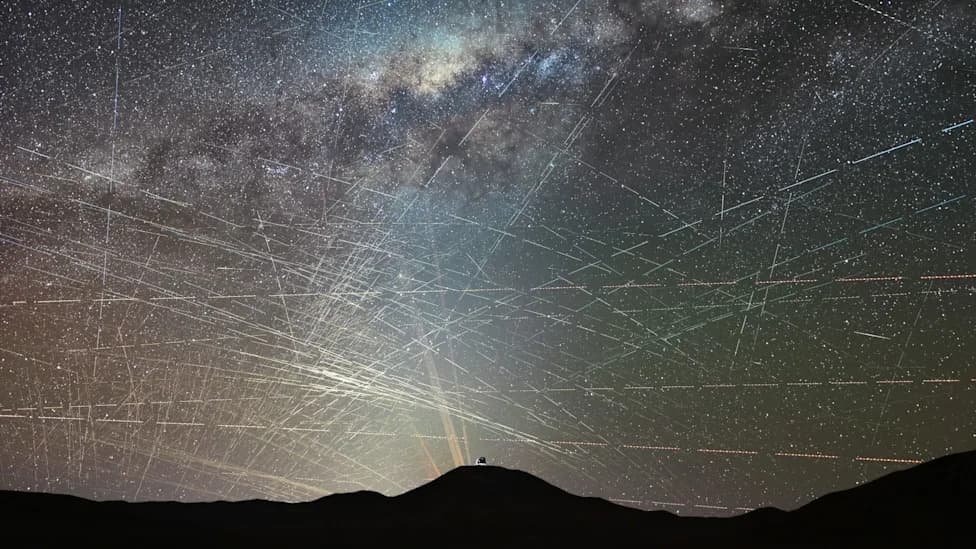
Bright streaks of light crisscross through a night sky.
Millions of satellites could re-shape the night sky — and scientists want the U.N. to weigh in.
Astronomers and space-policy advocates, led by the Outer Space Institute, are urging the United Nations to request an advisory opinion from the International Court of Justice (ICJ) to clarify states' legal duties to prevent orbital crowding and excessive night-sky light pollution.
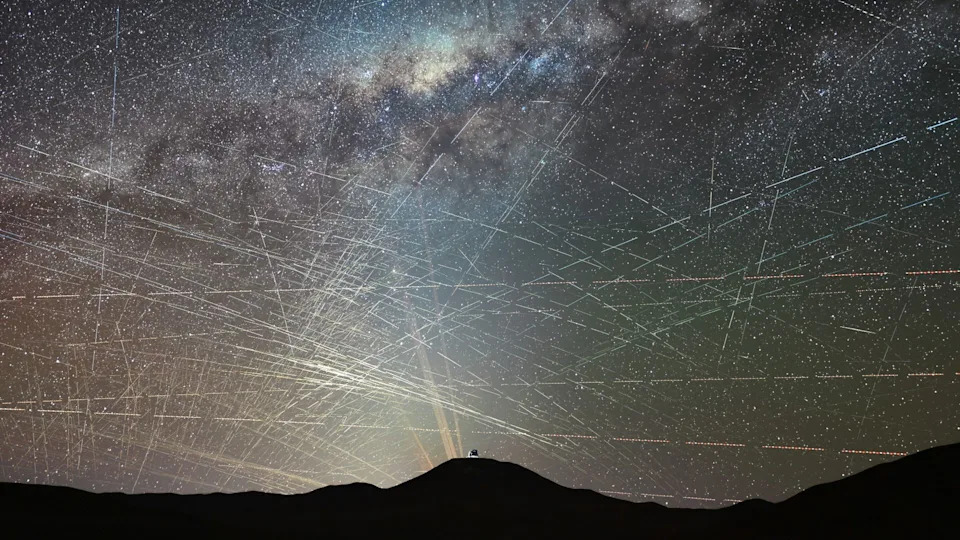
One hour of satellite crossings over the northern Atacama Desert in Chile in October 2025. | Credit: F. Kamphues, ESO/M. Kornmesser
Why scientists are alarmed
What began as concern over internet-beaming megaconstellations such as SpaceX's Starlink has intensified in the past year. Major companies — including SpaceX, Google and emerging players such as Starcloud — have announced plans for ever-larger networks in low Earth orbit, and some firms are proposing space-based data centers and fleets of reflective mirror satellites intended to beam sunlight to ground photovoltaic plants after sunset.
In July, the U.S. Federal Communications Commission granted a license to Reflect Orbital for a demonstrator mirror satellite called Eärendil-1, a first step toward a potential constellation of tens of thousands of mirrors. Critics warn that, if deployed at scale, such constellations could brighten the night sky to levels that seriously impair astronomical observations and erode the cultural value of dark skies worldwide.

A rendering of Reflect Orbital's proposed constellation of mirror satellites. | Credit: Reflect Orbital
The legal route scientists want
The Outer Space Institute is pushing the U.N. to ask the ICJ for an advisory opinion interpreting key provisions of the 1967 Outer Space Treaty — especially Article 9, which requires states to act with "due regard" for the interests of other nations. The group argues that COPUOS (the U.N. Committee on the Peaceful Uses of Outer Space) has been unable to move the issue forward because its consensus-based decision-making lets single states block action.
Aaron Boley, an astronomer at the University of British Columbia and co-director of the Outer Space Institute, explained that a U.N. General Assembly request for an ICJ opinion needs only a simple majority of states present and voting, making it less vulnerable to a single obstructing nation. "You only need 50% plus one of the voting states," he said, noting that the court could clarify states' obligations without dictating exact numeric limits on launches.

A rendering of one of SpaceX's planned "Starmind" AI satellites in orbit. | Credit: SpaceX
What an ICJ opinion would mean
Legal experts stress that ICJ advisory opinions are not directly enforceable, but they carry moral and diplomatic weight. Robin J. Frank, a former NASA legal counsel, told Space.com that such opinions can raise awareness, help like-minded states cooperate, and influence national courts and regulators. She and others point to Vanuatu's successful push for an ICJ advisory opinion on climate obligations — issued in July 2025 — which boosted legal and political efforts worldwide and helped shape a U.N. General Assembly resolution in May 2026.
"The ICJ has no enforcement mechanism, so the opinions are more of a diplomatic tool," Frank said. "But it can still be very valuable. It carries a certain moral authority and can help sway domestic courts and policy."
Advocates say an ICJ interpretation of Article 9 could influence how nations evaluate satellite licensing, environmental reviews and international cooperation, even if it stops short of prescribing a precise satellite cap.
What’s next and why it matters
Scientists previously proposed creating a COPUOS expert group to monitor satellite light pollution; that effort had backing from Chile, Spain, Slovakia, Bulgaria, the Dominican Republic, Peru and South Africa but failed to reach consensus. With commercial plans for vast orbital infrastructure accelerating — from megaconstellations to mirror fleets and space-based data centers — researchers warn that clearer international guidance and stronger oversight are needed to protect astronomy and the shared cultural heritage of the night sky.
Image credit: One hour of satellite crossings over the northern Atacama Desert in Chile in October 2025. | Credit: F. Kamphues, ESO/M. Kornmesser
Help us improve.