Kazakhstan’s saiga antelope have rebounded to an estimated 4.1 million across Eurasia by 2025 after decades of poaching and a major disease die-off. Their large-scale grazing reduces dry grass biomass, fragmenting and flattening fuels and thereby lowering wildfire intensity. The saiga’s recovery also supports steppe biodiversity, but brings challenges including human–wildlife conflict, migration barriers and vulnerability to sudden mass die-offs. Integrating wildlife into fire-risk and landscape planning could amplify these nature-based benefits.
Saiga Comeback: How Kazakhstan’s Antelopes Are Cutting Wildfire Risk and Restoring Steppe Resilience
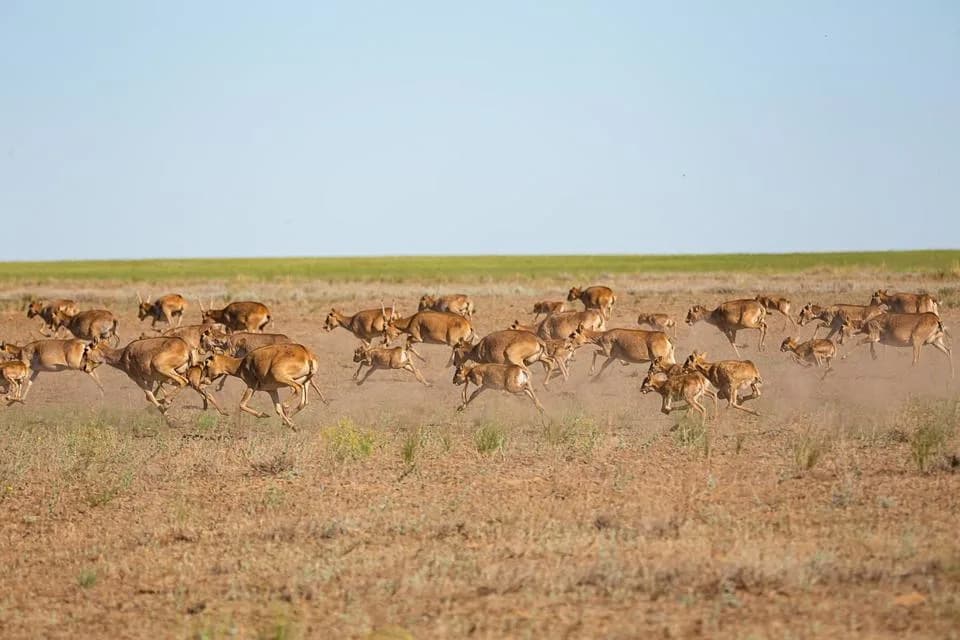
Saiga antelopes run on a prairie outside Almaty, Kazakhstan. (Photo by Abduaziz MADYAROV / AFP) (Photo by ABDUAZIZ MADYAROV/AFP via Getty Images)AFP via Getty Images
Kazakhstan’s vast steppe has become increasingly vulnerable to hotter, drier summers and fast-spreading wildfires. Alongside conventional fire-management tools—firebreaks, controlled burns and monitoring—a strikingly simple force is helping reduce combustible vegetation across large areas: grazing by the recovering saiga antelope.
A Resilient Return
Once driven to the brink of extinction by intensive poaching in the 1990s and a catastrophic bacterial outbreak in 2015, the saiga antelope has made a remarkable recovery. By 2025 the global saiga population reached an estimated 4.1 million individuals across Eurasia, concentrated mainly in Kazakhstan. Stronger anti-poaching enforcement, new protected areas, and improved monitoring contributed to this rebound, and the IUCN revised the species’ status from Critically Endangered to Near Threatened.
Grazing as a Natural Fire-Management Tool
Large, nomadic herbivores such as saiga reduce wildfire risk by consuming and trampling fine fuels—dry, standing grasses that ignite and spread fire readily. Systematic grazing lowers vegetation height and density, flattens fuel beds and fragments continuous grass layers into a mosaic of grazed and ungrazed patches that act like natural firebreaks. These changes reduce oxygen flow through the fuel bed, slowing combustion and lowering fire intensity, while increased moisture retention speeds decomposition.
Long-Term Vegetation Shifts
Over seasons and years, persistent grazing can alter plant-community composition: suppressing highly flammable invasive annual grasses and favoring less flammable succulents and forbs. Saiga movements also disperse seeds across hundreds of miles, connecting habitats and contributing to landscape heterogeneity that is less prone to severe, widespread fires.
Wider Ecological Benefits
Beyond wildfire mitigation, the saiga recovery supports steppe biodiversity. Their patchy grazing creates nesting habitat and cover for threatened birds such as the Great Bustard and the critically endangered Sociable Lapwing, and sustained populations help maintain food resources for predators and scavengers like wolves and steppe eagles.
Challenges and Limits
The benefits of saiga grazing are real but context-dependent. Herd movements are highly variable, making it difficult to predict where grazing will reduce fuel at the times and places most needed for fire control. Infrastructure and transport corridors can block migrations and prevent saiga from reaching some overgrown pastures. Rising herd sizes also increase overlap with pastoral lands, producing human–wildlife conflict over water, pasture access and crop damage; in some cases authorities have authorized controlled culls to protect agriculture.
Saiga remain vulnerable to sudden mass die-offs from disease outbreaks that can be triggered or worsened by climatic extremes. Their conservation therefore requires ongoing veterinary surveillance, rapid response capacity, and landscape-scale planning that balances wildlife recovery with pastoral livelihoods.
Policy Implications
Kazakhstan’s saiga comeback highlights how biodiversity restoration can deliver practical ecosystem services. Integrating wildlife dynamics into fire-risk planning—through coordinated monitoring, targeted habitat protection, conflict-mitigation measures and compensation schemes for herders—could strengthen steppe resilience to climate-driven wildfire risk. Conservation metrics and funding priorities should account for these second- and third-order benefits so investments in species protection also support adaptation goals.
Conclusion: The saiga’s recovery offers a promising, nature-based contribution to wildfire resilience on the Eurasian steppe, but maximizing its benefit will require careful, landscape-scale management that addresses human–wildlife conflict, infrastructure barriers and disease risks.
Help us improve.