ETH Zurich researchers show that pericentromeric satellite repeats in fruit flies act like chromosome-specific barcodes that help homologs pair during meiosis. Simultaneous disruption of two chromosome pairs caused marked centromere unpairing (19.4% extra centromere signals; 28.2% unpairing at the Responder region). The D1 protein can cluster matching repeats but may also promote mispairing when barcodes diverge. Natural crosses between strains with very different satellite profiles showed similar pairing defects, suggesting satellite divergence could affect reproductive compatibility.
Chromosome 'Barcodes': How Repetitive Satellite DNA Guides Meiotic Pairing in Fruit Flies
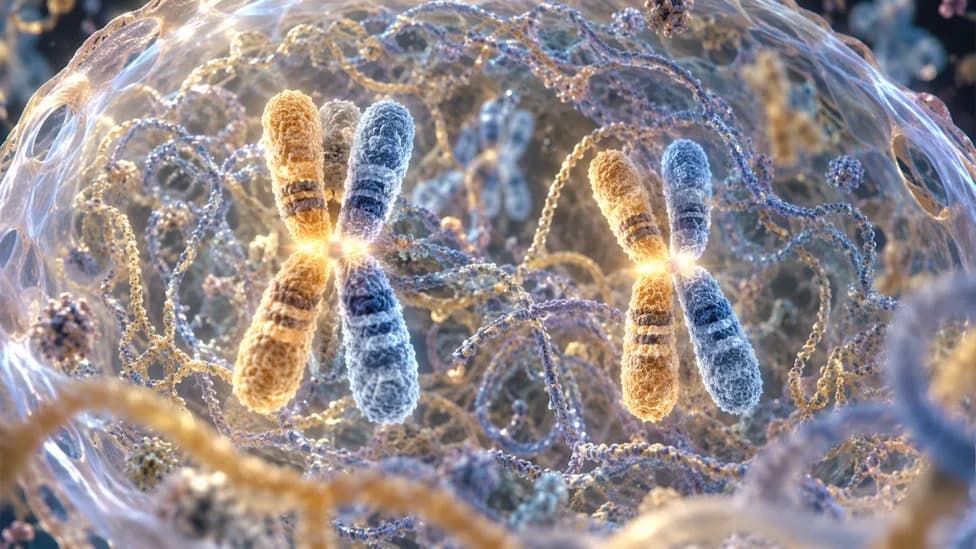
Repetitive DNA and the D1 protein help matching fruit fly chromosomes recognize one another before eggs form. (CREDIT: Talia Shavit-Weiner / AI-generated)
New work from ETH Zurich suggests that repetitive satellite DNA near centromeres acts like a molecular barcode that helps homologous chromosomes find each other during meiosis in Drosophila melanogaster. When those barcode-like repeat patterns were disrupted on two chromosome pairs, pairing errors rose sharply and a DNA-binding protein called D1 sometimes promoted incorrect associations.
Barcode-Like Satellite Repeats Help Homologs Recognize Each Other
Most cells contain two copies of each chromosome, one from each parent. Meiosis reduces that number by half so eggs and sperm inherit a single copy of each chromosome. Before chromosomes separate, maternal and paternal homologs must locate and pair. Recombination helps in many species, but pairing can also begin without recombination, implying additional recognition mechanisms.
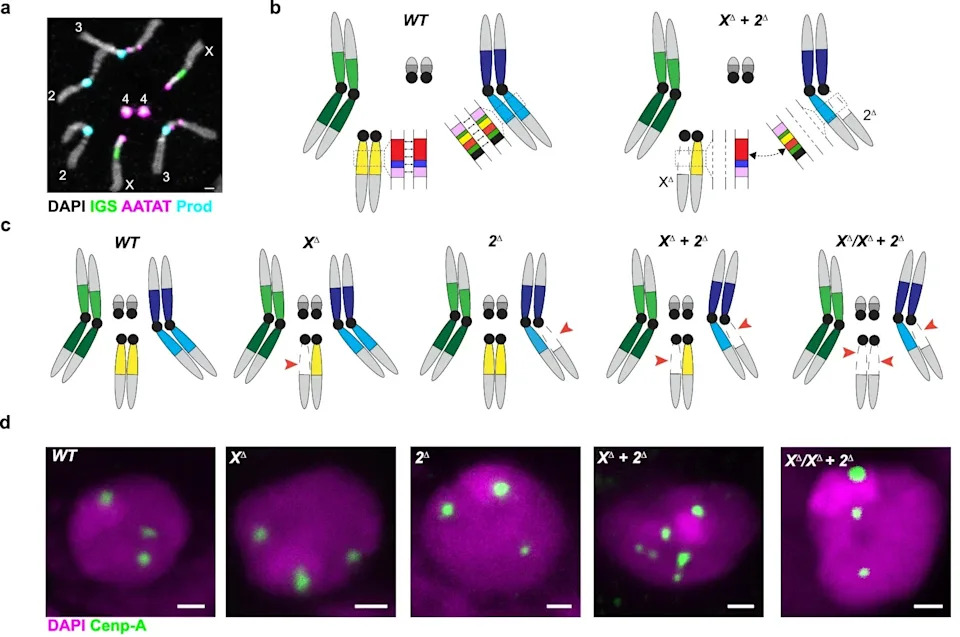
Pericentromeric satellite DNA repeats function in meiotic centromere pairing. (CREDIT: Nature Communications)
Satellite DNA consists of short motifs repeated many times and is concentrated at centromeres and nearby pericentromeric regions. Historically dismissed as "junk," these repeats can form distinctive, chromosome-specific patterns in fruit flies. The ETH Zurich team, led by Lena Skrutl and Madhav Jagannathan, tested whether those patterns provide chromosomes with a recognizable identity.
Targeted Disruptions Reveal Pairing Failures
Previous single-chromosome disruptions produced only subtle defects because the remaining chromosomes can still match by elimination. To expose direct effects, the researchers engineered simultaneous satellite deletions on two chromosome pairs. One engineered X chromosome lacked almost the entire ~11-megabase region that includes a prominent 359-base-pair repeat; a deletion on chromosome 2 removed nearly all satellite repeats in a separate region and also eliminated 41 genes.
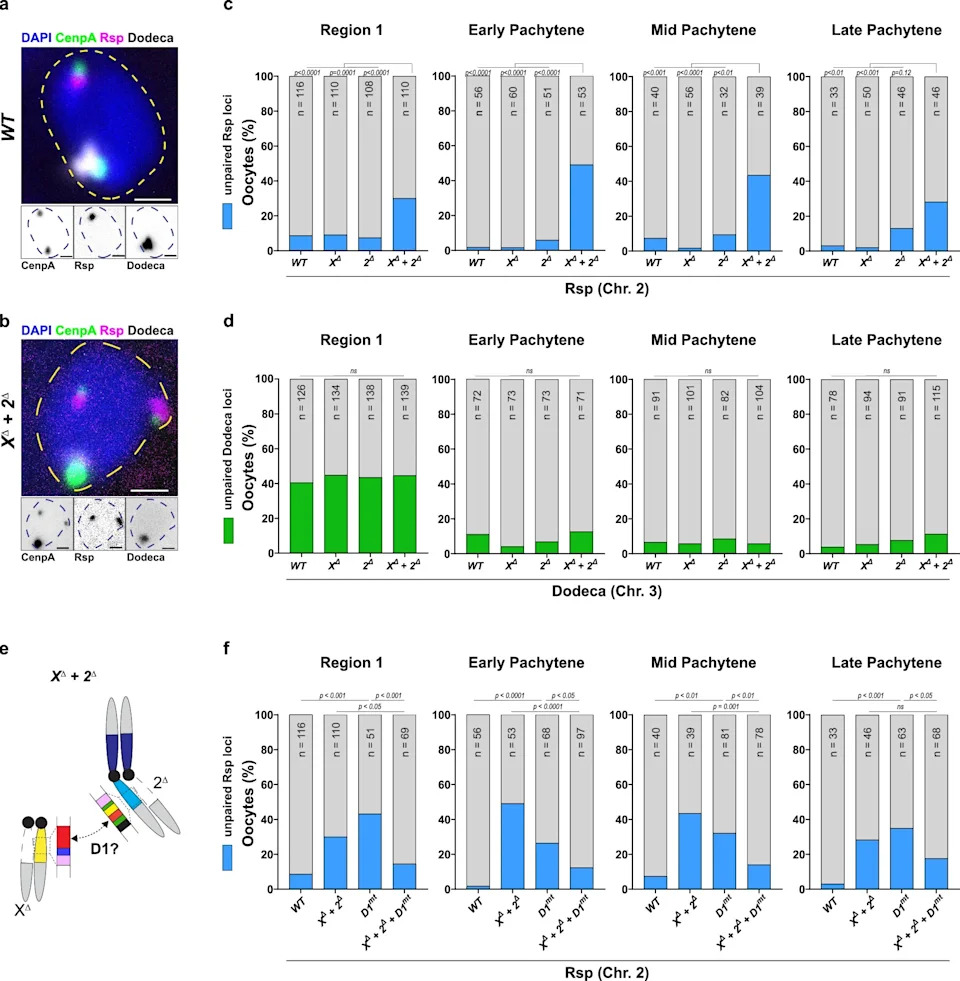
Loss of meiotic centromere pairing at chromosomes carrying satellite DNA deletions. (CREDIT: Nature Communications)
With both deletions present, pairing defects increased markedly. In double-deletion females, 19.4% of late-pachytene egg cells showed more than four visible centromere signals—roughly four times the control rate—indicating some homologous centromeres failed to stay paired. A direct probe of chromosome 2's Responder satellite region remained unpaired in 28.2% of late-pachytene cells, more than twice the control frequency.
Defects Concentrate Near Centromeres And Depend On Repeat Patterns
The failures were not uniform: a satellite marker on chromosome 3 stayed paired, and several ~1-megabase regions along chromosome 2 arms continued to pair during mid-pachytene. These observations point to centromeric and pericentromeric repeat architecture—not global synapsis collapse—as the key factor. Additional experiments that duplicated or translocated satellite arrays produced similar mispairing when repeat patterns were mismatched, supporting the barcode model.
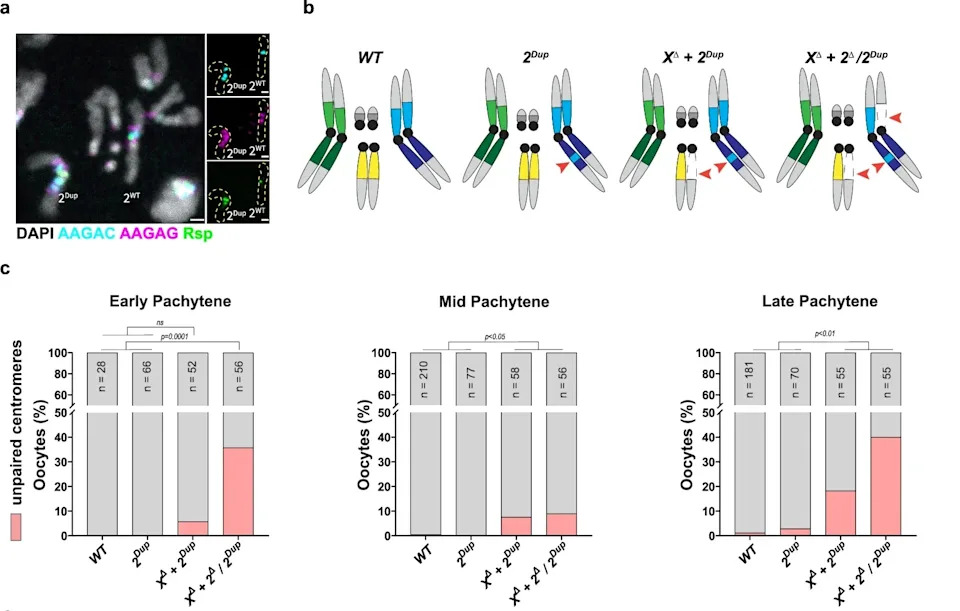
Mismatched satellite DNA repeats drive meiotic centromere unpairing. (CREDIT: Nature Communications)
D1 Protein Can Glue — Or Misglue — Chromosomes
Biochemical assays implicated the D1 protein as a mediator. Purified D1 bound directly to both the 359-bp repeat and related 260-bp repeats, and adding D1 to microscopic beads coated with those sequences caused the beads to cluster. That provides a plausible physical mechanism by which similar satellite regions on homologs might be brought together.
But D1 is a double-edged sword: when repeat patterns matched, D1 reinforced correct organization; when barcodes diverged, D1 sometimes promoted inappropriate associations between similar repeats on nonhomologous chromosomes. Removing D1 in flies with the double deletions improved pairing of chromosome 2 at several meiotic stages, while removing D1 from otherwise normal flies could itself produce pairing defects. The authors describe D1 as acting more like molecular glue than an error-free recognition code.
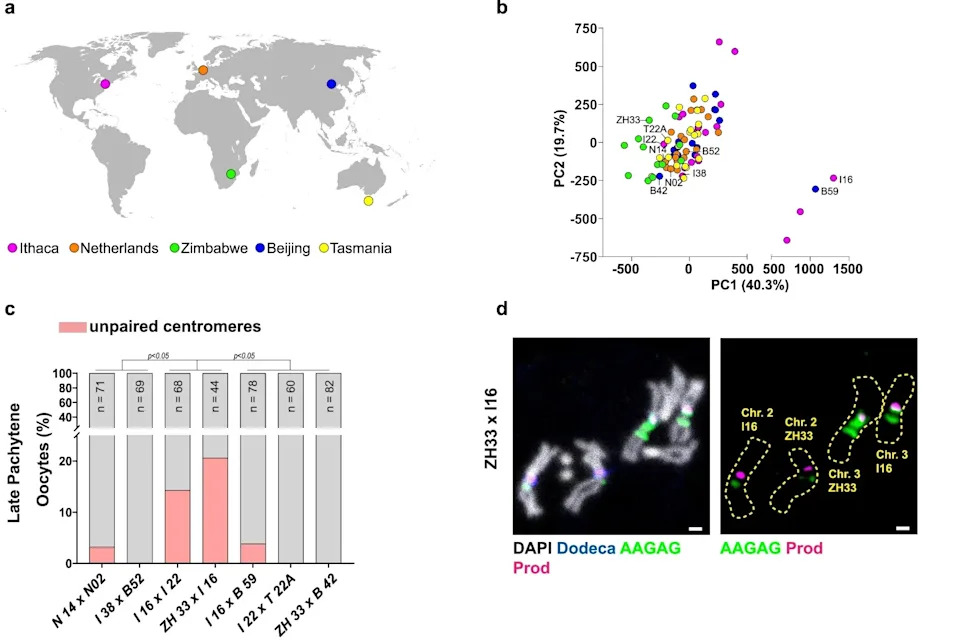
Satellite DNA divergence in naturally occurring populations leads to meiotic pairing defects. (CREDIT: Nature Communications)
Cellular Responses And Natural Variation
Cells activated surveillance pathways when pairing was incomplete. Pachytene checkpoint 2 (Pch2) appeared to delay meiotic progression—potentially allowing more time to resolve pairing—whereas loss of the spindle checkpoint protein Mad2 improved pairing in the double-deletion background and adding extra Mad2 worsened unpairing when repeats were disrupted. Pairing failures were also linked to cell death during egg development, suggesting defective meiotic cells can be eliminated before segregation proceeds.
To test whether natural satellite variation produces similar outcomes, the team analyzed 84 wild D. melanogaster strains from the Global Diversity Lines project. Crosses between parents with strongly divergent satellite profiles yielded offspring with significantly more centromere-unpairing defects than crosses between parents with similar satellite profiles. By contrast, ordinary single-nucleotide polymorphisms and small indels did not show this relationship, suggesting the effect is specific to satellite divergence.
Implications And Caveats
The findings raise the possibility that rapidly evolving satellite DNA could influence reproductive compatibility and, over evolutionary timescales, contribute to speciation. The authors caution that the idea is tentative: experiments were performed in fruit flies; some engineered deletions removed non-satellite DNA (including protein-coding genes); and it remains unproven whether similar barcode-like systems exist in humans or other animals.
"The term 'junk DNA' is no longer tenable," Jagannathan said. "We clearly demonstrate that this so-called rubbish has an important function during meiosis in the fruit fly."
The study, "Meiotic pairing through barcode-like satellite DNA repeats," appears in Nature Communications and offers new insight into meiotic recognition, satellite DNA function, and the rapid evolution of repetitive sequences.
Help us improve.