Summary: President Trump’s efforts to shrink U.S. engagement abroad have measurable domestic consequences. Ending embassy air-quality monitoring and cutting global health and aid programs correlate with higher pollution, increased U.S. health costs, lost manufacturing opportunities and humanitarian harm. Studies cited include a 2022 National Academy of Sciences estimate of a median 895 deaths prevented by embassy monitoring, a Bipartisan Policy Center finding of up to 8,000 U.S. premature deaths and $60 billion in annual health costs from foreign pollution, and USAID-Stop Work’s estimate of at least 13,000 American layoffs tied to aid cuts.
Trump’s Foreign-Policy Rollback Is Hitting Americans at Home
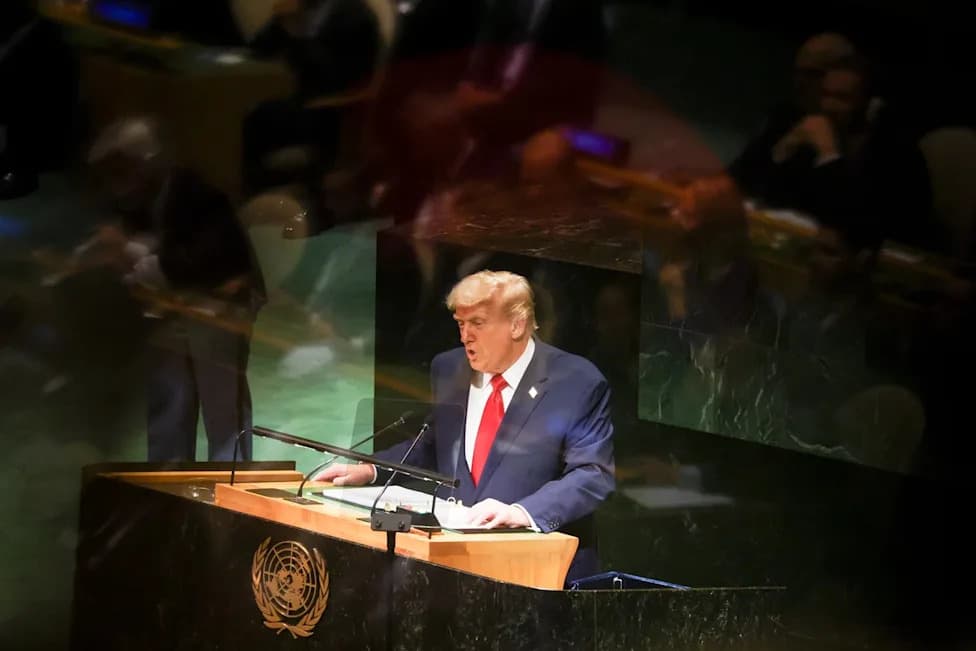
US President Donald Trump during the United Nations General Assembly (UNGA) in New York, US, on Tuesday, Sept. 23, 2025. The United Nations General Assembly, which opened today, brings more than 150 world leaders and their entourages into Midtown - a convergence that has been compared to hosting the Super Bowl every day for a week, across an entire neighborhood. Photographer: Michael Nagle/Bloomberg via Getty Images
President Donald Trump has repeatedly minimized U.S. obligations to the international community, a stance whose consequences are increasingly visible both overseas and inside the United States.
Last month, as trade negotiations with Canada collapsed, Trump posted on Truth Social, "WE DON'T NEED CANADA, THEY NEED US!" In March, while still insisting that any combat with Iran would be brief, he suggested other countries would have to "fend for themselves" in the Strait of Hormuz after hostilities ended.
Trump appears to seek the prestige of global power without accepting the responsibilities that traditionally accompany it — and that contradiction is producing tangible, costly effects for Americans.
Policy Changes With Direct Domestic Consequences
Last year, the administration ended a State Department program through which U.S. embassies independently monitored local air quality. A 2022 National Academy of Sciences study estimated that this program prevented a median of 895 pollution deaths in the cities where it operated. A subsequent study found air pollution levels rose by as much as 33% in the months after the program was terminated.
A separate analysis from the Bipartisan Policy Center concluded that pollution originating overseas contributes to as many as 8,000 premature U.S. deaths and more than $60 billion in additional annual U.S. health costs. That same research found foreign pollution has blocked new industrial permits and constrained manufacturing in at least 85 U.S. counties, undercutting efforts to revive domestic production.
Cuts To Global Aid Undermine U.S. Interests
Deep reductions to programs at the U.S. Agency for International Development (USAID) aimed at combating global hunger have been linked by public-health experts to the deaths of hundreds of thousands of children, with projections suggesting potentially millions more could die by the end of the decade if funding does not recover. The cuts also harmed American economic interests: U.S. farmers historically supplied roughly 40% of international food assistance, and more than 80% of contractors working with USAID were American companies.
USAID-Stop Work, which tracks the fallout from the cuts, estimated at least 13,000 American workers were laid off as a result. In short, shrinking U.S. engagement abroad has produced direct economic and humanitarian blowback at home.
How International Problems Become Domestic Ones
Air pollution created overseas can drift onto U.S. soil. Preventable disease outbreaks abroad make Americans more vulnerable when global health programs are underfunded. Political instability and climate-driven displacement abroad increase migration pressures on U.S. borders. Even everyday household budgets feel the impact: Democrats on the Joint Economic Committee estimate the average U.S. household has paid about $4,200 more for goods and services since Trump took office, a figure that critics link in part to foreign-policy choices that affect trade and energy markets.
These are not abstract debates: they are cause-and-effect relationships that underscore why international engagement and investment can serve clear domestic interests.
Bottom line: Narrowing America's role in global governance may yield short-term political talking points, but the resulting environmental, public-health and economic costs risk harming millions of Americans.
Evan Brechtel contributed to this report.
Originally published on MS NOW.
Help us improve.