Sheryl Sandberg says a decline in women pursuing senior corporate roles stems from workplace barriers, not reduced ambition. Lean In’s 2025 report (9,500 U.S. employees across 124 organizations) found women as motivated as men but less likely to seek promotions, with 25% citing personal obligations versus 15% of men. Sandberg urges stronger parental leave, flexible schedules, fertility and family benefits, and cultural changes to keep women in leadership and improve retention.
Sheryl Sandberg: Women Aren't Losing Ambition — Corporate Policies Are Pushing Them Out
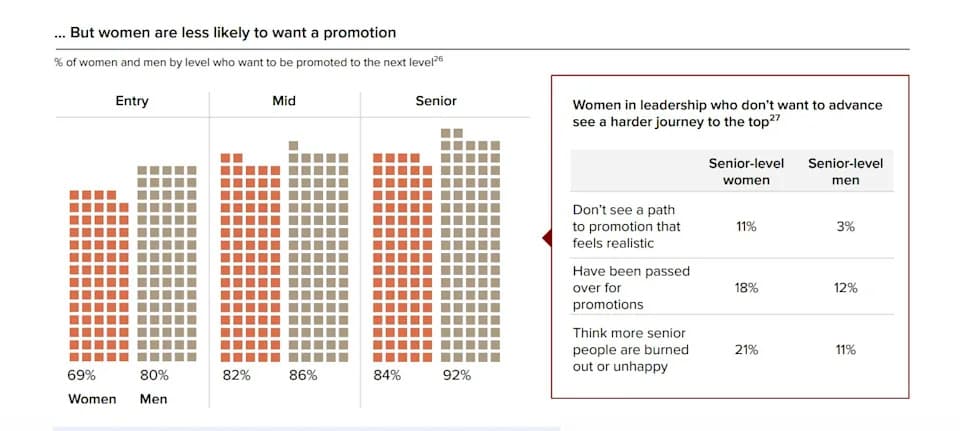
Lean In's 2025 Women in the Workplace report found a gender gap when it came to women wanting promotions.Lean In
Sheryl Sandberg, the former chief operating officer of Meta and author of the bestselling book Lean In, warns that fewer women are pursuing senior corporate roles — not because they lack ambition, but because workplace policies and culture are driving them away.

"Lean In" was published in 2013 and became an immediate bestseller.Taylor Hill/FilmMagic
Women Want The Same Opportunities — But Don’t Feel Supported
In an interview with Business Insider, Sandberg — who co-founded the Lean In organization — pointed to Lean In’s 2025 Women in the Workplace report (co-published with McKinsey), which surveyed roughly 9,500 U.S. employees across 124 organizations. The report found that women’s career motivation closely matches men’s, yet women are less likely to want promotions. Many who opt not to pursue advancement cite practical barriers rather than a lack of drive.

Women in leadership positions are more likely to bring up policy changes like egg freezing coverage or pregnancy parking, Sandberg said.MoMo Productions/Getty Images
"This is not the women who are saying, 'I don't want to do it,'" Sandberg said. "It's the women saying, 'I don't want to do it because I'm not wanted, I'm not getting the same opportunities and the same support, and I face an unfair burden at home.'"
Data Shows Structural Barriers
The 2025 report found that among employees who did not want to advance, 25% of women cited "personal obligations" compared with 15% of men. The study also documented persistent gaps in household labor and fewer mentorship and sponsorship opportunities for women. Independent research supports these trends: a KPMG analysis found that from 2023 to 2026 labor-force participation fell most sharply among women with children under five, while an IZA working paper reported that adding a woman to a public company board raised female employment and earnings by about 1–2%, driven mainly by improved retention.

Sandberg advocated for policy changes while at Google and Meta.Bloomberg/Getty Images
Policy and Culture Changes That Matter
Sandberg argues that firms benefit when more women hold leadership roles: companies tend to perform better and adopt employee-focused policies. She points to concrete measures that can help retain and advance women, including stronger parental and bereavement leave, flexible schedules, fertility and family-care benefits (Meta covers fertility services through Progyny), lactation rooms, and cultural norms that stop sidelining women.

Better policies, particularly ones that help working moms, can help retain and motivate more female employees.Natalia Lebedinskaia/Getty Images
Sandberg also shared examples from her own career: at Google she pushed for pregnancy parking, and at Meta she supported expanding fertility coverage after an employee faced cancer-related fertility challenges. Such policy changes often come when women leaders advocate for practical solutions.
A Personal View — Support Choices, But Don’t Let Talent Slip Away
Stepping down from Meta in 2022 to focus on philanthropy and venture work, Sandberg said she respects women’s personal choices — whether that means raising children, starting a business, or going part-time — but she worries about the broader loss if too many women are pushed out of senior roles. "We need environments that make women feel wanted and supported in leadership," she said.
Bottom line: The question isn’t whether women are ambitious. It’s whether companies are creating the policies and culture that let that ambition be realized and retained.
Help us improve.