Peter de Caluwe will take over as artistic director of the Salzburg Festival on Oct. 1, 2027, after a preparatory transition with interim director Karin Bergmann. The 63-year-old Belgian led Brussels' La Monnaie through 160 productions and 23 world premieres and is known for bold, occasionally controversial programming. Kristina Hammer begins a second five-year term as festival president on Jan. 1. The Grosses Festspielhaus will close for reconstruction in 2029–30, with an interim venue planned in Salzburg's old city.
Peter de Caluwe Named Salzburg Festival Artistic Director, Taking Office Oct. 1, 2027
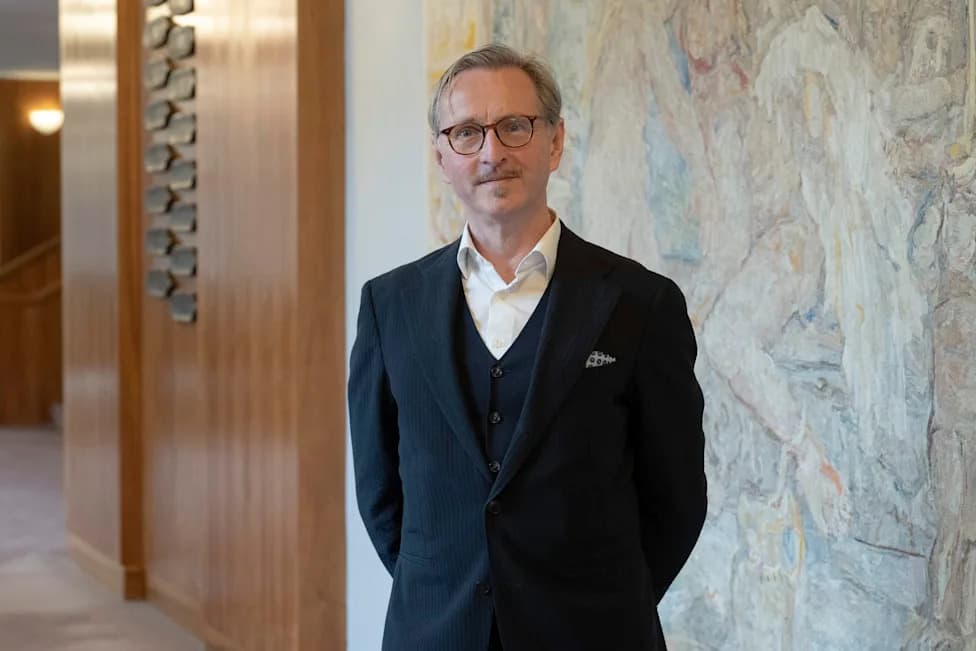
Peter de Caluwe, who will become artistic director of the Salzburg Festival in October 2027, poses at the Grosses Festspielhaus in Salzburg, Austria on Friday, Sept. 18, 2026. (Jan Friese/Salzburg Festival via AP)
Peter de Caluwe will become the artistic director of the Salzburg Festival on Oct. 1, 2027, stepping into one of the most influential roles in the international arts world after a long and innovative tenure at Brussels' La Monnaie.
De Caluwe succeeds Markus Hinterhäuser, who left the post in March after about a decade in charge. Karin Bergmann, a theatre specialist appointed in April, is serving as interim artistic director for this year and next; much of the 2027 programming was prepared under Hinterhäuser, and de Caluwe will begin a preparatory collaboration with Bergmann next month.
"Opera is not a museum. It definitely never has been or it shouldn't be," de Caluwe said in a telephone interview with The Associated Press following a Salzburg news conference.
A 63-year-old Belgian who speaks French, Dutch, English, German and Italian, de Caluwe first attended the Salzburg Festival in 1980 for Jean-Pierre Ponnelle's production of Mozart's Le Nozze di Figaro. He described himself as a listener and team player — an approach festival president Kristina Hammer welcomed after their initial conversation.
De Caluwe served as general and artistic director of La Monnaie from 2007 to 2025 (having earlier worked there under Gerard Mortier in the 1980s). During his leadership the company mounted 160 productions, including 23 world premieres. Notable new works included Philippe Boesmans' Au Monde, Pascal Dusapin's Penthesilea and Macbeth Underworld, and Mikael Karlsson's Fanny and Alexander.
His tenure also included several provocative stagings that generated strong public discussion. Andrea Breth's 2012 production of Verdi's La Traviata — which emphasized prostitution and featured semi-naked performers and provocative imagery — was one of roughly five productions that provoked particularly intense reaction. "That's too little," he said of his record of controversy. "I would have liked more controversy in the way that they cause so much discussion that people really almost felt like a revolution."
Prior to appointing de Caluwe, the festival explored other leadership configurations: supervisory board member Karoline Edtstadler said negotiations were held with Barrie Kosky and Sophie de Lint about a possible joint leadership team.
This year's Salzburg Festival drew more than 261,000 ticketholders across 209 performances, with venues at 99% capacity during the mid-July through August season. Kristina Hammer, who became festival president in 2022, has been granted a second five-year term beginning Jan. 1.
Looking Ahead
De Caluwe begins a five-year term on Oct. 1, 2027; his first largely self-programmed summer season is expected in 2029. Because the Grosses Festspielhaus is scheduled for reconstruction during the 2029 and 2030 festivals, planners envisage an interim venue in Salzburg's old city for those seasons. De Caluwe has suggested that a production of Richard Strauss' Der Rosenkavalier is a possibility for the Festspielhaus reopening in 2031.
"We are not bound to a building," Hammer said. "We are bound to a DNA, a vision." De Caluwe's appointment — following a lineage that includes Gerard Mortier, Peter Ruzicka, Jürgen Flimm, Alexander Pereira and Markus Hinterhäuser — signals the festival's intent to balance tradition with provocative, contemporary programming.
Help us improve.