Scholars at Utrecht University have identified a 1,700-year-old parchment scrap containing lines from Book 12 of Homer's Odyssey. Discovered by Mark de Kreij while cataloguing early Christian and Greco-Roman manuscripts, the tiny 2.6 x 3 in. leaf likely derives from a pocket codex produced in Fayum, Egypt, around the 3rd–4th century A.D. The passage describes the slaughter of Helios' sacred cattle and the divine retribution that follows. Only about 30 similar Homeric parchment fragments are known, and the find will be included in a forthcoming catalogue of the collection.
1,700-Year-Old Odyssey Fragment Discovered Tucked Inside Dutch Library Book
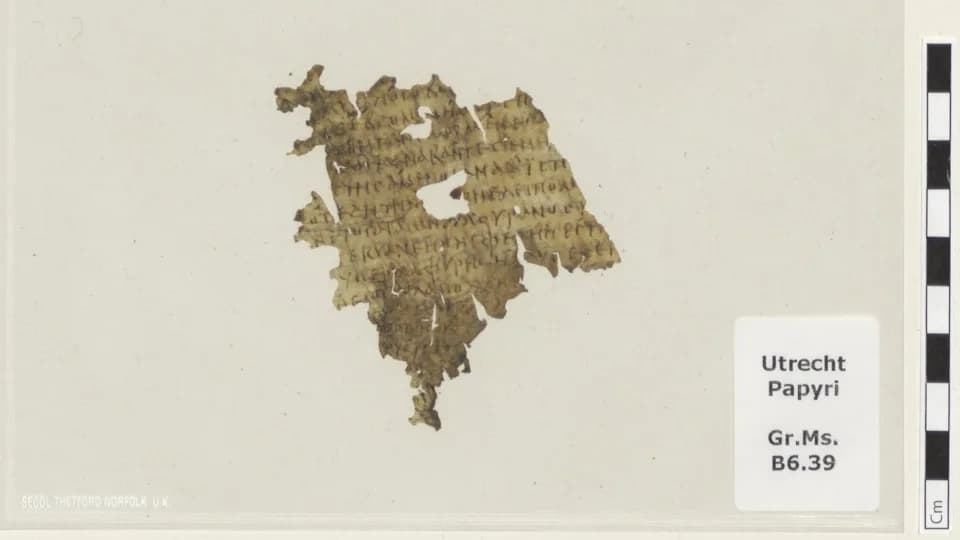
A researcher discovered a fragment of the "Odyssey" in a Utrecht University library book in the Netherlands. | Credit: Utrecht University
Researchers at Utrecht University have identified a tiny parchment fragment containing lines from Book 12 of Homer's Odyssey. The scrap—only about 2.6 by 3 inches (6.6 x 7.7 cm)—was recognized by Mark de Kreij, a Greek literature specialist at Radboud University, while he examined a collection of early Christian and Greco-Roman manuscripts acquired by the university in the mid-20th century.
What the Fragment Contains
The leaf preserves verses that describe the moment the sun god Helios discovers Odysseus' men have slaughtered and eaten his sacred, "immortal" cattle—an episode that leads to Zeus' devastating punishment and leaves only Odysseus alive. Scholars date the parchment codex that likely produced this pocket-sized edition to the 3rd–4th century A.D., probably from the Fayum oasis in Egypt.
"There are so many boring parts in the Odyssey," de Kreij told RTV Utrecht. "This happens to be a really fun passage."
Why the Find Matters
Only about 30 comparable Homeric parchment fragments are known, making this a rare addition to the small corpus of early books of Homer. The fragment may have survived because it was bound in the middle of a pocket-size codex and thus protected by neighbouring pages. How the leaf became mixed with the university's larger collection of Egyptian texts remains unclear.
The discovery follows another unexpected Homeric find earlier this year, when archaeologists in Egypt reported papyrus fragments of the Iliad inside a Roman-era mummy. Both epics—the Iliad and the Odyssey—are conventionally dated to the late eighth or early seventh century B.C., with the Odyssey recounting Odysseus' long journey home after Troy.
Next Steps
Although de Kreij first identified the fragment in 2024, he will include a full study of Utrecht University's Greco-Roman Egyptian holdings in an upcoming book titled Hieratic, Demotic, Greek, and Coptic Texts in the Utrecht University Collection. The fragment will be catalogued and studied further to confirm paleographic details and context.
Help us improve.