The 1947 Roswell wreckage came from Project Mogul, a classified NYU‑developed balloon program that sought to detect Soviet nuclear tests. Initial military statements and the program's secrecy helped create a vacuum filled by conspiracy theories, especially after a 1980 book revived public interest. In 1994 the U.S. Air Force concluded the debris was linked to NYU Flight 4 of Project Mogul, but Roswell's UFO legend endures.
The Roswell Truth: How a Top‑Secret 1947 Spy Balloon Sparked a UFO Legend
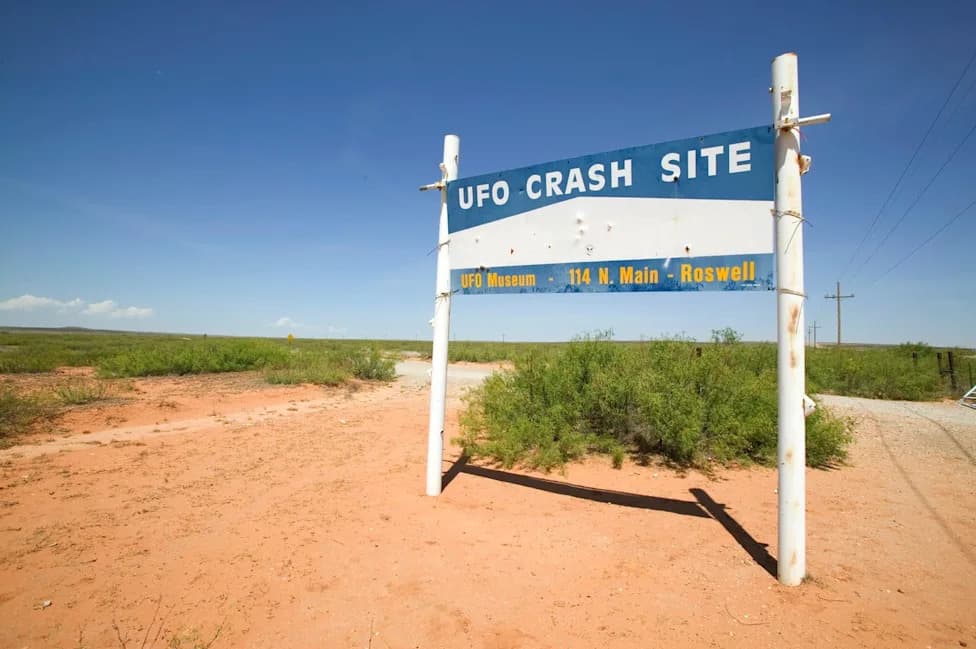
The Secret Military Project Behind Roswell's 'UFO'David Zaitz - Getty Images
In 1947, wreckage found near Roswell, New Mexico, came from a highly classified U.S. balloon program — Project Mogul — designed to detect Soviet nuclear tests from the upper atmosphere. Because the project was secret, the unusual debris and the military's early, confusing statements helped seed decades of speculation and conspiracy theories.
Cold War Context
As World War II's embers cooled, the United States and the Soviet Union began a shadowy contest of intelligence and technology. One covert effort, Project Mogul, used long arrays of constant‑level balloons and telemetering equipment developed by New York University to keep instruments at a steady altitude and relay data to ground stations. The aim was to pick up low‑frequency sound waves and other signals that might indicate distant nuclear tests.
Project Mogul: Ambitious and Secret
A U.S. Air Force Reserve report later described Project Mogul as covering a wide range of upper‑atmosphere science — from radiowave and radar propagation to ionospheric and solar physics, terrestrial magnetism and meteorology. The program drew substantial resources, including aircraft and ships, and at one point employed more than 100 staff (excluding contractors). Despite solid science, the expense and operational limits of balloon arrays meant fixed‑wing reconnaissance soon became the preferred approach.
The Roswell Wreckage
On June 14, 1947, rancher W.W. "Mac" Brazel and his son discovered unusual debris in a pasture about 80 miles northwest of Roswell. Brazel brought pieces of the material a few weeks later to local authorities, and on July 8 the Roswell Daily Record published a headline claiming the Roswell Army Air Field had recovered a "flying saucer." The military quickly countered that the wreckage was likely from a weather balloon; Brazel publicly disputed that description the next day.
From Obscurity to Infamy
The incident faded from national news for decades until the 1980 publication of The Roswell Incident, a book that argued the official balloon story was a cover‑up. That book, followed by other books, eyewitness accounts and pop culture attention, turned Roswell into one of the most enduring UFO stories in history.
Declassification and Official Explanation
In 1994 the U.S. Air Force released a report linking the 1947 debris to Project Mogul — identifying the material with NYU Flight 4, launched on June 4, 1947, which later came down in the New Mexico desert. The report concluded the classified nature of the program and the unusual appearance of the materials (balloon rigging, radar reflectors and specialized equipment) had led to misidentification and persistent rumors.
"This won't lay it to rest," Colonel Albert C. Trakowski, a retired Air Force officer who worked on Project Mogul, told The New York Times in 1994. "The psychology is simple: People believe what they want to believe."
Today Roswell embraces its place in UFO lore. The town markets itself as an extraterrestrial destination, with a UFO museum, festivals and a tourism logo that features a flying saucer. Whether seen as a Cold War footnote or the origin of a global myth, the Roswell episode illustrates how secrecy, science and storytelling can combine to shape public imagination.
Help us improve.