Kaja Kallas abruptly called off plans for a high-level EU advisory panel on defense after reported opposition from Germany, France and Italy. The group, first proposed on Sept. 1 and expected to include Anders Fogh Rasmussen, was due to launch in Brussels on Sept. 7 but was cancelled on Sept. 6. Critics said the panel risked duplicating work under Defence Commissioner Andrius Kubilius, while Germany stressed that NATO remains the primary forum for capability planning. Officials say the core challenge remains: how to speed up Europe�s rearmament.
Kaja Kallas Abruptly Shelves High-Level EU Defense Panel After Pushback From Berlin, Paris, Rome
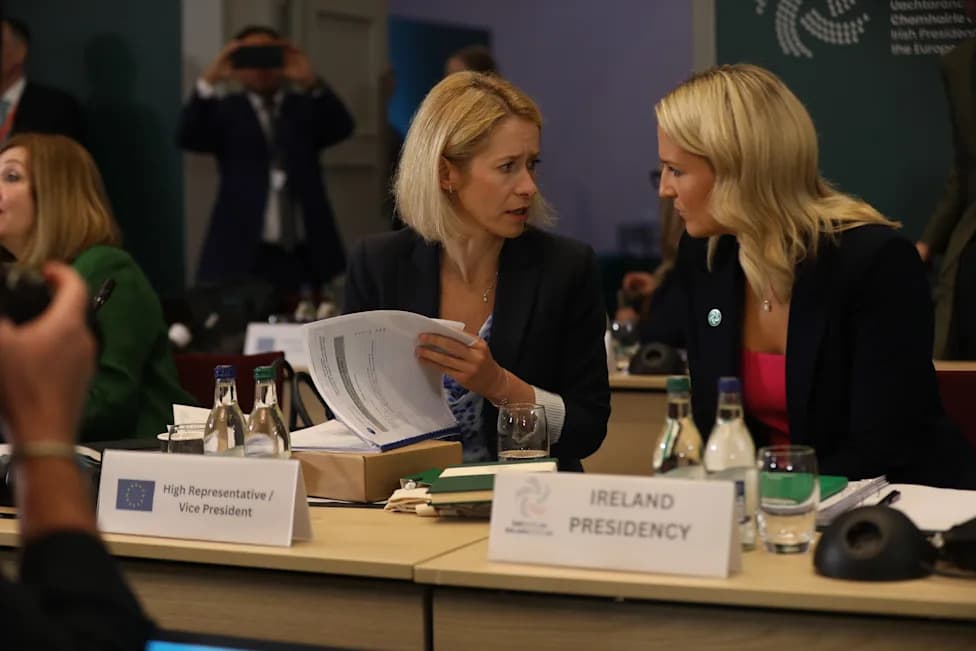
EU High Representative for Foreign Affairs and Security Policy Kaja Kallas (L) speaks with Irish Minister for Defence Helen McEntee (R) during an informal meeting of European Union defense ministers in Wicklow, Ireland, on Sept. 1, 2026. (Mostafa Darwish/Anadolu via Getty Images)
EU foreign policy chief Kaja Kallas unexpectedly abandoned plans for a high-level advisory panel on European defense just hours before its public launch, following reported opposition from several member states, most prominently Germany, France and Italy.
The initiative was first proposed by Kallas at an informal meeting of defense ministers in Wicklow, Ireland, on Sept. 1. It aimed to convene former political and military leaders to produce concrete recommendations to close Europe�s capability shortfalls more quickly. Former NATO secretary-general Anders Fogh Rasmussen was widely reported to have been expected to chair the panel, with former defense ministers Jüri Luik of Estonia and Florence Parly of France among the likely members. The United Kingdom and Ukraine were also anticipated to take part.
The formal launch � a fireside conversation with Kallas planned for Sept. 7 at Brussels' Biblioth�que Solvay and due to host roughly 150 invitees � was cancelled on the afternoon of Sept. 6 before membership had been finalised.
“Some member states felt this was not the right path to pursue at this moment,” an unnamed EU official told Politico, adding that Kallas�s office would instead explore new ways to engage member states.
German news agency dpa reported that Berlin's objections were central to the decision, and Euractiv said France, Germany and Italy jointly rejected the proposal. Critics had informally compared the planned panel to a “Draghi report for defense,” arguing it risked duplicating existing work.
When asked by reporters, a German defense ministry spokesperson declined to comment on internal EU consultations but emphasized that Germany regards NATO as the primary forum for military capability planning. The spokesperson noted that defense and armaments policy remain the responsibility of member states and that NATO-derived planning underpins capability efforts, while EU initiatives such as PESCO, the European Defence Fund (EDF), SAFE and Military Mobility play supporting roles.
The cancellation also highlights institutional tensions over who should steer the EU's defense agenda. Some capitals feared the panel would duplicate work being carried out by Defence Commissioner Andrius Kubilius, while Berlin has separately pushed to incorporate parts of the European External Action Service into the European Commission.
Kallas has repeatedly argued that Europe cannot keep outsourcing its defense to the United States and must accelerate rearmament as Russia increases hybrid and, increasingly, kinetic pressure on the continent�s eastern and northern flanks. One EU official, speaking on condition of anonymity, said the core problem remains: Europe still needs to decide how to strengthen its defense faster, regardless of this panel's fate.
What Happens Next
Kallas�s office says it will seek new ways to engage member states on capability shortfalls. Observers expect further debate within capitals and institutions over the appropriate balance between NATO-led planning, Commission initiatives, and EU foreign-policy organs like the EEAS.
Help us improve.