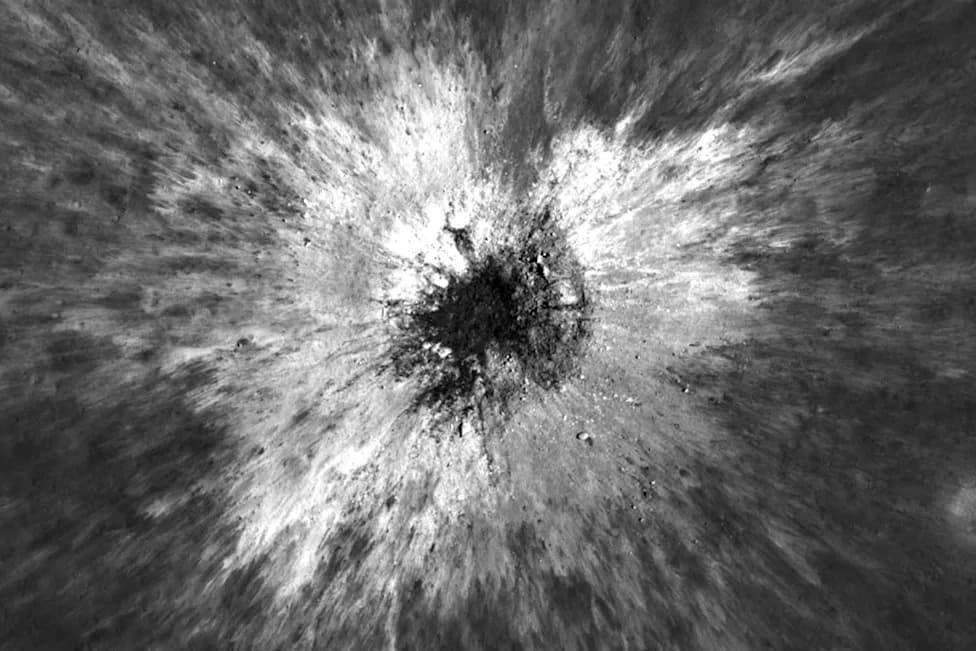
NASA has published detailed images of a SpaceX Falcon 9 upper stage impact site on the Moon. The strike, at about 5,400 mph on August 5, created a roughly 60-foot-wide, under-10-foot-deep crater surrounded by V-shaped dark and bright streaks. Scientists say the dark streaks are older, weathered subsurface material, while the bright streaks are fresher material excavated by the collision. LRO captured the high-resolution images after a precise tilt maneuver and a six-day wait; South Korea's Danuri returned the first photos.
NASA Releases High-Resolution Images of SpaceX Rocket Impact on Moon — 60‑ft Crater Revealed
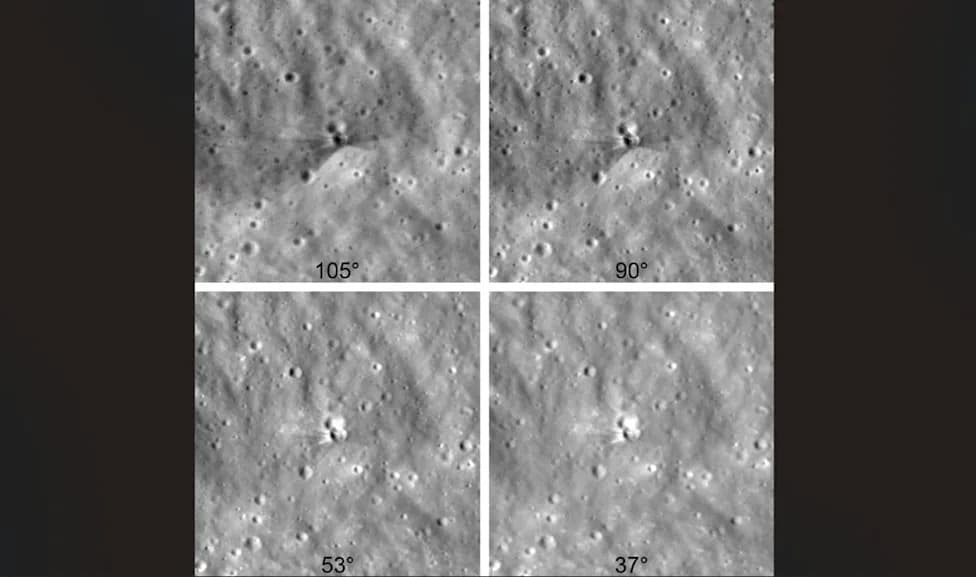
Four views show the SpaceX Falcon 9 impact crater under varying lighting angles, revealing dark, weathered surface material and brighter, deeper ejecta | ©Image Credit: NASA Goddard/Intuitive Machines
NASA has released new high-resolution images showing where a derelict SpaceX Falcon 9 upper stage struck the Moon at roughly 5,400 mph on August 5, leaving a distinctive scar on the lunar surface.
What the Images Reveal
The photographs show a crater about 60 feet (≈18 meters) across and under 10 feet (≈3 meters) deep. Radiating from the impact are two contrasting sets of streaks — dark and bright — that form a pronounced V-shaped, butterfly-like pattern around the site.
Why the Pattern Appears
Scientists attribute the V-shaped pattern to the rocket stage's low-angle impact. The dark streaks are older, weathered material that was lying just beneath the surface and became exposed; over eons this material had been altered by solar wind, cosmic rays, and micrometeorite bombardment. The bright streaks are fresher subsurface material excavated by the strike and not previously exposed to space weathering.
Background: The Object That Struck the Moon
The object was an upper stage of a SpaceX Falcon 9 rocket that had spent roughly a year drifting in space. Before becoming debris it performed mission-critical work: in 2025 the same upper stage carried two private lunar landers — Firefly Aerospace's Blue Ghost and ispace's Resilience — each carrying experiments and a small rover as part of NASA's efforts to commercialize lunar deliveries.
Imaging the Site: A Technical Challenge
Capturing the impact site was technically demanding. NASA's Lunar Reconnaissance Orbiter (LRO) orbits the Moon in a polar path about 60 miles (≈100 km) above the surface and scans roughly a mile every second while the Moon rotates beneath it. Flight controllers executed a precise tilt maneuver to point LRO's cameras at the impact area, and it took six days for the scar to align with the orbiter's ground track so it could be imaged.
South Korea's Danuri spacecraft was first to return pictures of the site, but LRO — which has been circling the Moon since 2009 — provided the higher-resolution follow-up needed for detailed scientific analysis.
Sources: NASA; Firefly Aerospace; Korea Aerospace Research Institute; NYP.
Help us improve.