
Savvas Koushiappas (Brown University) proposes that an irreducible quantum uncertainty between the Universe's size and its expansion rate could produce the observed acceleration, offering a geometric alternative to dark energy. Applied at cosmological scales, this uncertainty modifies the standard expansion equations and can either mimic evolving dark energy or, for other parameter choices, replace the Big Bang singularity with a bounce. Upcoming surveys such as DESI, Euclid, and the Vera C. Rubin Observatory could test these predictions.
Could Quantum Gravity Be Hiding in the Universe's Acceleration?
(Maximusnd/iStock/Getty Images Plus)
The Universe is expanding, and precise measurements show that expansion is speeding up. Explaining what drives this acceleration remains one of cosmology's deepest puzzles.
Dark energy is the label most commonly used for the unknown cause of the acceleration—an empirical description rather than a demonstrated physical mechanism. In the standard cosmological model, dark energy accounts for roughly 68% of the Universe's energy density, a value that sits uneasily next to expectations from quantum field theory.
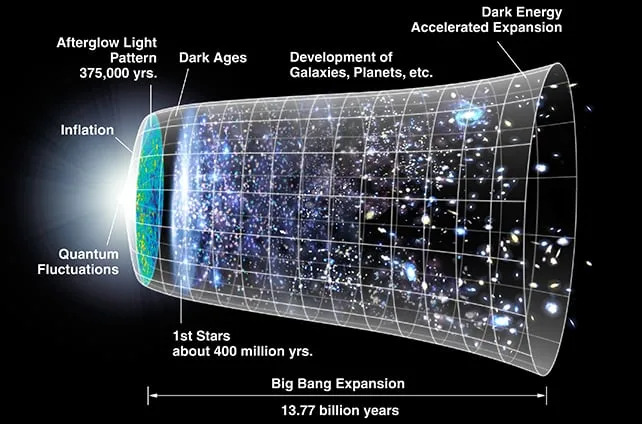
Dark energy has been used to help explain how the Universe's expansion is accelerating. (NASA/WMAP Science Team)
Quantum Geometry as an Alternative
In a recent paper published in Physical Review D, Savvas Koushiappas of Brown University proposes that some of the behavior normally attributed to dark energy could instead arise from a quantum modification of spacetime geometry. His idea is that there is an irreducible quantum uncertainty between the size of the Universe and its expansion rate. Applied at cosmological scales, this uncertainty alters the equations used to describe cosmic expansion and can produce late-time acceleration as a macroscopic imprint of quantum effects.
'In this picture, the accelerated expansion of the late Universe may be the macroscopic imprint of an irreducible quantum uncertainty in simultaneously knowing the size and expansion rate of the Universe,' Koushiappas writes.
How the Model Works
Koushiappas frames the proposal within a quantum-gravity context so that general relativity and quantum principles can coexist at the largest observable scales. The key modification effectively changes how the Friedmann equations (which govern expansion) evolve over time. Crucially, the model allows the relevant quantum scale to extend to the cosmological horizon—the limit from which light has had time to reach us—making the effect potentially observable.
YouTube Thumbnail
Depending on the sign and value of a central exponent in the model, the consequences differ: positive values can mimic an evolving form of dark energy, while sufficiently negative values can remove the initial Big Bang singularity and replace it with a cosmological 'bounce'—a rebound from a prior contracting phase.
Observational Tests and Limitations
If correct, the proposal would shift part of the explanation for cosmic acceleration from an unknown energy component to a modified geometric description of spacetime with quantum origins. That makes it potentially testable: upcoming and ongoing surveys such as DESI, Euclid, and the Vera C. Rubin Observatory should tighten constraints on the expansion history and could reveal signatures consistent with this geometric quantum effect.

Subscribe to ScienceAlert's free fact-checked newsletter
Koushiappas is careful to note that the idea does not answer every question. The model leaves open theoretical and observational challenges and will require further calculation and comparison with precision data before it could supplant or supplement the standard dark-energy interpretation.
Paper: Savvas Koushiappas, Physical Review D. Funding and observational follow-up will determine whether this quantum-geometry proposal can survive stringent empirical tests.
Help us improve.





















