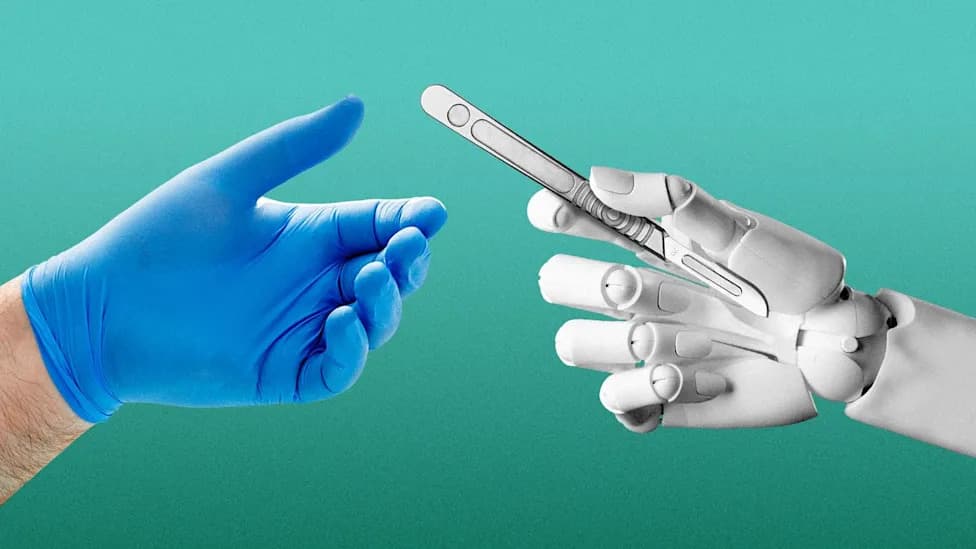
The authors of a new JAMA paper argue that fully autonomous AI systems could outperform physicians and human–AI teams on core clinical tasks by 2030. They cite studies showing AI systems excelling at history-taking and diagnosis (including a ChatGPT model reported to identify final diagnoses first in 60% of 377 complex cases). The paper warns of "AI-induced deskilling" and notes unresolved legal, liability, and regulatory barriers. Professional societies urge AI remain supportive while debates continue about safety, equity, and oversight.
AI Doctors by 2030? JAMA Authors Argue Autonomous Systems Could Outperform Physicians on Key Tasks
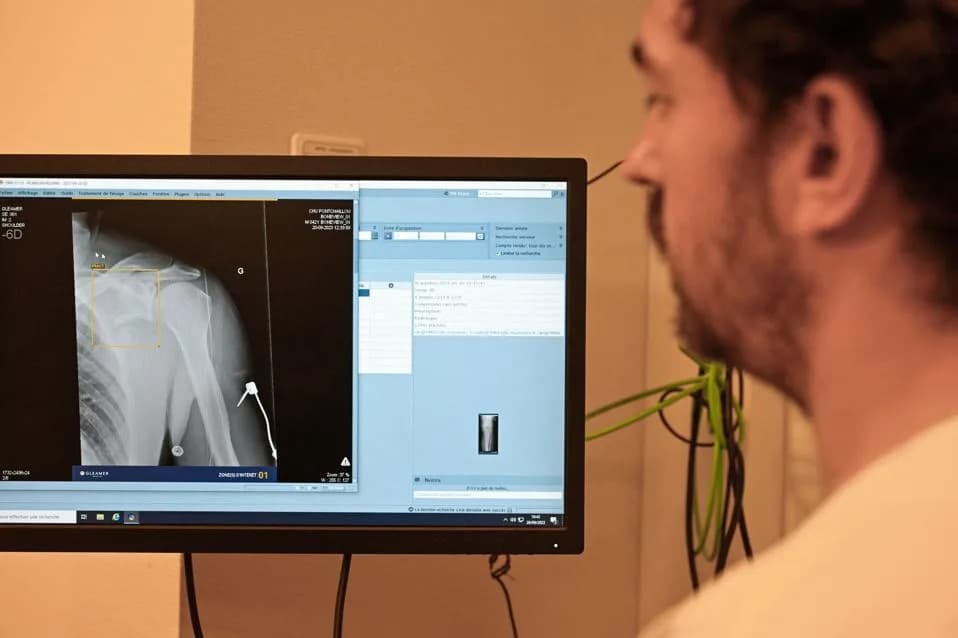
A doctor, helped by artificial intelligence for medical imaging, looks at an x-ray on a screen.
A group of health researchers and entrepreneurs argues in a new JAMA paper that top-tier medical care may soon be delivered not by doctors aided by artificial intelligence, but by fully autonomous AI systems that could surpass both physicians and human–AI teams as early as 2030.
What the Paper Claims
The paper, authored by bioethicist Ezekiel Emanuel, research fellow Abe Baker-Butler, and Curai Health CEO Neal Khosla, challenges the prevailing view—endorsed by professional bodies such as the American College of Physicians—that AI should remain only a "supportive role" in clinical decision-making. The authors contend that rapidly improving AI models may soon perform core clinical tasks more accurately and consistently than humans or human–AI teams.
Evidence Cited
The authors cite multiple studies they say demonstrate superior AI performance on specific clinical tasks. One study is reported to show Google's Articulate Medical Intelligence Explorer was "significantly better" than physicians at eliciting patient complaints, reviewing symptoms, and taking medical histories. Another analysis cited in the paper reports that a ChatGPT model (referred to as "o3" in the paper) correctly identified the final diagnosis first in 60% of 377 complex real-world cases; by comparison, a group of 20 internal medicine physicians reached the correct first diagnosis in about 16% of a 302-case subset, as reported.
The authors also highlight a 2024 study in which adding practicing physicians to AI-driven case simulations reportedly worsened outcomes compared with letting the AI operate alone—raising questions about the value of certain human–AI team configurations.
Risks and Practical Barriers
The paper warns of "AI-induced deskilling": the gradual erosion of clinicians' diagnostic and decision-making skills when cognitive work is regularly ceded to automated tools. The authors acknowledge significant unresolved issues—liability, reimbursement, and regulatory frameworks—that currently prevent fully autonomous AI systems from independently providing care in most jurisdictions.
Perspectives and Counterarguments
Not all experts agree with an imminent shift to autonomous AI care. Robert Wachter, in his 2026 book A Giant Leap, argues that AI-augmented physicians will remain the top-tier providers while an "economy class" of patients may receive AI-only care. Professional organizations such as the American Medical Association and the American College of Physicians continue to recommend that AI serve a supportive role to ensure patient safety and minimize harm.
Analogy and Context
The authors liken medicine's potential trajectory to AI's rise in chess: after IBM's Deep Blue beat Garry Kasparov in 1997, human–AI teams dominated for years until AI alone outpaced hybrids. They argue medicine could follow a similar curve, compounded by the unique risk that clinicians who relinquish cognitive work may find it difficult to reclaim those skills.
Conflicts of Interest and Background
Neal Khosla leads Curai Health, an AI-first primary care company. The paper's disclosures note an investment connection: Neal's father, venture capitalist Vinod Khosla, was an early investor in OpenAI and is reported to have been mentioned in the conflict-of-interest section. The authors present these links transparently while arguing the evidence merits urgent discussion.
Bottom line: The JAMA paper sparks a provocative debate about whether—and how—autonomous AI could reshape clinical care. The claims rest on selected studies that the authors interpret as evidence of superior AI performance on discrete tasks; open questions remain about generalizability, safety, regulation, and the consequences of clinician deskilling.
Help us improve.