President Trump has repeatedly sought to place major executive acts beyond judicial scrutiny, arguing courts should not review decisions under statutes like the Alien Enemies Act, 10 U.S.C. §12406, IEEPA, and the Trade Act. Federal courts — including the Supreme Court — have rejected blanket nonreviewability, insisting on habeas rights, statutory interpretation, and the major questions doctrine. Accepting the administration's theories would allow unprecedented expansion of executive power and weaken separation-of-powers safeguards.
Trump's Campaign To Put Presidential Acts Beyond Judicial Review Threatens A Core Check On Power
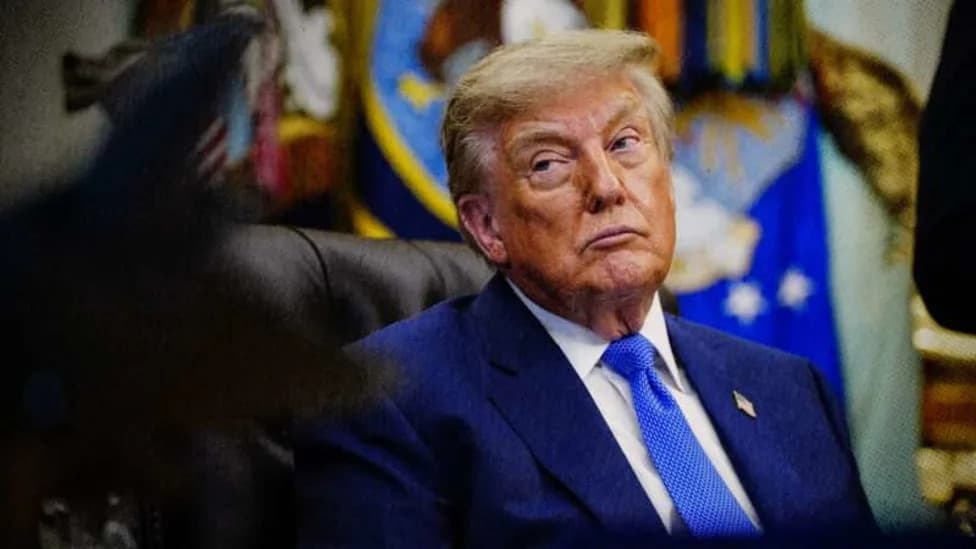
Photo: Bonnie Cash - Pool via CNP/CNP/Polaris/Newscom
President Donald Trump has repeatedly sought to shield major executive actions from judicial scrutiny, both through public attacks on judges and through legal theories asserting that courts lack authority to review core presidential decisions. From asylum restrictions to mass deportations, National Guard federalizations, emergency tariffs, security-clearance suspensions, and an ambitious plan to rebuild the White House East Wing, the administration has pressed a broad theory of nonreviewability that federal courts have repeatedly rejected.
Asylum Rule And The Tigar Rebuke
In 2018, after an Oakland federal judge temporarily enjoined new asylum restrictions, Mr. Trump dismissed the ruling as the work of "an Obama judge." The decision turned on the plain language of the Immigration and Nationality Act, which allows "any alien" physically present in the United States to apply for asylum, including those who arrive between ports of entry. Chief Justice John Roberts publicly rebuked the president, reminding Americans that federal judges are not partisan appointees in the sense of being agents of a political party.
The Alien Enemies Act And The Boasberg Order
In March 2025, Chief Judge James Boasberg temporarily blocked an administration effort to deport alleged members of the Venezuelan gang Tren de Aragua under the Alien Enemies Act (AEA), a 1798 statute that applies only when there is a declared war or a foreign government has perpetrated or threatened an invasion. The Justice Department argued AEA proclamations and the president's factual determinations under the Act were nonreviewable. The Supreme Court later vacated Boasberg's TRO for lack of jurisdiction but unanimously held that AEA detainees are entitled to notice and a meaningful opportunity to seek habeas corpus relief before removal. Despite the TRO, 238 Venezuelans were deported from Harlingen, Texas, on the day the court acted.
National Guard Federalizations And Statutory Limits
Mr. Trump relied on 10 U.S.C. §12406(3) to federalize state National Guard units without governors' consent, arguing the statute confers unreviewable discretion to the president. The 9th Circuit rejected the view that statutory claims are nonjusticiable political questions, explaining that treating statutory interpretation as beyond judicial review would systematically favor the president over Congress. The Supreme Court later left a TRO in place in Trump v. Illinois, concluding the president likely misread the statute's reference to "regular forces," a narrow construction that limits federalization under §12406(3).
Tariff Power, IEEPA, And The Major Questions Doctrine
To impose sweeping tariffs in 2025, the administration invoked the International Emergency Economic Powers Act (IEEPA), claiming authority to rewrite Congress's tariff schedule after declaring national emergencies. Courts — including the U.S. Court of International Trade and the Federal Circuit — rejected that claim, invoking the major questions doctrine, which requires clear congressional authorization when the executive asserts vast economic and political power. The Supreme Court affirmed in Learning Resources v. Trump that IEEPA does not authorize the tariff regime the president announced.
Security Clearances, Retaliation, And The White House Ballroom
The administration also argued that decisions to grant or revoke security clearances are unreviewable, even when used as a tool to punish law firms representing disfavored clients. District Judge Richard Leon rejected that position, finding the blanket sanctions violated the First Amendment. Separately, Mr. Trump's plan to demolish and replace the White House East Wing with a much larger ballroom prompted litigation in which the D.C. Circuit refused the government's contention that courts lack the power to enjoin the project, holding that congressional delegation would be required for such an extraordinary act.
Why Judicial Review Matters
Across these disputes, the administration has advanced a common theme: the president's statutory and emergency determinations are unreviewable or should receive near-absolute deference. Federal courts — from trial judges to the Supreme Court — have repeatedly pushed back, defending doctrines such as habeas review and the major questions doctrine to ensure statutory text and constitutional safeguards constrain executive power. Accepting the administration's theories would allow unprecedented aggrandizement of executive authority and weaken a central protection against abuses of power.
Bottom Line: Judicial review is not a partisan convenience; it is a structural check embedded in statutes, the Constitution, and precedent. Courts have a vital role in interpreting the law and ensuring the executive acts within the limits set by Congress and the Constitution.
Help us improve.