MIT researchers developed HECIA, an interactive atlas that maps how habitat design elements—lighting, privacy, circulation and reconfigurability—connect to behavioral health outcomes including stress, sleep, homesickness and social bonding. Modeled on NASA risk maps, the tool lets designers trace links forward from mission constraints or reverse-map from outcomes to design levers. HECIA is a decision-support resource—not a universal blueprint—and its insights may also apply to submarines, polar stations and other extreme environments.
Designing Mars Habitats: New Atlas Links Lighting, Layout and Privacy to Astronaut Mental Health
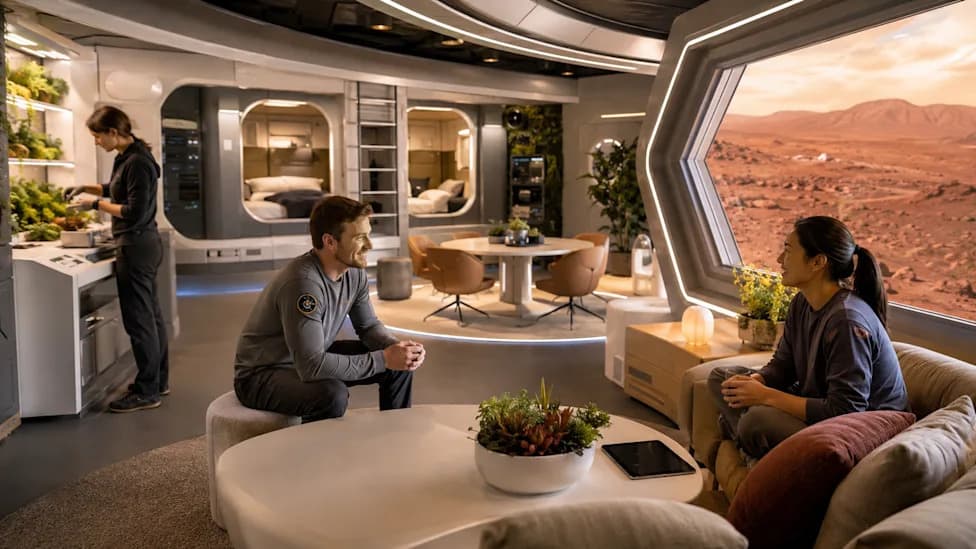
Space habitat design could shape astronaut mental health on long missions by influencing sleep, privacy, connection, and homesickness. (CREDIT: Shutterstock)
Space habitats must do more than protect astronauts from radiation, micrometeoroids and malfunctions. For missions that last months or years, the arrangement of walls, lighting, privacy and reconfigurable spaces can shape crew stress, sleep, homesickness and social bonds—sometimes as decisively as life‑support engineering.
Overview
Researchers led by MIT have produced an evidence-based framework and interactive tool, the Human-Environment Connection and Interaction Atlas (HECIA), that maps how concrete habitat design choices connect to behavioral, emotional and social outcomes. The goal is to make psychological and social trade-offs visible during early design decisions so planners can weigh behavioral health alongside traditional engineering risks.
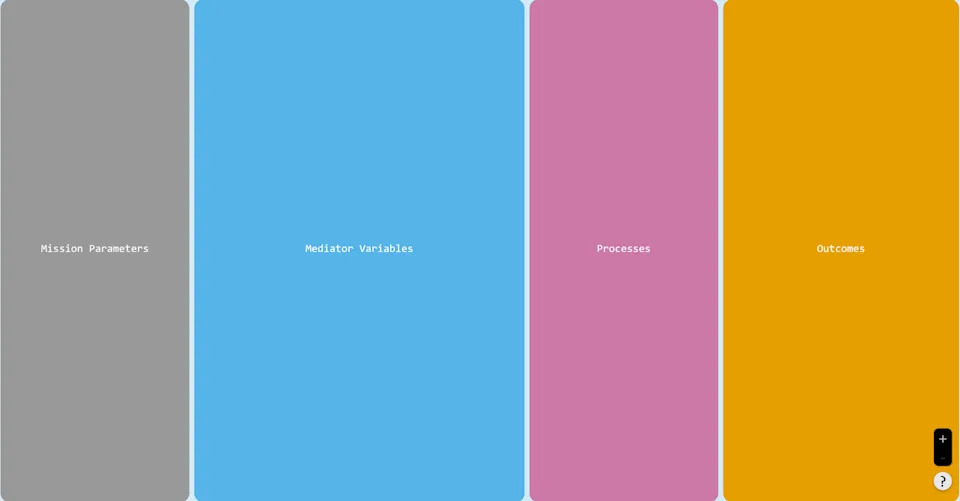
MIT-developed interactive tool called the Human-Environment Connection and Interaction Atlas, or HECIA. (CREDIT: MIT / HECIA)
About HECIA
HECIA was developed by Mich Lin (PhD candidate, MIT Human Systems Lab and Engineering Systems Lab) and colleagues using a risk-mapping approach modeled on NASA’s directed acyclic graphs (DAGs). The team synthesized peer-reviewed literature and expert interviews to convert empirical findings—about lighting, circulation, privacy, reconfigurability and more—into a navigable network of upstream design features and downstream behavioral outcomes.
“People have long recognized that living in space is hard. As priorities shift toward long-duration exploration, making sure crews are safe, healthy, happy and productive becomes even more important,” said Mich Lin.
How the Tool Works
Designers can use HECIA in two ways: start from a mission constraint (for example, distance from Earth) and follow forward to likely behavioral effects, or start from a behavioral outcome (such as homesickness) and trace backward to design levers like food systems, privacy or reconfigurable spaces. Each node includes a concise, research-based summary and suggested design interventions.
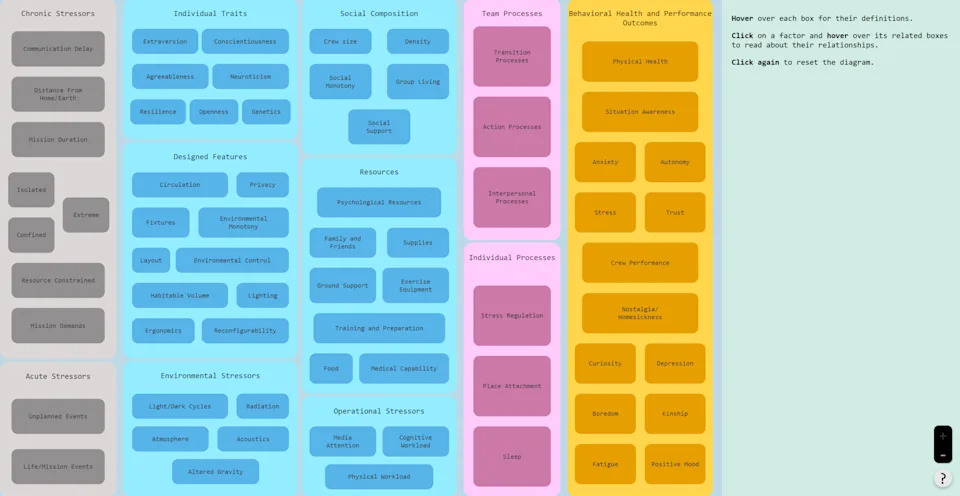
HECIA is modeled after a risk-mapping format used by NASA. (CREDIT: MIT / HECIA)
To populate the atlas, the team reviewed aerospace and human-factors literature and refined affective targets from existing taxonomies (drawing on resources such as Brené Brown’s Atlas of the Heart). They selected 14 emotions and experiences most relevant to isolated, confined and extreme habitats—examples include anxiety, autonomy, nostalgia, curiosity, fatigue and kinship.
Practical Applications
HECIA can reveal nonobvious chains of influence—for instance, how circulation paths and shared entrances promote incidental social contact and reduce isolation, or how lighting and color affect circadian rhythms, sleep quality and daytime performance. The tool is intended as decision support rather than a prescriptive blueprint; final designs must still respect mission objectives, mass and systems constraints.
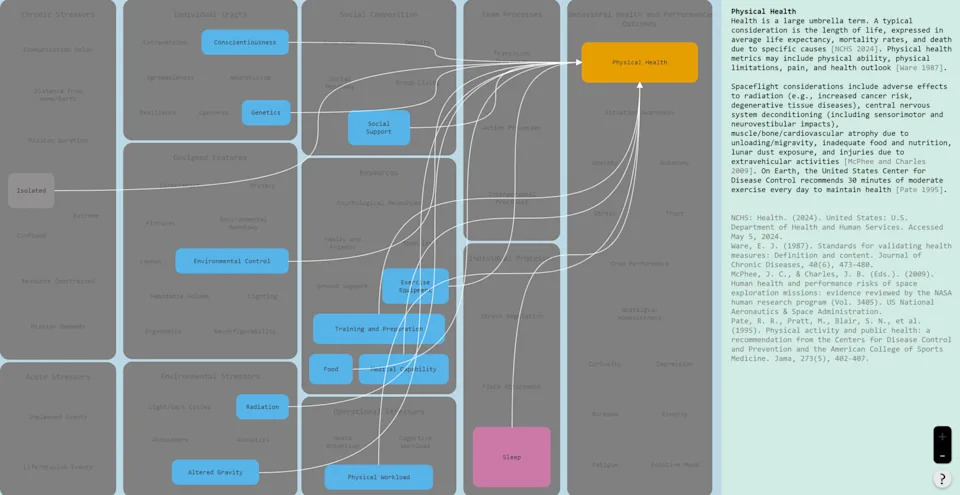
Findings became links in a larger web showing how design choices may affect mental, emotional, and social wellbeing. (CREDIT: MIT / HECIA)
The framework may also inform design in other extreme settings such as submarines, polar research stations, oil rigs, refugee camps and other isolated or high-stress environments where the built environment shapes daily life.
Limitations and Next Steps
HECIA organizes and surfaces existing evidence, but it does not claim a single solution will work for every context. The atlas highlights relationships and intervention points that can guide research priorities and design trade-offs. The research was led by Lin with collaborators including Lu Chen (former MIT undergraduate), Katya Arquilla (University of Colorado Boulder), and contributors from KBR/NASA and industry. The project received partial support from NASA.
Further reading: The team cites related reviews and empirical studies on mission architecture, lighting, analog environments, social support and biopsychosocial health available in journals such as npj Microgravity, Indoor and Built Environment, Wilderness & Environmental Medicine, Frontiers in Psychology and Frontiers in Space Technologies.
Help us improve.