During a routine 2025 seabed survey off Ramatuelle, French naval teams discovered a 16th‑century merchant ship at roughly 8,200 feet (≈2,500 m). Designated Camarat 4, the hull measures over 98 feet (30 m) and appears to carry at least 200 earthenware pitchers, about 100 plates, anchors, cannons and cauldrons. The extreme depth has preserved the wreck intact, and investigators plan 3D photogrammetry, targeted sampling and multidisciplinary study to learn more about 16th‑century Mediterranean trade and shipbuilding.
Routine French Navy Scan Reveals 500‑Year‑Old Merchant Ship — Deepest Wreck in French Waters
Navy Researchers Scanned the Seafloor and Tracked a Ping. Then They Found a Staggering 500-Year-Old Shipwreck.
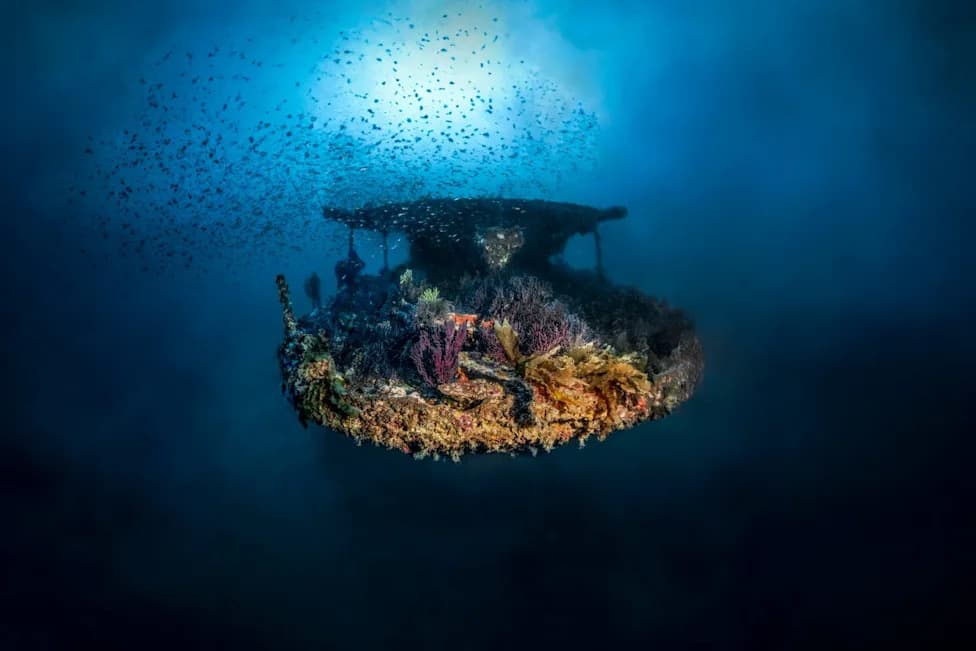
French naval teams conducting a routine seabed survey in 2025 accidentally discovered a remarkably well‑preserved 16th‑century merchant ship roughly 1.5 miles off the coast of Ramatuelle. Resting at about 8,200 feet (≈2,500 meters) below the surface, the wreck — now designated Camarat 4 — is the deepest shipwreck ever recorded in French territorial waters.
How It Was Found
The Maritime Prefecture of the Mediterranean reported that an unusual sonar return prompted further investigation. The French Navy's Expert Center for Human Diving and Underwater Intervention and the Department of Underwater and Submarine Archaeological Research first deployed an A18D deep‑sea autonomous underwater vehicle (AUV) to obtain initial visuals. Those images led to a follow‑up inspection with a remotely operated vehicle (ROV) that produced high‑resolution photographs and detailed site mapping.
"The sonar detected something quite big, so we went back with the device's camera, then again with an underwater robot to snap high‑quality images," said Thierry de la Burgade, deputy maritime prefect, according to Agence France‑Presse.
What the Teams Found
Survey measurements indicate the hull is more than 98 feet (30 meters) long and about 23 feet (7 meters) wide. The cargo appears to be largely intact beneath sediment: at least 200 globular earthenware pitchers with pinched spouts and ribbon handles, roughly 100 yellow plates, anchors, cannons and two cauldrons. Several pitchers bear the monogram "IHS" — a Christogram historically used to represent Jesus Christ — and decorative motifs likely inspired by plant forms.
Officials described the ceramics as typical of 16th‑century Ligurian production, suggesting the vessel was sailing southwest from Liguria (present‑day northern Italy) when it sank. Because of the wreck's extreme depth, it remained largely undisturbed by salvage or looting, preserving a valuable archaeological assemblage.
Why It Matters
"Camarat 4 is a remarkable discovery due to its depth, its unprecedented nature, and the opportunity it offers to study a virtually intact 16th‑century complex," the investigative team wrote. Arnaud Schaumasse, head of the culture ministry's underwater archaeology department, called it the deepest wreck ever found in French territorial waters.
Authorities plan to create a comprehensive 3D digital model using photogrammetry, return for targeted sampling of select artifacts, and work with maritime archaeology experts for multidisciplinary analysis. By combining remote sensing, AUV and ROV imagery, and careful sampling, researchers hope to learn more about 16th‑century Mediterranean trade routes, ship construction methods and cargo distribution.
Next Steps
Planned activities include expanded photogrammetry of the hull and surrounding seabed, targeted recovery of select objects for conservation and study, and collaborative research with specialists in ceramics, naval architecture and maritime history. Given the wreck's depth and preservation, Camarat 4 offers a rare window into early modern seafaring and commerce.
Help us improve.