
U.S. District Judge Sharion Aycock has refused, for now, to block majority-Black judicial subdistricts in DeSoto County after a lawsuit by Robert Foster, a county supervisor and former GOP gubernatorial candidate. Foster challenged the subdistricts following the Supreme Court’s Louisiana v. Callais decision, which limited consideration of race in redistricting. Voting-rights groups say the ruling preserves the county’s only district that gives Black voters a realistic chance to elect their preferred candidates. Plaintiffs can still present new evidence or file fresh litigation.
Federal Judge Keeps DeSoto County’s Majority-Black Judicial Subdistricts Intact — For Now
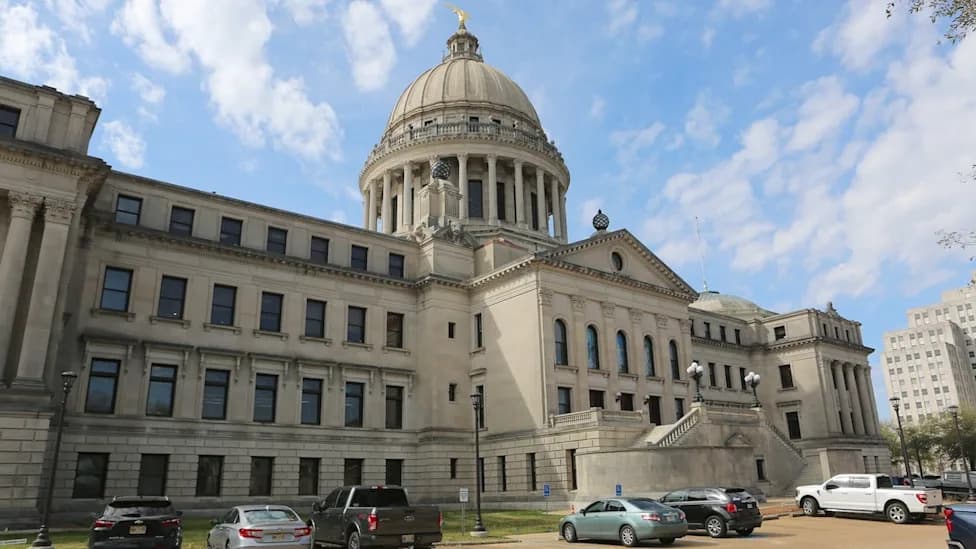
JACKSON, MS - MARCH 11: The Mississippi State Capitol Building is displayed on March 11, 2022 in Jackson, Mississippi. (Photo by Peter Forest/Getty Images for MoveOn & Emmett Till Legacy Foundation)
A federal judge has refused, at least temporarily, to block majority-Black judicial subdistricts in DeSoto County, Mississippi, rejecting a last-minute challenge filed by Robert Foster, a DeSoto County supervisor and former Republican candidate for governor.
Foster's July lawsuit argued that the county’s newly drawn judicial subdistricts violated the Voting Rights Act and asked the court to invalidate the districts so voters would not elect two new county judges ahead of the November elections. The filing came in the wake of the U.S. Supreme Court’s decision in Louisiana v. Callais, a ruling that critics say has constrained the use of race in redistricting and weakened some protections under the Voting Rights Act.
U.S. District Judge Sharion Aycock declined to intervene so close to the election, writing that changing district lines now would be disruptive and that the plaintiffs had not presented sufficient evidence to justify immediate court action.
“The Plaintiffs have not provided sufficient evidence to justify this Court's involvement,” Judge Aycock wrote, citing Supreme Court precedent about judicial intervention near elections.
Voting-rights advocates praised the decision. The Legal Defense Fund said the ruling preserves “the only judicial district in the county that gives Black voters a meaningful opportunity to elect candidates of their choice.” Ming Cheung, a senior staff attorney with the ACLU Voting Rights Project, added that the ruling prevents an “unfounded, last-minute attempt to take away [Black voters'] only meaningful opportunity to participate in judicial elections.”
The plaintiffs argued that when the Mississippi Legislature redrew state judicial districts it added an additional circuit judge and an additional chancery judge for DeSoto County whose elections must be held from majority-Black subdistricts. The lawsuit named the three-member State Board of Election Commissioners — Governor Tate Reeves, Secretary of State Michael Watson and Attorney General Lynn Fitch — as defendants.
DeSoto County, on Mississippi’s northwestern border, is the state’s third-most-populous county and voted for Donald Trump by more than 60% in 2024. Historically, no Democratic presidential candidate has carried DeSoto County since 1976.
Although the ruling is being hailed by voting-rights groups as a victory for Black voters in the county, it is not necessarily final. Plaintiffs may present new evidence or file new litigation, and Judge Aycock could revisit the matter if additional facts are submitted.
What Happens Next: The case could return to federal court if plaintiffs submit further evidence or refile their challenge. Meanwhile, state lawmakers continue to redraw legislative maps to reflect population changes, and the role of race in drawing districts remains a subject of litigation after the Supreme Court’s decision in Louisiana v. Callais.
Help us improve.





















