
James Webb’s mid-infrared observations of IRS 3, a star about 0.55 light years from Sagittarius A*, reveal oxygen-rich dust and spectral evidence of water. Researchers used Webb’s MIRI instrument and radiative-transfer simulations to reconstruct the star’s dusty envelope. The finding — the first detection of water for this class of object near the Galactic Center — shows that molecular material can survive intense radiation and that aging stars there may still supply ingredients for future star and planet formation.
James Webb Image Reveals Water Can Survive Near the Milky Way’s Central Black Hole
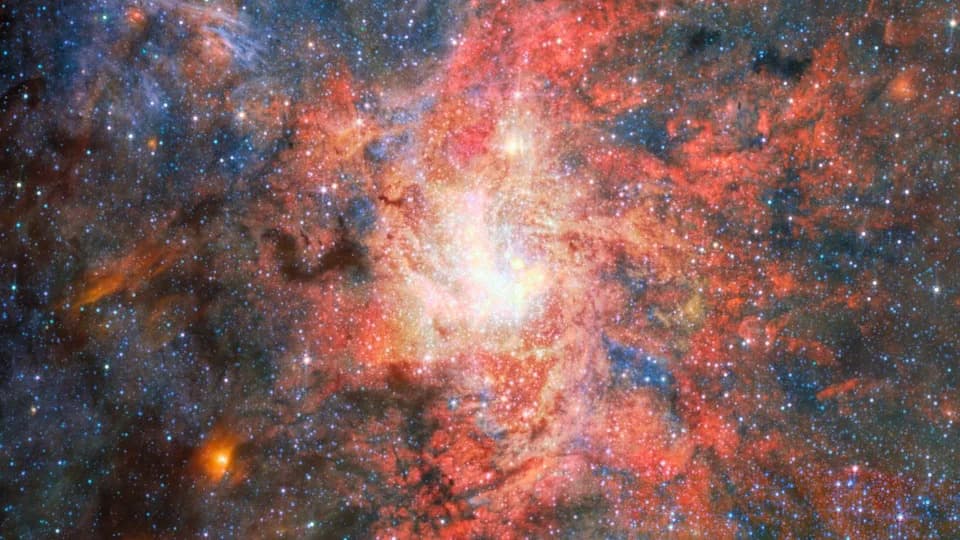
Credit: ESA/Webb, NASA & CSA, F. Peißker, J. Lu, F. Yusef-Zadeh, N. B. Sabha, C. Chan
A striking mid-infrared image from the James Webb Space Telescope does more than dazzle — it provides evidence that water-bearing, oxygen-rich material can persist unusually close to the supermassive black hole at the center of our galaxy.
What Webb saw: The image focuses on a star known as IRS 3, about 0.55 light years from Sagittarius A*, the Milky Way’s central black hole. Using Webb’s Mid-Infrared Instrument (MIRI) — which can peer through dust — researchers detected signatures consistent with oxygen-rich dust and the presence of water in the star’s surrounding envelope.
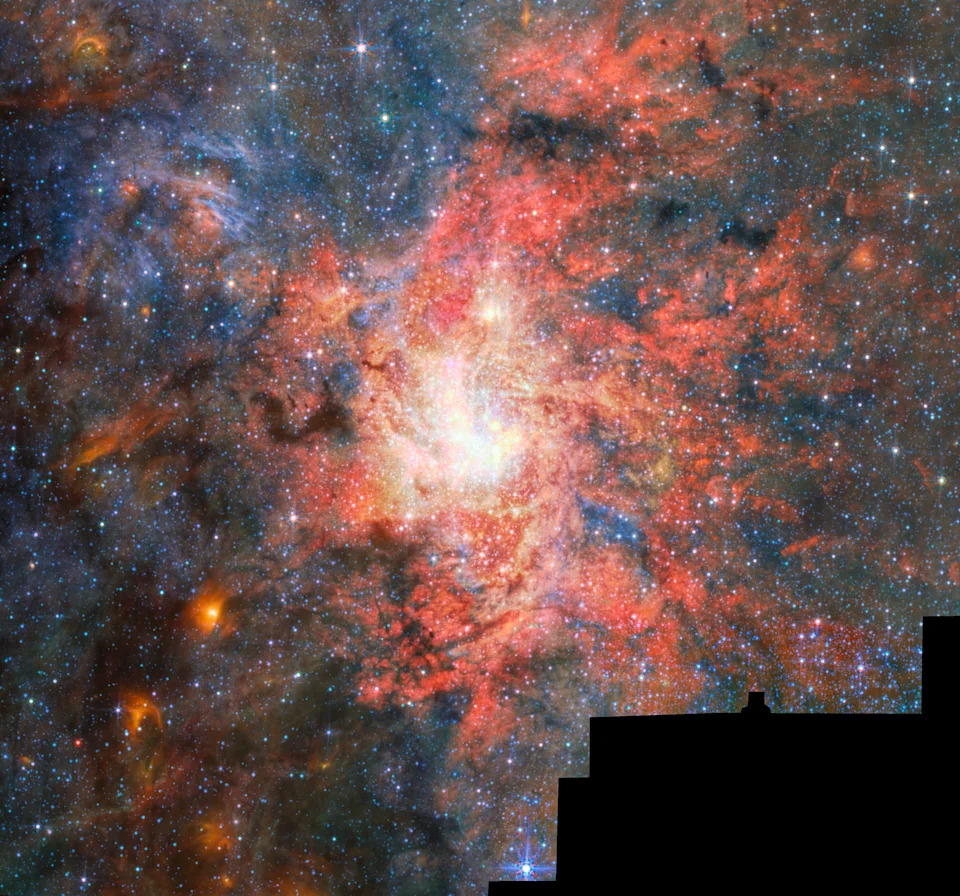
Credit: ESA/Webb, NASA & CSA, F. Peißker, J. Lu, F. Yusef-Zadeh, N. B. Sabha, C. Chan
How the team reached this conclusion
The international team combined Webb’s mid-infrared observations with detailed radiative-transfer simulations that model how light travels through and is emitted by dusty, molecular envelopes. Earlier studies had attributed IRS 3’s strong mid-infrared glow to carbon-rich dust; the new analysis instead favors an oxygen-rich composition and finds spectral evidence for water — a first for this type of object near the Galactic Center.
"The detection of water is especially exciting because it shows that molecular material can survive in an environment dominated by intense radiation," said Macarena Garcia Marin of ESA, a co-author of the study. "This tells us that even close to a supermassive black hole, stars can continue contributing material back into their surroundings."
Why this matters
IRS 3 sits in a hostile region with a high density of stars and strong ultraviolet and X-ray radiation from the Galactic Center. Finding oxygen-rich dust and water there implies that molecular and solid materials are more resilient to extreme conditions than previously thought. As an evolved, late-stage star, IRS 3 may be returning oxygen and water to its environment — ingredients that could later contribute to the formation of new stars and planets even in the central regions of the galaxy.
Image credit: ESA/Webb, NASA & CSA; F. Peißker, J. Lu, F. Yusef-Zadeh, N. B. Sabha, C. Chan
Help us improve.





















