
The James Webb Space Telescope's latest image — named Picture of the Month by NASA, the Canadian Space Agency and the European Space Agency — reveals a glowing orange cometary globule nicknamed the "treasure chest." The structure contains about 70 stars, including an O-type star roughly 19 times the mass of the Sun, and a cluster age of about 1.3 million years. Located in the Carina Nebula ~7,500 light-years away, the shape has been partly carved by radiation and winds from nearby massive systems such as Eta Carinae and Trumpler 16.
James Webb's Stunning 'Treasure Chest': A Colorful Cometary Globule Brimming With Young Stars
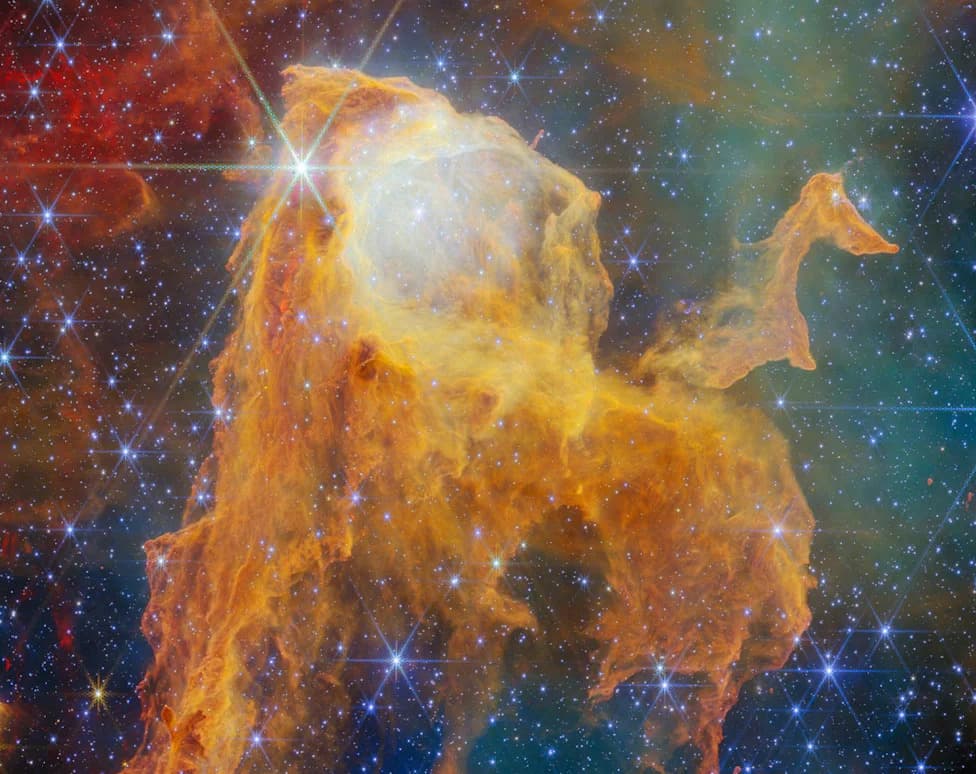
The James Webb Space Telescope has delivered a breathtaking new image — selected as Picture of the Month by NASA, the Canadian Space Agency and the European Space Agency — that reveals a glowing orange structure nicknamed the "treasure chest." At its center is a cometary globule: a vast, comet-shaped cloud of gas and dust illuminated from within by newly forming stars.
What Is a Cometary Globule? Cometary globules get their name from their comet-like appearance: a dense, darker head with a fainter trailing tail. They are not actual comets but rather compact clouds sculpted by radiation and stellar winds. In this image, the globule's rounded head resembles the lid of an open box, while dozens of bright protostars peek out from inside the trunk.
Stars Hidden Inside the Chest Astronomers estimate roughly 70 stars reside within this structure, including an unusually large O-type star about 19 times the mass of the Sun. These O-type stars are extremely massive, hot and luminous, so they attract close scientific interest. The star cluster's age is estimated at about 1.3 million years, meaning these objects are still young and emerging through the surrounding dust.
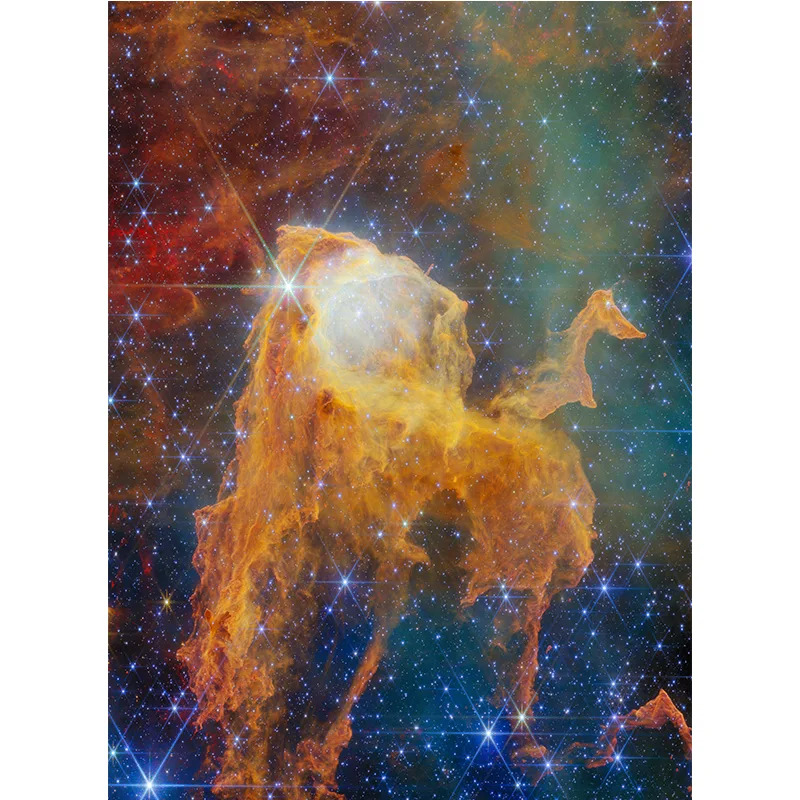
Credit: ESA/Webb, NASA & CSA, M. Reiter
Where It Sits The feature is part of the Carina Nebula, located in the constellation Carina about 7,500 light-years from Earth. The Carina Nebula is a vast and complex star-forming region first cataloged in the 18th century, and this globule is one of five targets currently observed by Webb in the area.
Shaped by Powerful Neighbors The chest-like silhouette is not only the result of internal star formation: external forces have carved the shape as well. Intense radiation and stellar winds from the nearby Eta Carinae system (approximately 39 light-years to the northwest in projected distance) and the Trumpler 16 cluster are stripping away lighter dust and gas. For context, one star in the Eta Carinae system is estimated to be roughly 100 times the Sun's mass and several million times as luminous — enough to sculpt and erode neighboring clouds over time.
Why It Matters Images like this showcase the dynamic processes of star birth and the interplay between newborn stars and their environment. They help astronomers study how massive stars form, how clusters evolve, and how feedback from bright neighbors sculpts the interstellar medium.
Credit: ESA/Webb, NASA & CSA, M. Reiter
Help us improve.





















