The U.S. received multiple Israeli warnings that Iran planned plots to kill President Trump, but U.S. agencies, including the CIA, could not independently verify many of the claims. Reported threats ranged from sniper and knife attacks to a shoulder‑launched missile threat during a NATO trip to Ankara. Despite limited corroboration, the White House and Secret Service took precautionary measures, including an aircraft switch in Turkey. The case highlights differences between U.S. and Israeli threat assessments and strains in U.S. intelligence coordination.
U.S. Unable To Independently Verify Israeli Warnings Of Alleged Iranian Plots Targeting Trump, Officials Say
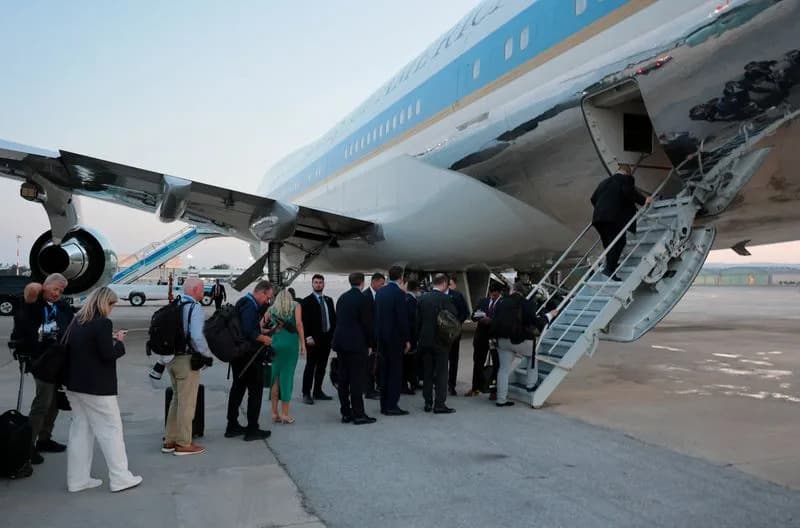
FILE PHOTO: People board Air Force One carrying U.S. President Donald Trump, en route to Washington after his participation in the NATO leaders' summit, at Ankara Esenboga Airport in Ankara, Turkey, July 8, 2026. REUTERS/Jonathan Ernst/File Photo
The U.S. received repeated warnings from Israeli intelligence over the past year that Iran intended to target President Donald Trump, but U.S. agencies — including the CIA — were unable to independently corroborate many of those claims, current and former U.S. officials told Reuters.
Allegations and Specific Warnings
Sources said the tips relayed to U.S. intelligence and in some cases delivered directly to senior White House officials described a range of possible plots, from a sniper attack to recruiting an assailant to stab Trump at a large public event. The most detailed warning reportedly arrived before the NATO summit in Ankara, when Israeli briefers said Iran might try to strike while Trump traveled on Air Force One, potentially using a shoulder‑launched missile.
Verification and Third‑Party Assessments
U.S. officials told Reuters that the Central Intelligence Agency could not corroborate several of the specific threats shared by Israeli sources since early last year. A Turkish official said Turkey's intelligence services also had no evidence to support the reported NATO‑summit threat and relayed that assessment to U.S. counterparts.
Operational Precautions
Despite the lack of independent confirmation, White House officials and the U.S. Secret Service took precautionary steps. Among those measures was an unusual deception operation in Turkey that involved moving the president from Air Force One to a different aircraft for his departure. Secret Service spokesman Anthony Guglielmi said the agency "continuously analyzes a wide range of information to guide our protective operations in real time and across every location we secure."
Intelligence Context and Internal Strains
The reporting highlights both the influence of Israeli intelligence on the Trump administration's Iran policymaking and broader differences between U.S. and Israeli threat assessments. U.S. intelligence has long judged that Iran seeks retaliation for the 2020 killing of Qassem Soleimani, but earlier this year U.S. agencies assessed Iran was not actively building a nuclear weapon — a conclusion that diverged from some Israeli warnings.
Officials described occasions when the CIA rated Israeli reporting about Iran as "low confidence," including some alleged assassination plans. The story also sheds light on frictions inside the U.S. intelligence community: last year the CIA reduced some coordination with the National Intelligence Council, resulting in fewer comprehensive community‑wide assessments on issues such as Iran.
Responses From Officials
An Israeli embassy spokesperson pushed back against suggestions that intelligence sharing was intended to influence U.S. policy, saying critics would just as readily accuse Israel of concealing information to suit their own agendas. The White House and CIA declined to comment for the report. Reuters reported the story from Washington, citing Erin Banco with additional reporting by Humeyra Pamuk.
Why it matters: The episode demonstrates how allied intelligence reports can shape U.S. protective and policy decisions even when those reports cannot be independently verified, and it underscores the operational and analytical challenges at the center of U.S.-Israeli cooperation on Iran.
Help us improve.