
NASA's James Webb Space Telescope has produced high-resolution NIRCam and MIRI images of NGC 2392, the Lion Nebula, revealing a face-like ionized gas bubble and a dusty "mane" shaped by a central white dwarf. Webb's observations show fine dust structures, with some filaments being eroded by the star's radiation while others survive. Astronomers estimate the nebula will disperse in roughly 10,000 years, and these images offer a detailed snapshot of planetary-nebula evolution.
Webb Reveals a 'Lion' Face in Stunning New Images of NGC 2392
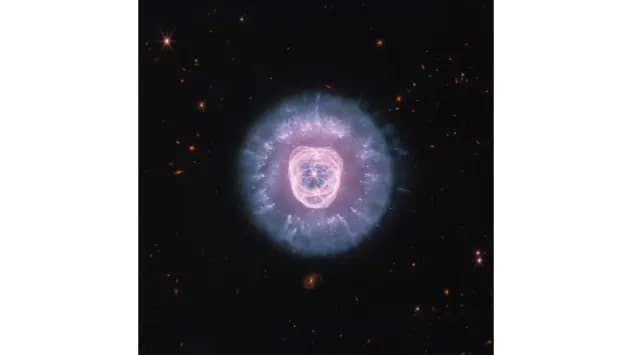
NASA's James Webb Space Telescope imaged the planetary nebula NGC 2392, the Lion Nebula, using the observatory's NIRCam and MIRI instruments. The central star's remains are responsible for the nebula's structure, including a lion face-shaped bubble of ionized gas and dust "mane." (Credit: NASA, ESA, CSA, STScI; Image Processing: Alyssa Pagan (STScI))
Dazzling new observations from NASA's James Webb Space Telescope have captured breathtaking views of NGC 2392, popularly known as the Lion Nebula. Webb's Near-Infrared Camera (NIRCam) and Mid-Infrared Instrument (MIRI) reveal a striking face-like bubble of ionized gas and a hazy dust "mane" surrounding a bright, dying central star.
What Webb Shows
The nebula's nickname comes from the appearance of its inner dust shell, which resembles a mane, and a bright central remnant that looks like a button nose. Webb's higher resolution compared with earlier Hubble images uncovers finer structure in both gas and dust and shows the nebula in a dynamic stage of change.
How the Lion Formed
When a star can no longer sustain nuclear fusion, it pulsates and sheds its outer layers, creating expanding shells of gas and dust known as a planetary nebula. The hot stellar core left behind becomes a white dwarf. In NGC 2392, that white dwarf is heating and ionizing material inside the shell, producing the bubble that forms the lion-like face and gradually eroding dust along its path.
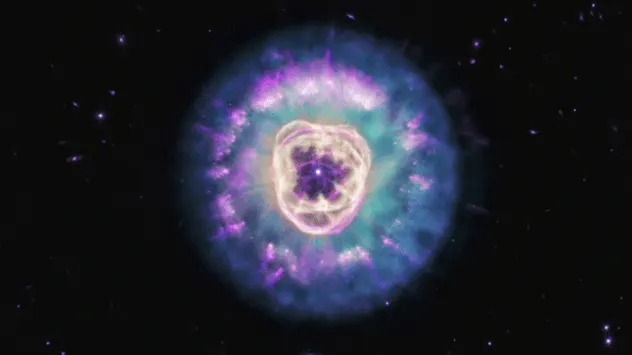
NASA's James Webb Space Telescope's mid-infrared image of planetary nebula NGC 2392, nicknamed the Lion Nebula, highlights the varying dust structures. Some dust is being destroyed by the dying central star's radiation, while some dust filaments manage to survive. (Credit: NASA, ESA, CSA, STScI; Image Processing: Alyssa Pagan (STScI))
Dust, Destruction, and Survival
Webb's mid-infrared images highlight contrasting dust structures: some filaments are being destroyed by the central star's harsh radiation while other strands remain intact. These observations give astronomers a clearer picture of how stellar remnants sculpt and disperse nebular material over time.
Timescale and Context
Astronomers estimate the Lion Nebula will disperse in roughly 10,000 years — a brief interval in cosmic terms. Webb's snapshot provides both a visually striking image of stellar death and a valuable data point for studying the evolution of planetary nebulae.
Mission Note: The James Webb Space Telescope launched in December 2021 and reached the Sun–Earth L2 point in January 2022. These images combine NIRCam and MIRI data and include image-processing work by Alyssa Pagan (STScI). (Credit: NASA, ESA, CSA, STScI)
Help us improve.





















