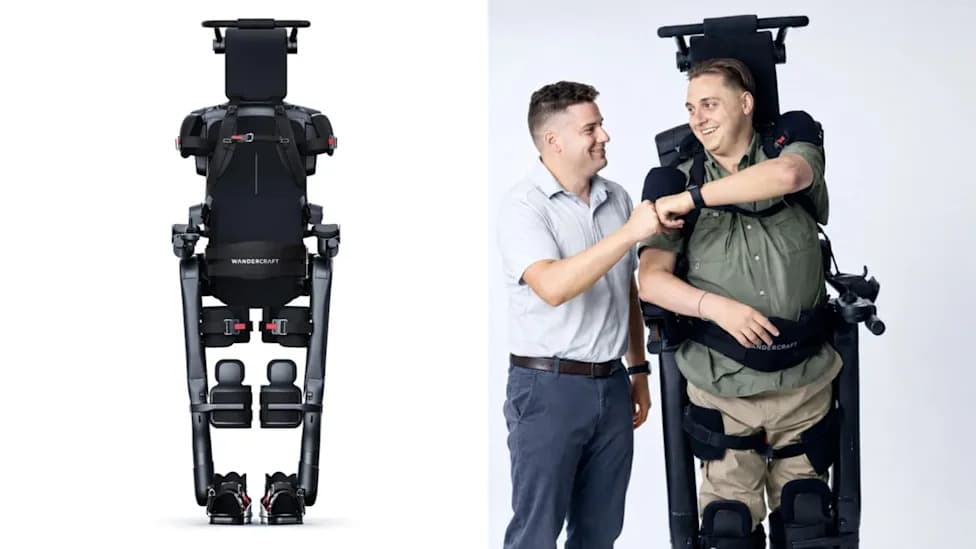
Wandercraft’s Eve, a self‑balancing standing exoskeleton for wheelchair users with spinal cord injuries, has won FDA clearance after a three‑site clinical trial reported safety and user‑reported benefits including improved endurance, reduced spasticity and better sitting balance. Backed by a $75 million Series D closed in June 2025, the company plans a US launch in September 2026. Medicare reimbursement is available for eligible users under DMEPOS billing code K1007.
Wandercraft’s Eve Wins FDA Clearance: Self‑Balancing Exoskeleton Approved for Personal Use

Wandercraft’s self-balancing exoskeleton wins FDA clearance
Wandercraft has received US Food and Drug Administration (FDA) clearance for Eve, its self‑balancing standing exoskeleton designed to support upright mobility for wheelchair users with spinal cord injuries.
Building on the company’s Atalante X rehabilitation platform—already used in more than 150 rehabilitation and research centres—Eve is intended to complement, not replace, a wheelchair by expanding opportunities to stand and interact with the environment. The device uses motorised joints and advanced stabilisation algorithms to maintain balance automatically, while users control direction with a handheld controller.
Clinical Evidence and Trial Results
The FDA decision was supported by a three‑site clinical trial that enrolled people with a range of spinal cord injury severities. The trial emphasised safety, functional performance, training, and readiness for personal use. Participants completed structured training and then undertook functional, usability, and task‑based assessments that reflected likely everyday activities.
By the end of the study, participants reported improvements in several measures of daily life: overall health status, psychological well‑being, endurance during daily tasks, reduced lower‑limb spasticity, and better sitting balance. Some participants also reported improved sleep and improvements in bladder and bowel function, Wandercraft said.
Gail Forrest, director of the Tim and Caroline Reynolds Center for Spinal Stimulation at Kessler Foundation (one of the trial sites), said: "What makes these findings meaningful is that the technology was evaluated not only on engineering performance but also on how users and companions could safely integrate it into real‑world activities. The combination of functional performance, usability, and user‑reported outcomes gives this technology substantial clinical relevance."
Commercial Rollout and Reimbursement
Wandercraft closed a $75 million Series D financing round in June 2025 to support Eve’s regulatory and commercial pathway and plans a US launch in September 2026. Medicare has provided a reimbursement pathway for eligible personal exoskeleton users since 2024 under the Durable Medical Equipment, Prosthetics, Orthotics, and Supplies (DMEPOS) programme using billing code K1007.
To prepare for market launch, Wandercraft has partnered with rehabilitation and complex rehabilitation technology providers, including New York‑based Walk US and Pennsylvania’s Good Shepherd Rehabilitation, to raise clinical and commercial awareness and support distribution and training.
Matthieu Masselin, CEO of Wandercraft, said: "FDA clearance of Eve marks one of the most important moments in Wandercraft's history and a significant step for the people, families, clinicians, researchers, and partners who helped make it possible."
Market Context
Wandercraft joins several companies developing personal exoskeletons. ReWalk, a Massachusetts‑based company, received FDA clearance for its first exoskeleton in 2014 and its latest model, ReWalk 7, secured clearance in March 2025.
According to the Christopher & Dana Reeve Foundation, more than five million people in the United States live with paralysis, including hundreds of thousands with spinal cord injuries—underscoring the potential relevance of devices that increase upright mobility and participation.
This article was originally produced by Medical Device Network, a GlobalData‑owned brand, and has been edited for clarity and flow.
Help us improve.