
Astronomers have for the first time confirmed three supermassive black holes in one galaxy, J0148-4214, more than 12.5 billion light-years away. Two of the black holes are close enough that researchers expect them to merge, and the third may either join later or be a remnant of a past collision. The finding, made with wavelength analysis from the James Webb Space Telescope, sheds light on early-Universe processes that grew massive black holes and informs future gravitational-wave searches.
Astronomers Find First Galaxy With Three Supermassive Black Holes — Two Are Poised To Merge
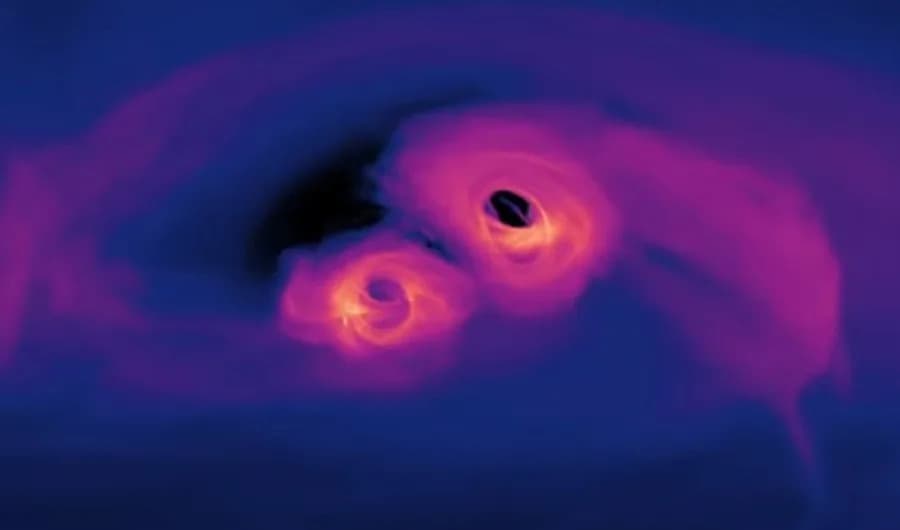
For the first time, astronomers have confirmed three supermassive black holes in a single galaxy, and at least two of them appear likely to merge, a new study reports.
The trio was detected in galaxy J0148-4214, located more than 12.5 billion light-years from Earth. Researchers identified the objects by analyzing wavelength information in images taken by the James Webb Space Telescope (JWST).
Discovery Details
Two of the supermassive black holes lie very close together and are expected to coalesce into a single, larger black hole. The third object could eventually join that merger, though researchers also caution it might be the remnant of an earlier collision.
Why This Matters
Supermassive black holes — roughly 100,000 to 10 billion times the mass of the Sun — are the largest class of black hole. When two such giants collide, they produce gravitational waves that ripple through space-time. Finding multiple massive black holes in one distant galaxy gives astronomers valuable insight into how these objects grew so large in the early Universe and helps set expectations for the kinds of mergers future gravitational-wave observatories should detect.
"It suggests that processes in the early Universe were efficient at bringing massive black holes together, setting the stage for the massive black hole mergers we expect to detect with future gravitational wave observatories," said lead study author Hannah Übler of the Max Planck Institute for Extraterrestrial Physics.
Quick FAQ
Could any of these black holes affect Earth? No. The galaxy is more than 12.5 billion light-years away, so there is no direct effect on our solar system.
What If a Black Hole Passed Through a Person? Such an event is essentially impossible in practice. Hypothetically, a black hole passing close enough to a human would create extreme tidal forces and be catastrophic, but encounters like that do not occur at the scales and distances of galaxies.
This discovery — reported using JWST wavelength data — is a milestone for studying how massive black holes assembled in the early Universe and for anticipating future gravitational-wave signals from supermassive mergers.
Help us improve.





















