Perseverance's SuperCam detected chromium-bearing corundum — the mineral that composes rubies and sapphires — in three plagioclase-rich float rocks along Jezero Crater's rim. TRL spectra showed characteristic peaks at 692.7 nm and 694.1 nm, and one sample exhibited a ~3 ms decay consistent with terrestrial corundum. The finding is chemically surprising because corundum usually forms where silicon is scarce; researchers favor formation linked to the impact that created Jezero and possible hydrothermal alteration. Confirming the origin will likely require locating the source outcrop or returning samples to Earth.
Perseverance’s Laser Finds Ruby-Like Corundum in Jezero Crater — A Surprising Mineral Discovery
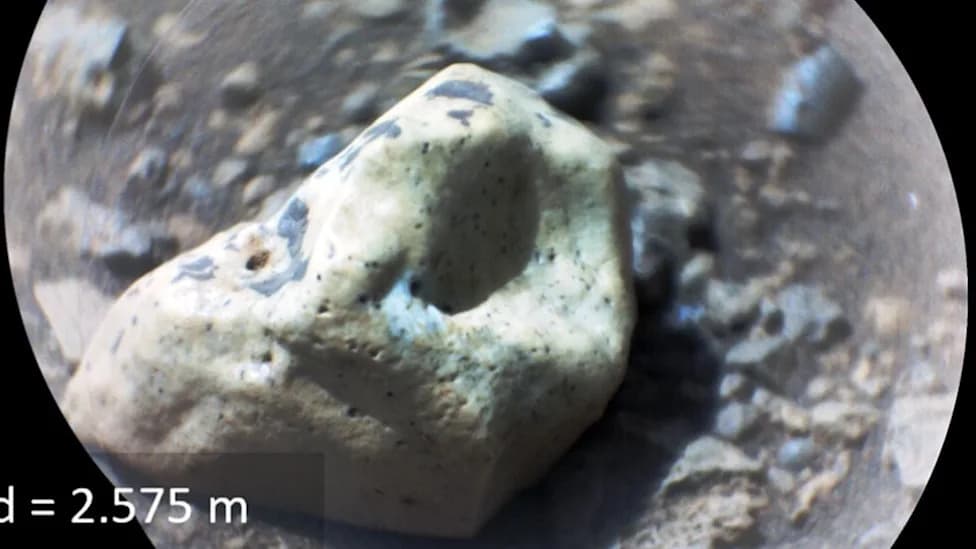
Rocks normal for Mars contained a gemstone mineral scientists didn't expect to find. (Ollila et al., Geophys. Res. Lett., 2026)
When NASA's Perseverance rover fired its SuperCam laser at pale rocks along the rim of Jezero Crater in 2025, mission scientists expected routine mineral scans. Instead, time-resolved luminescence (TRL) spectra revealed traces of corundum — the crystalline form of aluminum oxide that, on Earth, makes up rubies and sapphires.
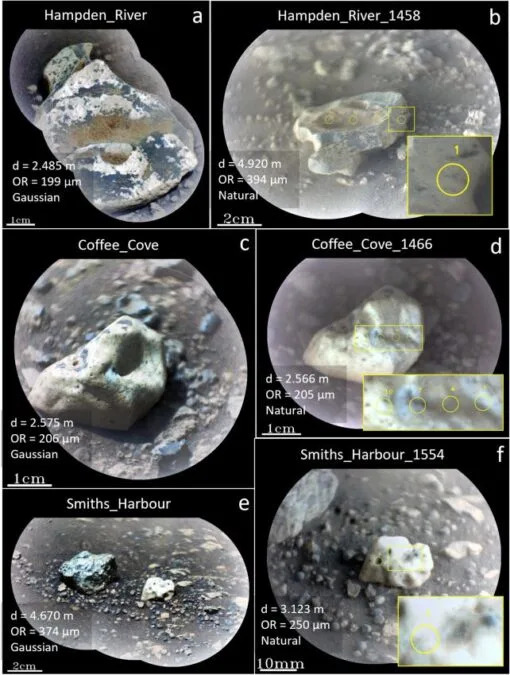
Corundum was found in three separate rocks. (Ollila et al.,Geophys. Res. Lett., 2026)
How the Discovery Was Made
Geochemist Ann Ollila and colleagues at Los Alamos National Laboratory first flagged the unexpected result in a conference abstract and have now published a full analysis in Geophysical Research Letters (2026). Perseverance examined three pale, plagioclase-rich float rocks — named Hampden River, Coffee Cove and Smiths Harbour — using TRL in March, April and July 2025. TRL uses a laser pulse to excite atoms in minerals and records the characteristic light they emit as they relax.
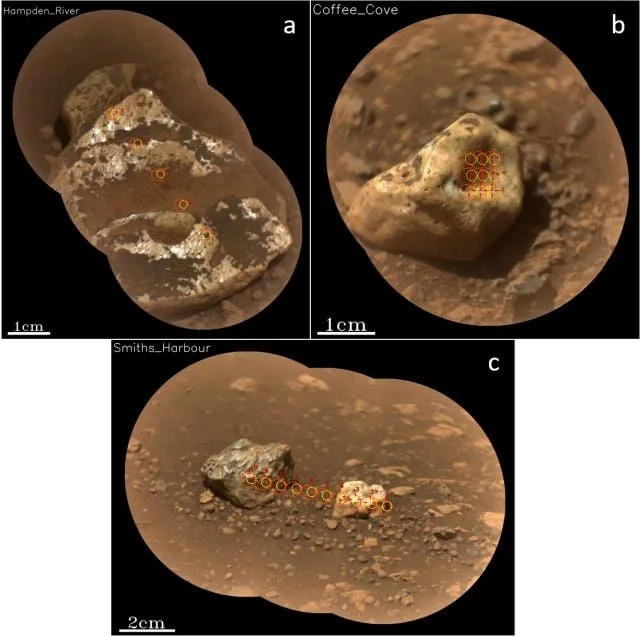
Natural-color mosaics of all three rocks. (Ollila et al.,Geophys. Res. Lett., 2026)
What the Data Shows
All three rock targets produced luminescence peaks at 692.7 nm and 694.1 nm, wavelengths characteristic of chromium-bearing corundum (the same chromium substitution that gives terrestrial rubies their color). The Smiths Harbour sample also showed a luminescence decay time near 3 milliseconds, consistent with laboratory measurements of terrestrial corundum. These signals indicate tiny grains of chromium-bearing corundum embedded within otherwise plagioclase-dominated rocks, not eye-catching gem crystals strewn across the Martian surface.
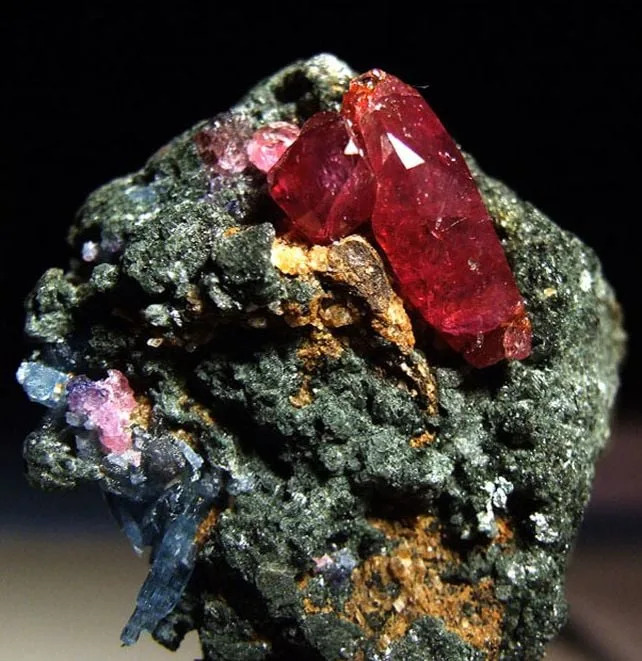
Ruby on Earth gets its brilliant hue from trace amounts of chromium. (StrangerThanKindness/Wikimedia Commons/CC BY-SA 3.0)
Why This Is Chemically Surprising
Corundum (Al2O3) typically forms where bulk chemistry is high in aluminum and low in silicon. Plagioclase feldspar is an aluminum‑silicate mineral that normally sequesters aluminum, so finding corundum grains inside plagioclase-rich rocks is chemically unexpected. The three detections from different locations along Jezero’s rim make the observation particularly intriguing.

Subscribe to ScienceAlert's free fact-checked newsletter
Possible Formation Scenarios
Ollila et al. consider several formation pathways: direct crystallization from magma, alteration by hot fluids, or production by high-pressure, high-temperature conditions generated in a large impact. The team favors a connection to the giant impact that excavated Jezero because impacts can create metamorphic environments that produce corundum; corundum has been observed in impact-modified rocks on Earth and the Moon. Local hydrothermal alteration could also have produced aluminum-rich, silicon-poor conditions favorable to corundum formation.
Implications and Next Steps
Although the TRL detections are compelling, they remain remotely measured signatures of very small grains. Definitive answers about formation processes require locating the source outcrop for the float rocks or returning samples to Earth for laboratory analysis. The authors note that a core from the suspected outcrop, returned by a sample‑return mission, would enable a much wider suite of tests and could clarify how this corundum formed — shedding light on Jezero’s geological and impact history.
Bottom Line: This is the first identification of corundum in a Martian context and suggests surprising, localized conditions in Jezero Crater that can produce aluminum-rich minerals, possibly linked to impact heating and hydrothermal activity.
Reference: Ollila et al., Geophysical Research Letters, 2026.
Help us improve.