
The North Carolina State team created a fluffy, seaweed-inspired porous mesh that captured over 90% of microplastic mass in lab tests across sizes from ~300 nm to 100 µm. A 5 mg piece of mesh removed 92% of plastic from a sample taken at Hawai'i's Kamilo Beach and held more than twice its own weight. Made from brown-algae biopolymers and shell-derived chitin, the material traps particles mechanically and via electrical attraction, but trials were done under controlled, high-concentration conditions. Researchers plan field tests and deployment trials next.
Seaweed-Inspired 'Fluffy' Mesh Captures Over 90% Of Microplastics In Lab Tests
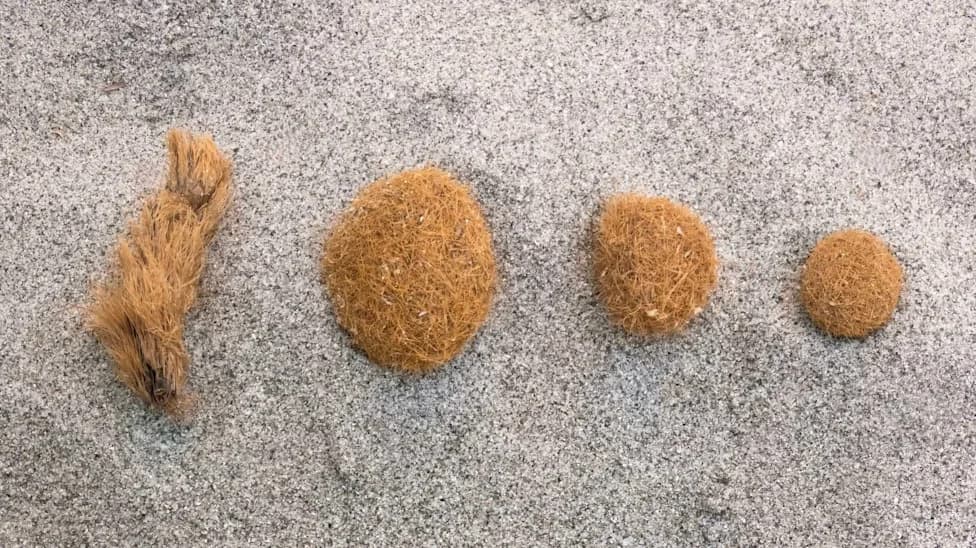
Photo Credit: iStock
Researchers at North Carolina State University have developed a soft, branched mesh modeled on tangled seagrass and drifting seaweed that captured more than 90% of microplastic mass in laboratory trials.
Nature-Inspired Design
The team, whose results were published in Science Advances, used natural blueprints—clumps of seaweed that snare debris—to design a multiscale, porous collector. By combining biopolymers derived from brown algae with chitinous material from crab and shrimp shells, they produced a lightweight, fluffy network that traps plastic in two ways: physical entanglement and electrical attraction.
Lab Performance
In controlled tests the mesh removed more than 90% of microplastic mass across particle sizes from about 300 nanometers up to 100 micrometers (roughly 0.000012 to 0.004 inches). To illustrate the material's efficiency, a tiny strip of mesh weighing approximately 0.00018 ounces (5 milligrams) removed 92% of the plastic from a sample collected at Hawai'i's Kamilo Beach and held more than twice its own weight.
"Our goal here was to develop a multiscale structure that allows us to capture the full range of plastic microparticles," said Orlin Velev, professor of chemical and biomolecular engineering and lead investigator.
Advantages and Practical Challenges
Filtering very small particles is normally difficult because fine meshes slow water flow; coarser filters allow nanoscale pieces to pass. The seaweed-inspired mesh addresses this by operating across scales, potentially enabling faster flow while still capturing both very small and larger microparticles. The material also retained particles in salty solutions comparable to seawater.
However, researchers emphasize important limitations: all experiments reported so far were performed in controlled laboratory conditions using plastic concentrations higher than those typically found in lakes or oceans. Open-water performance, durability, deployment logistics, and retrieval methods remain to be demonstrated.
Next Steps and Potential Impact
The team is exploring field deployments and concept designs such as pairing the mesh with self-dispersing cleaners that travel through water and later resurface carrying captured particles for collection. If scalable and practical in natural environments, the approach could aid efforts to protect fisheries and coastal ecosystems and reduce some impacts of plastic pollution—complementing, not replacing, strategies to cut plastic production and waste.
Bottom line: A bioinspired, biodegradable mesh shows strong promise in lab tests for trapping a wide range of microplastics, but further real-world testing is needed to confirm its effectiveness and usability at scale.
Help us improve.





















