NOAA will not coordinate the 2026 Arctic Report Card, and the National Academy of Sciences has removed a climate chapter from a judges' manual for independent review after presidential criticism. The 2025 Report Card recorded the Arctic's hottest year on record, with wide-ranging impacts from melting ice to altered global weather. Scientists warn these actions threaten access to trusted attribution science just as climate-linked litigation and policy decisions increasingly depend on it.
Imposing Ignorance: US Climate Science Under Siege After NOAA Ends Coordination of Arctic Report Card

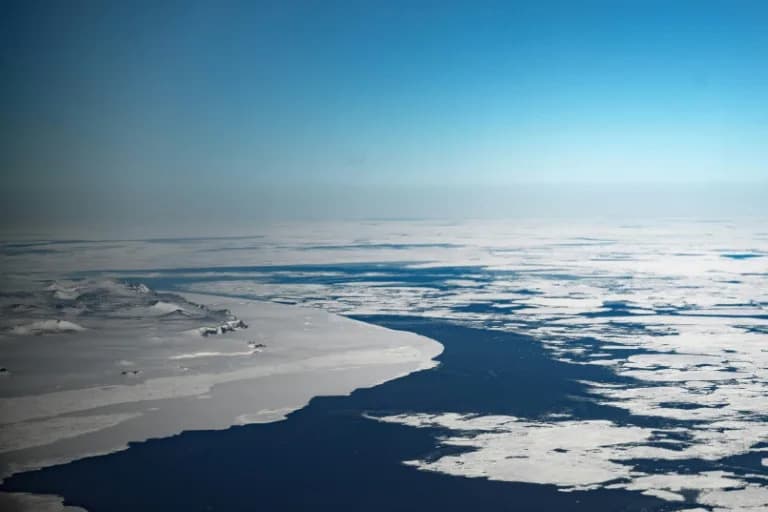
Driven by burning of fossil fuels, the Arctic is warming several times faster than the global average (Olivier MORIN)
A major US scientific assessment has been sidelined and leading research institutions have trimmed climate guidance for the courts, moves critics say are part of an escalating campaign to weaken public access to climate science. Officials announced this week that the National Oceanic and Atmospheric Administration (NOAA) will not coordinate the 2026 Arctic Report Card, even though the 2025 report — released before the cancellation — documented the Arctic's hottest year on record with cascading impacts from melting glaciers and shrinking sea ice to a greener tundra and disruptions to global weather.
"The Arctic is a bellwether of climate change," said Rick Spinrad, former administrator of NOAA. "They're imposing ignorance on the system in the hopes that that will address the challenges that are real associated with climate change."
Global Impacts
The Arctic is warming several times faster than the global average — a process known as Arctic amplification — and its changes reverberate far beyond the polar region. Loss of sea ice injects freshwater into the North Atlantic, reducing surface salinity and density and potentially weakening the Atlantic Meridional Overturning Circulation (AMOC), a major ocean current system that helps moderate Europe's climate. Scientists warn that these shifts can alter storm tracks, precipitation patterns and seasonal weather extremes across the Northern Hemisphere.
Institutional Shifts and Political Pressure
NOAA, which published the Arctic Report Card annually since 2006, provided no detailed rationale for relinquishing coordination of the 2026 edition, saying only: "Coordination of the 2026 Arctic Report Card will not be facilitated through NOAA" and that historical data will remain publicly available. Observers framed the cancellation as part of a broader pattern following mass layoffs and budget cuts in the administration's early months.
In a related move, the National Academy of Sciences (NAS) removed a chapter on climate science from a judges' reference manual after it drew public criticism from President Trump, who called the chapter "fraudulent, biased and misleading" on social media. NAS said the chapter is under independent review after coming under "considerable scrutiny," and that the review is expected to be completed this fall. The chapter's removal drew attention because the NAS had recently released a comprehensive assessment finding that attribution science — linking individual extreme events to human-driven climate change — is robust for many types of events.
Legal and Scientific Consequences
Experts warn the moves could hamper courts' access to trusted scientific guidance just as attribution science becomes central to a growing number of lawsuits against oil and gas companies. Carly Phillips, senior scientist at the Union of Concerned Scientists, described the pattern as a "broad attack on attribution science" that has included political pressure from lawmakers aiming to curb climate-related lawsuits.
The administration's policy changes also follow its rescission of the 2009 "endangerment finding," which had concluded that greenhouse gas pollution endangers human health and must be regulated — a decision that immediately rolled back federal vehicle-emissions standards and may affect future regulation of power plants amid rising demand for electricity and new natural gas projects.
Climatologist Michael Mann, co-author of Science Under Siege, said these efforts are unlikely to reverse the mounting scientific evidence or the visible effects of warming, such as heat domes and wildfires, but cautioned that political interference could slow accountability and public understanding. He warned: "But that doesn't mean they won't continue to try."
While NOAA says historical Arctic Report Card data remain publicly accessible, scientists and legal experts say the institutional changes and the NAS review raise concerns about the future availability of authoritative scientific summaries that courts, policymakers and the public rely on.
Help us improve.