
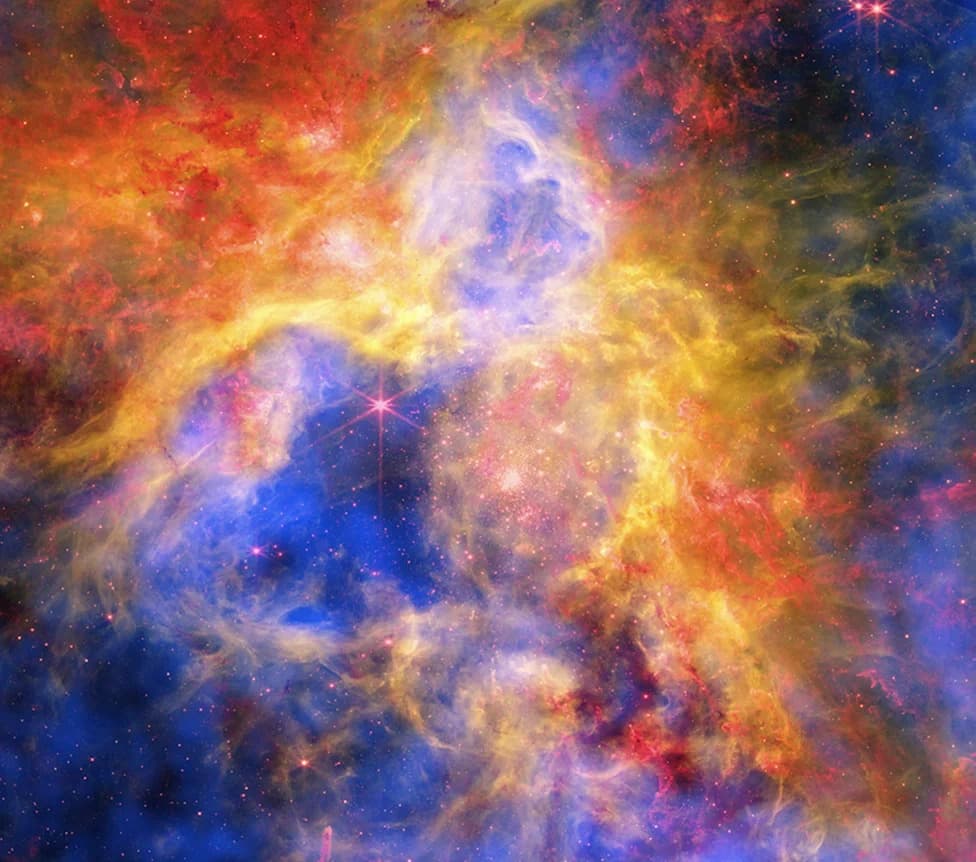
NASA has released a vivid composite image of the Tarantula Nebula (30 Doradus) that combines Chandra X‑ray, Webb infrared and Hubble optical data. The image reveals thousands of young stars set within honeycomb‑like clouds of gas and cool dust. Researchers, using these observations and archival Spitzer data, report the nebula may be losing energy through hot‑gas leakage, turbulent cooling, and thermal conduction. The multiwavelength dataset and analysis were published in the Astrophysical Journal.
NASA Unveils Vivid Composite Image of the Tarantula Nebula — Thousands of Young Stars Revealed
(NASA/ESA/CSA/STScI/Ohio St et al via SWNS)
Space scientists have released a striking new composite image of the Tarantula Nebula (30 Doradus), offering a fresh look at one of the nearest and most active star‑forming regions in the local universe.
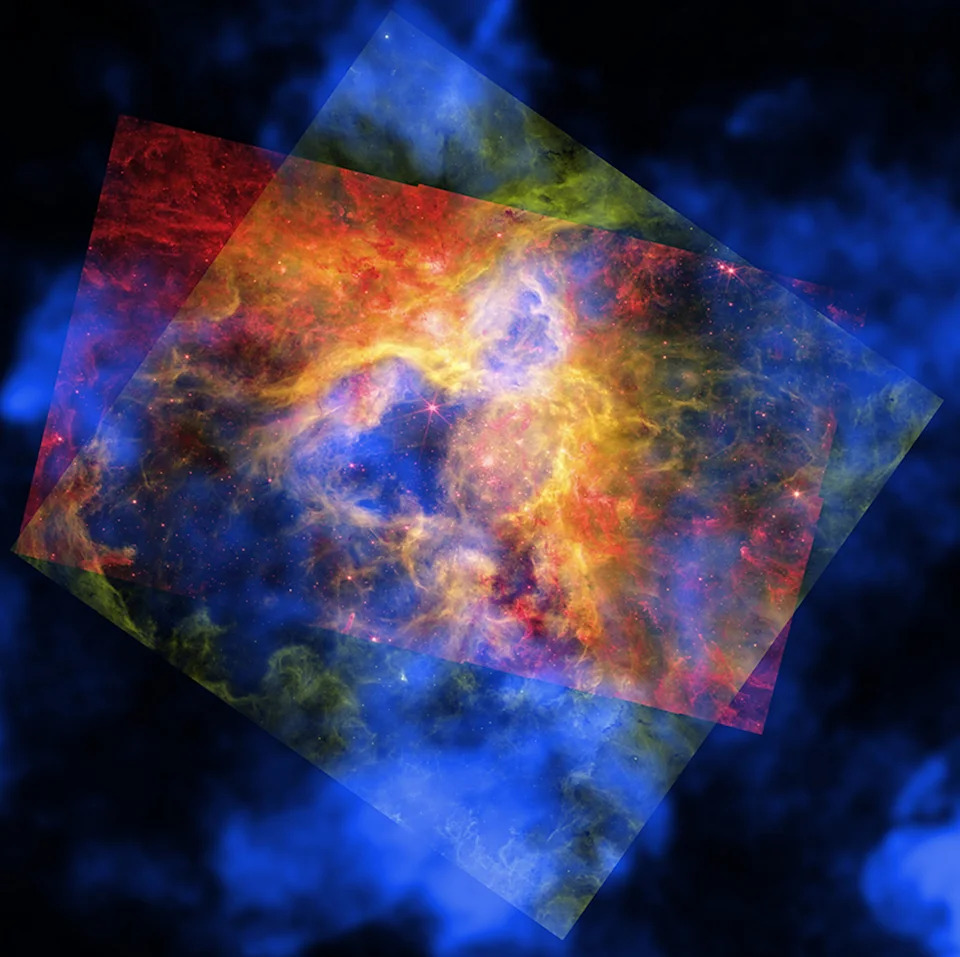
What the image shows: The colorful composite blends X-ray data from NASA's Chandra X-ray Observatory, infrared observations from the James Webb Space Telescope (JWST), and optical views from the Hubble Space Telescope. NASA described the result as "like a collage made of layered sheets of colored cellophane," a reference to the image's vivid, layered appearance.
Located in the Large Magellanic Cloud — a small companion galaxy to the Milky Way about 160,000 light‑years from Earth — the Tarantula Nebula contains thousands of young stars embedded in a honeycomb‑like structure of gas and dust. Webb's infrared data reveal many of these embedded young stars and broad swaths of cool dust that could form future stars and planets, while Chandra highlights high‑energy X‑ray emission from hot gas and energetic processes.
(NASA/ESA/CSA/STScI/Ohio St et al via SWNS)
Scientific findings: Combining the new composite with archival observations from NASA's retired Spitzer Space Telescope, researchers published a study in the Astrophysical Journal concluding that the Tarantula Nebula appears to be losing energy through multiple mechanisms. The team reports that energy is dissipated as up to half of the hot gas leaks outward, turbulent mixing cools some of the remaining gas, and thermal conduction transfers heat into cooler shell material without full mixing.
These multiwavelength observations help astronomers better understand how massive star clusters shape their surroundings, regulate star formation, and drive the evolution of their host galaxies.
Image credit: NASA/ESA/CSA/STScI/Ohio State et al via SWNS
Help us improve.





















