
Aug. 12 offers a predawn six-planet alignment, an afternoon partial solar eclipse across parts of the U.S., and the Perseid meteor shower peaking into Aug. 13. A new moon will create exceptionally dark skies, improving visibility for an estimated 50–100 meteors per hour at peak. Observers should use certified solar eclipse glasses for any Sun viewing and check local NASA resources for exact eclipse times.
Aug. 12 Skywatching: Six-Planet Alignment, Partial Solar Eclipse & Perseid Peak
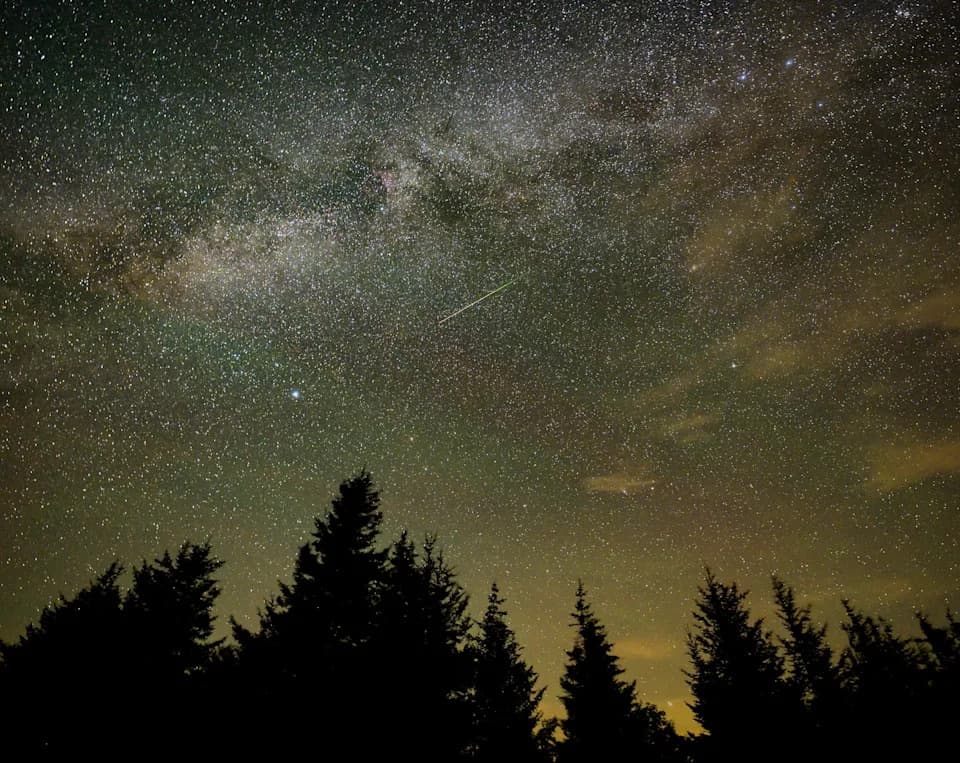
In this 30-second exposure, a meteor streaks across the sky during the annual Perseid meteor shower Aug. 11, 2021, in Spruce Knob, West Virginia. The Perseid meteor shower is expected to peak about Aug. 12-13, and with a new moon, may have optimal viewing, if skies are clear.
Wednesday, Aug. 12 promises a rare, concentrated night for skywatchers: a predawn six-planet alignment, a partial solar eclipse across parts of the U.S. in the afternoon, and the peak of the Perseid meteor shower into Aug. 13 — all under a new moon that will make the sky unusually dark.
Events To Watch
Planetary Parade (Predawn): In the hours before sunrise on Aug. 12, six planets will form a close apparent alignment. Look low toward the eastern horizon before dawn for the best view.
Partial Solar Eclipse (Afternoon): A partial solar eclipse will be visible across many U.S. states beginning around 11:34 a.m. ET, with the maximum near 1:46 p.m. ET (exact times vary by location). Observers must use certified solar eclipse glasses or a proper solar filter to view the Sun safely — never look directly at the Sun without proper protection.
Total Solar Eclipse Path: Totality on Aug. 12 will cross Greenland, Iceland, parts of Portugal and Spain, and portions of Russia. Only observers along that narrow path will see the Sun completely obscured.
Perseid Meteor Shower (Night): The Perseids peak from the evening of Aug. 12 into the morning of Aug. 13. NASA estimates the shower can produce roughly 50–100 meteors per hour at peak under ideal, dark-sky conditions; the new moon will make fainter meteors easier to spot.
Where U.S. Observers Can See a Partial Eclipse
States with partial visibility include: Alaska, Connecticut, Delaware, Illinois, Iowa, Indiana, Maine, Maryland, Massachusetts, Michigan, Minnesota, Montana, New Hampshire, New Jersey, New York, North Carolina, North Dakota, Ohio, Pennsylvania, Rhode Island, South Dakota, Vermont, Virginia, West Virginia and Wisconsin. Exact start, maximum and end times will vary by city — consult NASA or local eclipse resources for precise times in your area.
Viewing Tips & Safety
- Use certified solar eclipse glasses or a certified solar filter for any direct Sun viewing; ordinary sunglasses are not safe.
- For meteors, choose a dark location away from city lights and allow 20–30 minutes for your eyes to adapt to the dark.
- Bring a reclining chair or blanket, face toward the Perseus region (the Perseid radiant) but watch the whole sky — meteors can appear anywhere.
With a planetary alignment, a meteor shower at peak and a new-moon sky all on the same date, Aug. 12 offers one of the year’s most appealing nights for both amateur astronomers and casual stargazers.
Help us improve.





















