Colombia's recent magnitude-7.4 earthquake (about 100 km deep) and Venezuela's shallower late-June twin quakes illustrate how depth, fault motion, local ground conditions and building quality together determine earthquake impacts. Deeper quakes can be felt farther away but may dissipate energy before reaching the surface, while shallow, strike-slip events produce strong lateral forces that stress buildings. Aftershocks, soft soils and weak or informal construction increase casualties; experts call for stronger codes, better enforcement and expanded seismic monitoring and data sharing.
Explainer: Why Colombia's 7.4 Quake — And Venezuela's Twin Tremors — Were So Deadly
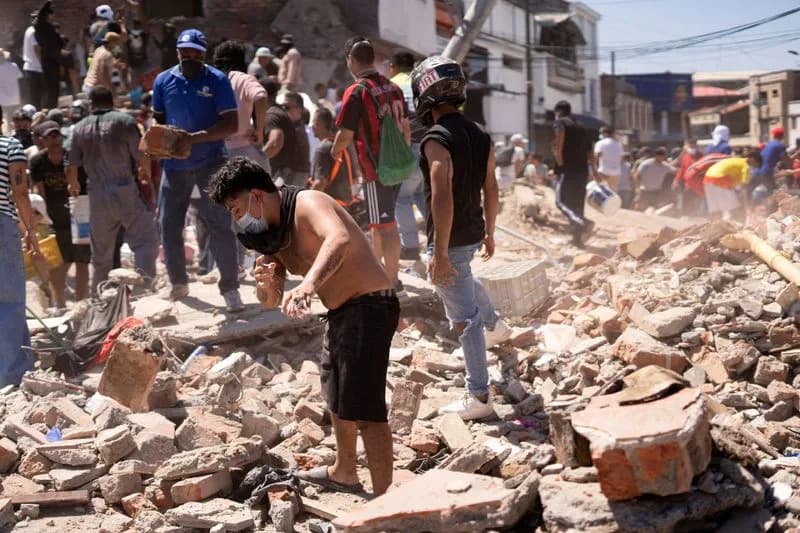
Residents dig through the debris of a collapsed building after an earthquake, in Cali, Colombia August 10, 2026. REUTERS/Camilo Rodriguez
As Colombia reels from one of the strongest earthquakes in its modern records — a magnitude 7.4 temblor that struck at an estimated 100 km (62 miles) depth and has been blamed for at least 250 deaths — scientists and emergency planners are asking why this recent cluster of powerful quakes has caused such high loss of life. The events, coming weeks after Venezuela's devastating late-June twin earthquakes, highlight how depth, fault motion, local ground conditions and construction practices together determine the human toll.
Moving Plates
Colombia and Venezuela lie along the margins of several shifting tectonic plates. Slow, persistent friction between those plates stores stress that is released periodically as earthquakes. According to German Prieto, a geologist at the National University of Colombia (UNAL), the recent Colombian quake involved the Nazca Plate subducting beneath the South American Plate far below the Earth's surface. In the Andean region the crust is roughly 40 km (25 miles) thick.
The U.S. Geological Survey put Monday's magnitude at 7.4 with an epicenter about 100 km deep. By contrast, Venezuela's late-June tremors measured about 7.2 and 7.5 but occurred at much shallower depths (under 20 km). The deeper focus in Colombia meant the quake was felt as far away as Panama, but energy had more distance in which to spread and partially dissipate before reaching the surface — a factor that likely helped prevent even more severe surface destruction.
"Colombia is a seismic country and we have to be prepared for these natural disasters," Prieto said. "You can't predict or prevent them, but their effects can be mitigated."
Motion and Magnitude
Earthquake magnitude scales are logarithmic: each whole-number increase corresponds to a large jump in released energy (roughly 30–32 times more energy per unit). For historical perspective, Colombia's strongest recorded quake was a magnitude 8.8 event off Ecuador in 1906 that unleashed about 126 times more energy than this week's Colombian quake and triggered a deadly tsunami.
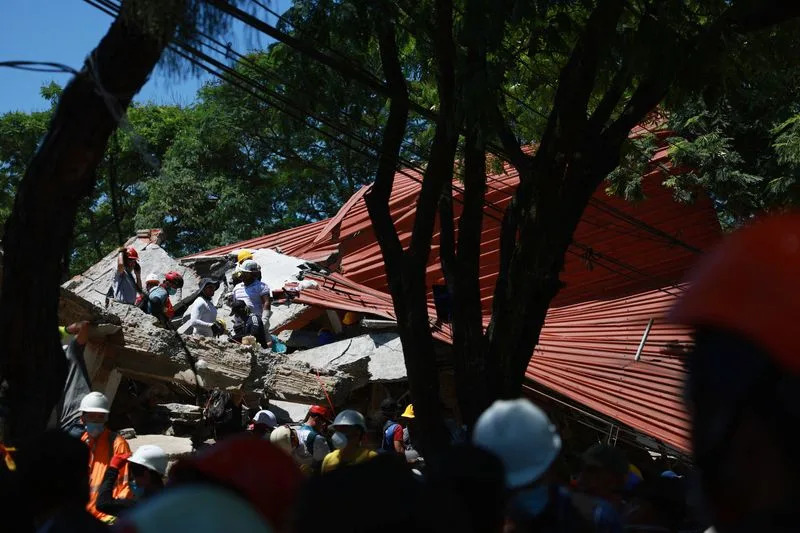
Rescue personnel work at the site of a damaged building following an earthquake, in Cali, Colombia, August 11, 2026. REUTERS/Raquel Cunha
Another crucial factor is the type of fault motion. The Colombia and Venezuela events were primarily strike-slip quakes, driven by horizontal, lateral movement along a fault. That side-to-side shaking produces strong shear forces that are especially damaging to buildings and infrastructure not designed to accommodate lateral motion.
Major earthquakes also commonly produce numerous aftershocks, which pose grave risks to people returning to damaged buildings. By Tuesday afternoon Colombia had recorded more than 100 aftershocks.
Terrain and Infrastructure
Nations that face frequent strong earthquakes, such as Chile and Japan, enforce stringent building standards and engineering practices so structures can flex and absorb shaking without collapsing. Where housing is informal or where engineering and code enforcement are weak, quakes can be catastrophic: the 2010 Haiti earthquake is estimated to have killed more than 300,000 people and caused damage equivalent to about 120% of the country's prior-year GDP.
Colombia began adopting earthquake-resistant construction methods in the 1970s and introduced its first national building code in 1984 after a destructive quake in Popayán; the current code dates to 2010. Prieto urged a careful study of this week's damage to identify ways to strengthen regulations, improve materials and increase compliance.
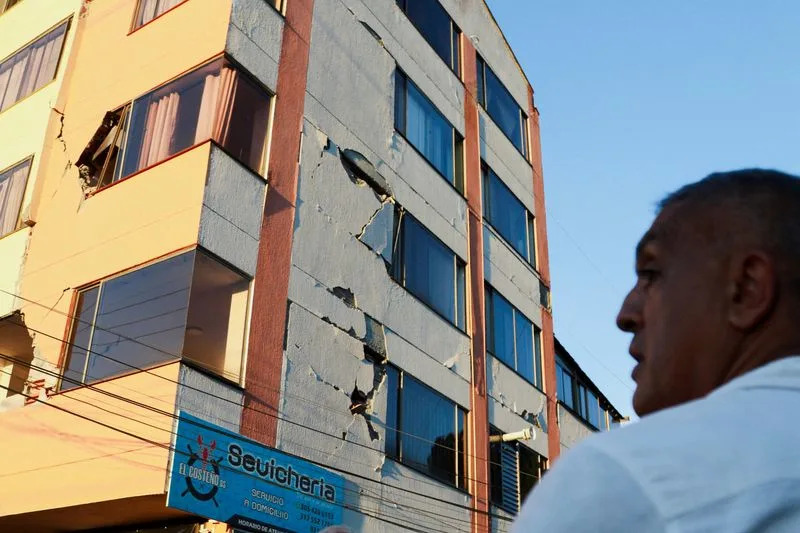
A man stands in front of a building damaged by an earthquake, in Manizales, Colombia August 10, 2026. REUTERS/Andres Camilo Valencia
Local ground conditions matter greatly. Soft or loose soils can amplify shaking: Mexico City, built on an ancient lakebed, is vulnerable even to distant quakes, and Venezuela's coastal La Guaira and Colombia's western valleys — both founded on softer ground — suffered amplified damage in recent events.
Forward Planning
Adopting and enforcing costly seismic standards is politically and economically challenging, especially in regions that rarely experience catastrophic quakes. Seismologist Suzan van der Lee of Northwestern University cautions that the historical record, while long, has not shown every possible type of shaking — and that surprises still occur.
"Our earthquake record is long but not so long that we've seen every possible type of shaking," van der Lee told Reuters. "We're often surprised when earthquakes happen in ways we haven't seen before."
Experts stress the value of expanding seismic monitoring networks, improving regional cooperation and sharing data across borders. Because plate boundaries frequently lie near political frontiers, international collaboration on seismic data and preparedness can help reduce future casualties and speed emergency responses.
What To Watch Next: post-event damage assessments, aftershock forecasts, and reviews of building-code compliance will be important to understand causes of the high death toll and to guide changes that can save lives in future earthquakes.
Help us improve.