The White House faces scrutiny after reports that President Trump was covertly moved from Air Force One amid an alleged Iranian plot while staff and journalists remained on the original jet. Critics say reporters were turned into unwitting decoys and may not have received required warnings under Intelligence Community Directive 191; defenders argue secrecy was necessary to protect the president. Lawmakers are demanding a congressional briefing to explain the intelligence, operational choices and safety measures.
Secret Air Force One Switch Sparks Outrage — Were Reporters Used as a ‘Decoy’?
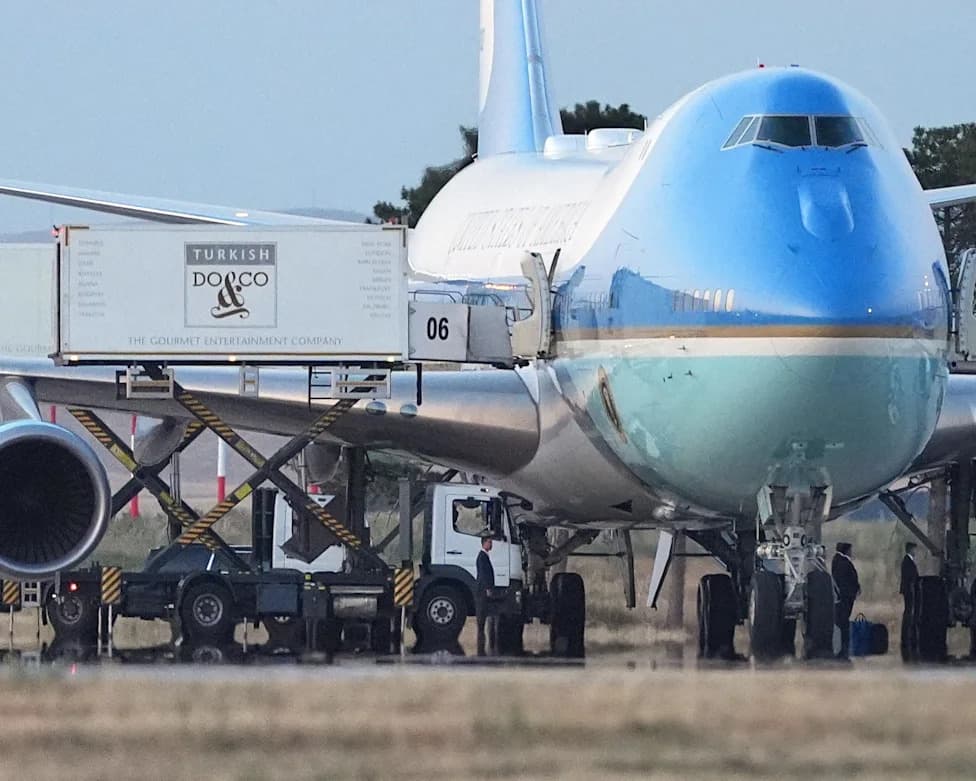
Catering trucks are parked near Air Force One as the motorcade carrying Donald Trump arrives following the Nato summit at Ankara international airport on 8 July.Photograph: Alex Brandon/AP
Democrats and press organizations are demanding answers after reports that President Donald Trump was secretly moved from Air Force One amid an alleged Iranian plot, while more than 100 aides, officials and journalists remained on the presidential jet. The episode — first reported by The Washington Post and The New York Times — has renewed questions about presidential security, transparency and the government's duty to warn civilians of credible threats.
What Happened
According to initial reporting, U.S. intelligence identified what officials judged a credible Iranian plot targeting the president. Trump was filmed boarding the presidential Boeing 747, then — shortly after — was apparently removed from the aircraft covertly (reports say inside a catering truck) and transferred to a U.S. Air Force C-32A. The smaller plane landed at RAF Mildenhall in Britain at about 10:20 p.m.; the older Air Force One and the travelling press pool arrived minutes later. Reporters aboard the 747 were reportedly instructed to keep their window shades closed during the flight.
Reaction And Key Questions
Critics say the operation effectively used staff and journalists as a decoy and that reporters were not given the information needed to make informed safety decisions. Steven Cash, a former CIA officer, said the tactic suggested officials reduced the president's risk at the expense of others. Senator Richard Blumenthal and other Democrats have called for a congressional briefing to determine what precautions were taken for those who remained onboard.
'If people on that plane were not warned, it may have violated Intelligence Community Directive 191, the government's "duty to warn" policy,' Cash said.
Defenders contend that protecting the president can require secrecy and deception. Former White House press secretary Ari Fleischer and others praised the Secret Service and military for following procedures they say are intended to safeguard the commander-in-chief.
Experts Weigh In
Analysts disagree about the threat's credibility and feasibility. Some national-security experts say an attempt by Iran to strike a presidential aircraft in Turkey would be logistically difficult without close clandestine operators and man-portable air-defense systems. Others, including former diplomats with experience of Air Force One operations, say the secrecy suggests serious intelligence that warranted extraordinary steps.
Legal And Ethical Issues
Observers have pointed to Intelligence Community Directive 191 (ICD 191), which requires agencies to warn people who are the specific targets of credible threats. The directive allows waivers where warnings would jeopardize sources or operations; critics say using people as a deliberate decoy stretches or contravenes that policy unless a narrow waiver applied and was justified. Questions also remain about the order of operations: whether the decoy aircraft was launched unaware of the president's removal, or whether the move was coordinated so no one was knowingly put at risk.
Broader Implications
The episode has broader implications for press access and trust: journalists say being kept in the dark about potential danger undermines their ability to assess personal risk. Lawmakers and press-freedom advocates are pushing for a full explanation, and some officials have called for a classified congressional briefing to account for the intelligence and operational choices.
Timeline Summary: initial reporting by leading outlets; covert transfer to C-32A; landing at RAF Mildenhall; appearance of Trump exiting the 747 after the two planes converged; public confirmation by the president that he switched aircraft; continuing debate over motives, methods and legal obligations.
The White House has acknowledged the plane switch but continues to defend the secrecy as a necessary security measure. The controversy is likely to intensify calls for oversight and clearer guidance on how to balance secrecy for protection with the duty to inform those at potential risk.
Help us improve.