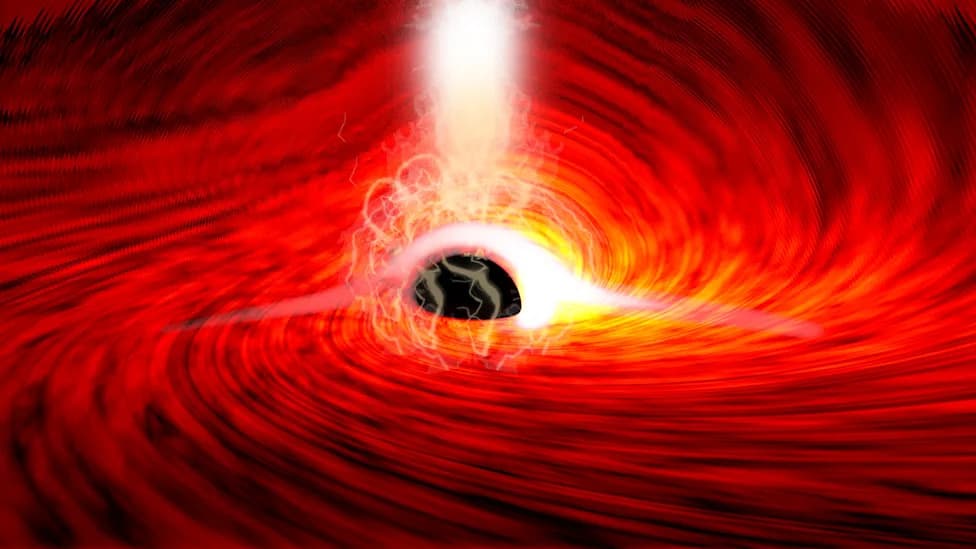
The German‑led eROSITA telescope's second public data release (DR2) catalogs nearly 2 million X‑ray sources, almost doubling the number previously known. Compiled from three all‑sky scans over 556 days, the release includes more than 1.9 million point sources (mainly active supermassive black holes and Milky Way stars) and roughly 64,000 extended objects such as galaxy clusters and supernova remnants. Optical and infrared counterparts have been identified for many sources; where matches exist, about 88% are distant galaxies hosting accreting black holes. DR2 provides a uniform, large statistical sample for studies of black hole growth, galaxy evolution and cosmic large‑scale structure; DR3 is planned for 2028.
eROSITA DR2 Nearly Doubles Known X‑Ray Sources — Close to 2 Million Objects Catalogued
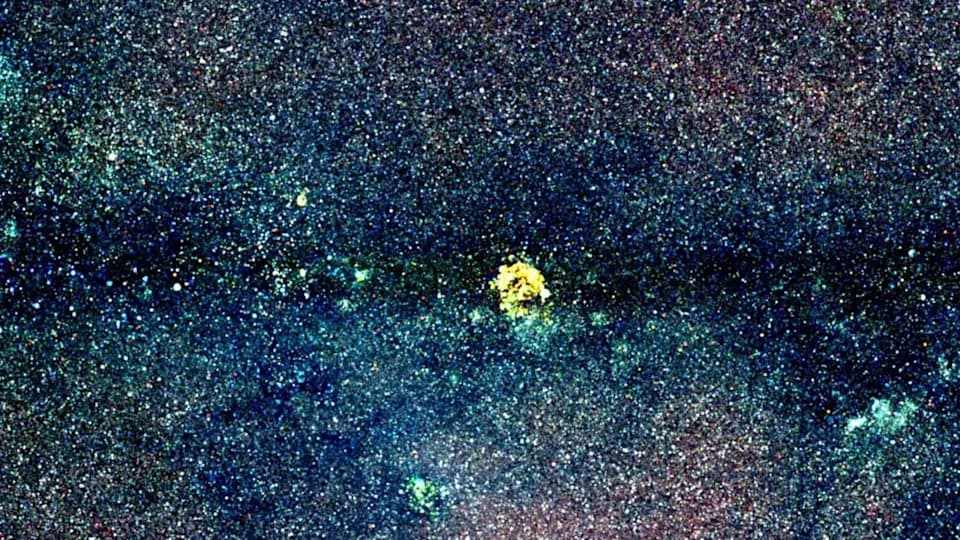
This view of the western X-ray sky from eROSITA shows tons of cosmic X-ray sources in different energy bands. . | Credit: MPE, J. Sanders
A major public dataset from the German-led eROSITA X-ray telescope has nearly doubled the number of known cosmic X-ray sources, delivering the most complete uniformly observed map yet of the universe's hottest, most energetic objects.
The second large public release from eROSITA, called DR2, lists almost 2 million X-ray–emitting sources — including actively accreting supermassive black holes, galaxy clusters, stars and other extreme phenomena — according to the Max Planck Institute for Extraterrestrial Physics (MPE). The catalog will enable researchers to study black hole growth, galaxy evolution and the formation of the universe's largest structures.
DR2 is built from data collected during eROSITA's first three all‑sky scans, an observing campaign that spanned 556 days. By combining repeated sweeps of the sky, astronomers were able to detect fainter X-ray sources that earlier surveys could not reliably find.
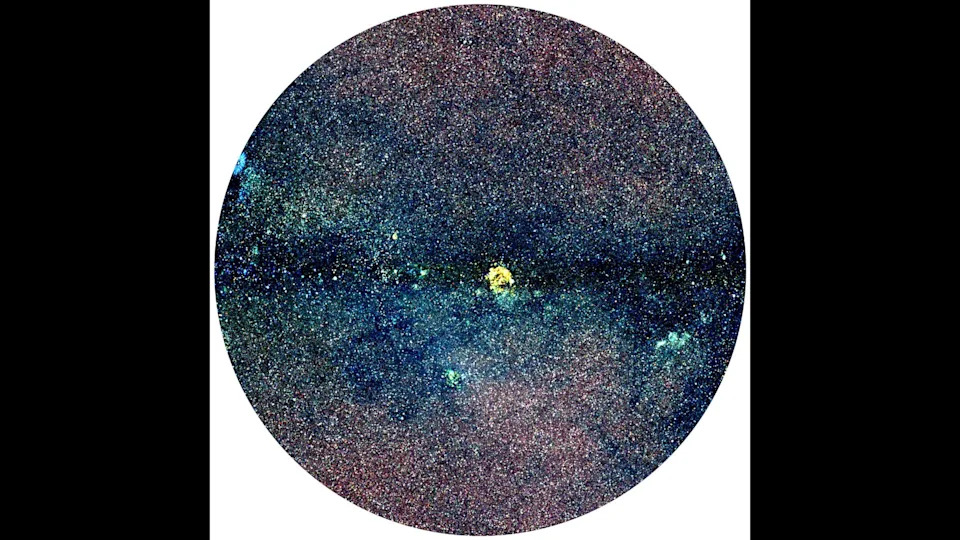
A full version of the western X-ray sky from eROSITA. | Credit: MPE, J. Sanders
What the Catalog Contains
Of nearly two million detections, more than 1.9 million are point‑like sources. Most of those are active supermassive black holes feeding at the centers of distant galaxies or individual stars within the Milky Way. These compact X‑ray emitters provide insight into how galaxies grow as well as stellar activity and life cycles.
Approximately 64,000 detections are extended sources — a category that includes massive galaxy clusters, nearby galaxies and supernova remnants (the glowing debris left behind after stars explode). Galaxy clusters are particularly valuable because they trace the universe's largest-scale structure and help scientists probe the roles of dark matter and dark energy in cosmic evolution.
Why X‑Rays Matter
Unlike visible light, X‑rays reveal some of the universe's most energetic environments. Gas falling toward a black hole can be heated to millions of degrees before crossing the event horizon; neutron stars, supernova remnants and the vast reservoirs of hot gas that fill galaxy clusters also emit strongly in X‑rays.

This animation shows a representation of the active galactic nuclei (AGN) identified in the DR2 catalogue. Each dot shows a single object, where the distance from the three-dimensional center increases with the source's redshift, or how far away it is from us. | Credit: MPE/J. Sanders
The uniformity and size of the DR2 catalog make it a powerful statistical resource. With nearly two million sources observed under consistent instrumental and survey conditions, researchers can chart how supermassive black holes grew across cosmic time, map the distribution of galaxy clusters to learn about large‑scale structure, and search for rare or unusual objects that smaller surveys would miss.
Cross‑Wavelength Matches and Follow-Up
The release includes optical and infrared counterparts for many X‑ray detections, helping to identify whether each source is a nearby star, a distant galaxy, a feeding black hole or another kind of high‑energy object. In catalog regions where counterparts have been identified, about 88% of matches are distant galaxies hosting actively accreting supermassive black holes.
"DR2 is the best inventory of the X‑ray sky we have to date and opens the door to robust statistical studies of cosmic populations," said Miriam E. Ramos‑Ceja, Ground Segment Manager for eROSITA and lead author of the DR2 paper. "X‑ray detection is only the first step," added Mara Salvato, eROSITA spokesperson and chair of the follow‑up working group, emphasizing the importance of linking X‑ray sources to counterparts at other wavelengths.
Although eROSITA stopped collecting new scientific observations in early 2022, the mission completed enough sky scans to support multiple public releases. The team plans a further data release, DR3, currently scheduled for 2028. The eROSITA‑DE DR2 catalog is available online for researchers and the public to explore.
With this release, astronomers now have an unprecedented, uniformly observed X‑ray dataset that will power studies across high‑energy astrophysics — from local stellar activity to the evolution of the most massive structures in the cosmos.
Help us improve.