A narrative review accepted Aug. 6 in Humanities and Social Sciences Communications finds social media can both support adolescents by building community and access to mental-health resources and correlate with harms such as anxiety, depression, loneliness, cyberbullying, poor sleep and harmful alcohol use. Effects vary by how platforms are used: active, relational engagement often produces better outcomes than passive, algorithm-driven consumption. Visual apps like Instagram and Snapchat are linked to body-image concerns, and algorithms can amplify emotionally salient content. The authors call for stronger moderation, improved digital literacy and more longitudinal research to better establish causation.
Adolescence Meets the Algorithm: How Social Media Helps — and Harms — Young People's Mental Health
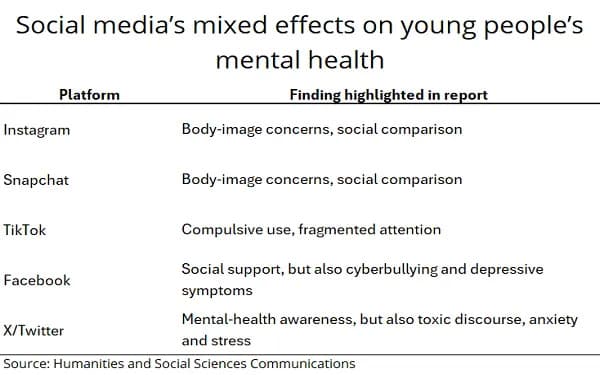
A growing body of research now paints a clearer picture of what hours of algorithmically curated social-media content can mean for adolescents and young adults. A narrative review accepted Aug. 6 for publication in Humanities and Social Sciences Communications finds that social platforms can both help young people find community, express themselves and access mental-health resources and, at the same time, be associated with harms including anxiety, depression, loneliness, cyberbullying, poor sleep and harmful alcohol use.
Not All Use Is Equally Harmful
The review, authored by Hamid Alhaj, Mahmoud Odwan Jaber, Marwan Assaf, Farah Awadhalla, Rita Alkhatib and Khaled Obaideen, emphasizes that social media is not uniformly toxic. Platforms can provide important social support—especially for people isolated offline—help users find niche communities, share experiences and locate mental-health information. Some included studies even linked social-media engagement with higher life satisfaction and improved self-esteem.
Active Versus Passive Engagement
Outcomes depend heavily on how people use social media: the content they consume and the nature of their interactions. Active, relational participation—conversing with friends, offering support or creating content—is generally associated with better outcomes. By contrast, prolonged passive consumption, such as endlessly browsing curated images of strangers’ lives, tends to be less restorative and is linked in some studies to poorer mental-health outcomes.
Visual Platforms And Social Comparison
Image-focused services raise particular concerns. Instagram and Snapchat are frequently associated with body-image worries and social comparison because highly curated imagery encourages users to measure themselves against idealized portrayals of beauty, success and lifestyle. Short-form, algorithm-driven apps such as TikTok have been tied to compulsive viewing and fragmented attention among younger users.
Algorithms Amplify Emotion — For Better And Worse
Recommendation systems curate content to maximize relevance and engagement. That curation can amplify emotionally salient material and, for vulnerable users, reinforce cycles of negative exposure—repeatedly surfacing material that triggers rumination or distress. At the same time, algorithms can surface supportive resources and communities, so the technology itself is not inherently harmful; its impact depends on governance, moderation, platform design and users' digital literacy.
Commercial trade-off: An engagement-driven system that finds upsetting content keeps people watching. The algorithm has optimized attention, but not necessarily well-being.
Business-Model Tensions And Advertising
Platforms profit when users keep watching, scrolling and returning. That economic incentive encourages designs that reduce friction and sustain engagement, sometimes with human costs. The review also links exposure to alcohol advertising and peer-driven drinking content with harmful alcohol consumption among adolescents—highlighting that the environment surrounding ads matters for risk behaviors, not just whether an impression met a targeting parameter.
Gender, Age And Differential Risks
Girls and young women appear especially vulnerable to appearance-related social comparison on image-heavy platforms and are more likely to experience anxiety, depression, cyberbullying and emotional strain tied to passive engagement. The authors also stress that adolescence and emerging adulthood are distinct developmental stages: adolescence often involves heightened peer sensitivity and body-image formation, while emerging adulthood involves different pressures around identity and autonomy.
Correlation Versus Causation And Research Limits
The authors warn against interpreting the evidence as definitive proof that social media causes mental-health problems. Much of the literature is cross-sectional, making causal inference difficult. Distress may lead some young people to use social media more intensively or in riskier ways, which can then reinforce negative feelings. The review itself is narrative rather than experimental, combines studies with varied methods, and covers a broad age range (roughly ages 10–40). The rapid evolution of platforms also means research can become outdated quickly.
Practical Takeaways
The overall conclusion is nuanced. Social media offers real benefits—reducing isolation, connecting people to support and improving access to mental-health information—yet compulsive consumption, harmful content, social comparison and algorithmically reinforced exposure present clear risks. The authors recommend stronger content moderation, improved digital literacy education, healthier usage habits, more meaningful offline interaction and longitudinal or intervention-based research to clarify causation and guide policy and product design.
For advertisers, media buyers and engineers: Beyond brand safety and impression counts, consider the environment your business model helps finance and whether platform design choices align with user well-being.
Help us improve.