
Two recreational divers found a Roman-era shipwreck three miles off Mazara del Vallo, Sicily, at about 150 feet deep. The site contains hundreds of amphorae—mainly Dressel 1A jars for wine and olive oil—stacked nearly seven feet high across a deposit more than 66 by 20 feet. Authorities recovered two lead anchor stocks and identified North African and Neo-Punic amphorae. Italy's Culture Ministry does not plan to raise the entire wreck; researchers say the find could shed light on ancient trade routes and shipbuilding.
2,000-Year-Old Roman Shipwreck Discovered Off Sicily — Hundreds of Amphorae Intact
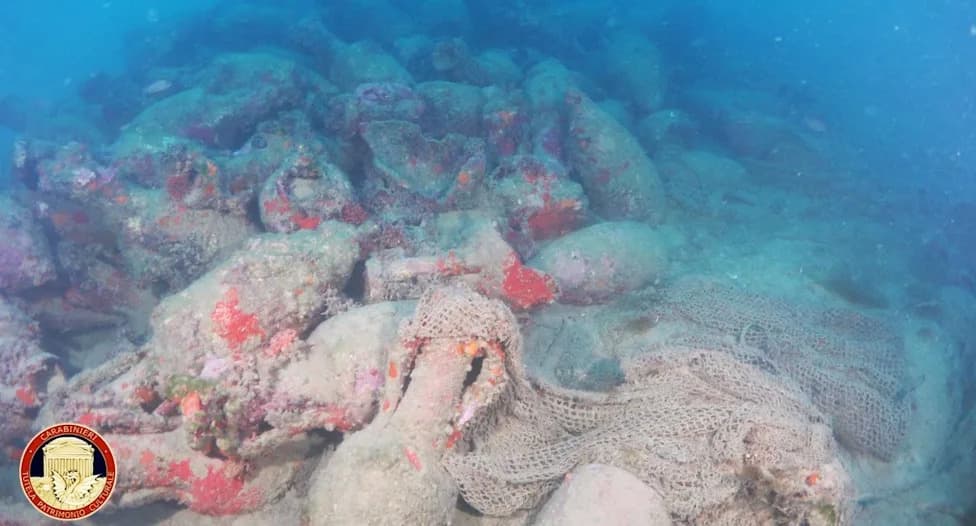
Ancient Roman Shipwreck Discovered in SicilyItalian Ministry of Culture
Two recreational divers have accidentally uncovered a remarkably well-preserved Roman-era shipwreck on the seabed off Sicily's western coast, the Italian Ministry of Culture announced. The site—believed to have lain undisturbed for more than 2,000 years—was located roughly three miles off Mazara del Vallo, about 80 miles west of Palermo, at an estimated depth of 150 feet.
The discovery
Freediver Giacomo de Mola, who was diving with spear fisherman Igor Bisulli, described the moment on Instagram: his instruments initially registered what looked like "a simple rock," but he felt compelled to investigate. "One last breath. And I descend. The visibility isn't the best. I see a large dark mass and think: 'The usual big rock,'" he wrote. As he drew closer he realized it was not rock but "an immense expanse of amphorae — hundreds of amphorae that had lain on the seabed for over 2,000 years."
What's at the site
Archaeologists date the wreck to the 2nd–1st centuries BCE. The site contains hundreds of clay amphorae—predominantly Dressel 1A types used to transport wine and olive oil—piled nearly seven feet high across a deposit more than 66 feet long and roughly 20 feet wide. Divers from local units of the Carabinieri recovered two lead anchor stocks and an additional lead fitting. Some amphorae types point to North African manufacture, and at least one example was identified as an older Neo-Punic vessel.
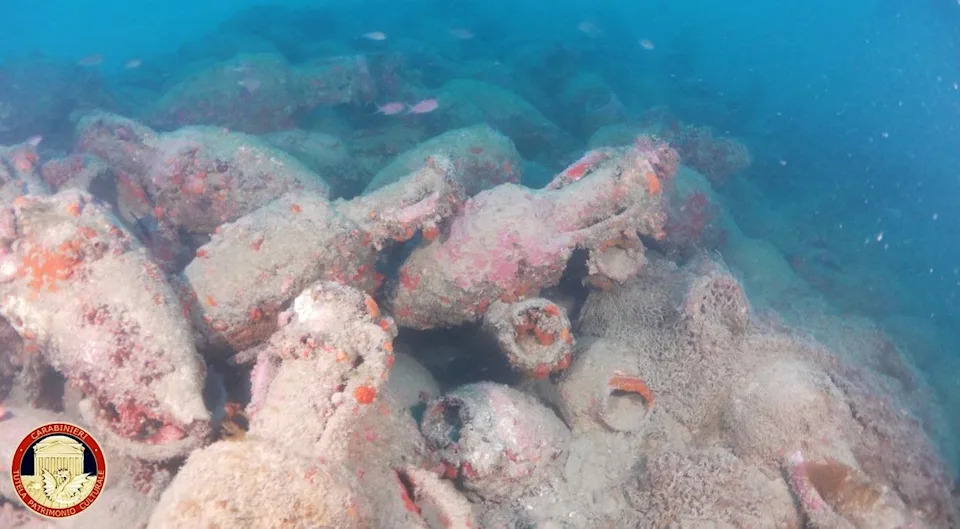
Amphorae, the ancient ceramic jars, piled up on the seafloor.Italian Ministry of Culture
"One of the most important underwater archaeological discoveries of recent years," said Italy's Culture Minister Alessandro Giuli, noting the find can reveal information about the people, routes and exchanges that made the Mediterranean a crossroads of civilizations.
Archaeological significance
Researchers say the concentration and condition of the amphorae increase the likelihood that an intact wooden hull and other organic remains may be preserved beneath the ceramic jars. If present and recoverable, such remains could offer rare insights into Roman shipbuilding techniques, cargo stowage, and ancient maritime trade networks across the central Mediterranean.
Conservation and next steps
The Ministry of Culture has stated it does not plan to raise the entire wreck. That approach is consistent with modern maritime archaeology, which favors in situ preservation when feasible and selective excavation or artifact recovery when necessary for study and conservation. Further research will include detailed mapping, careful documentation, targeted recoveries, and conservation of any retrieved materials.
Historical context
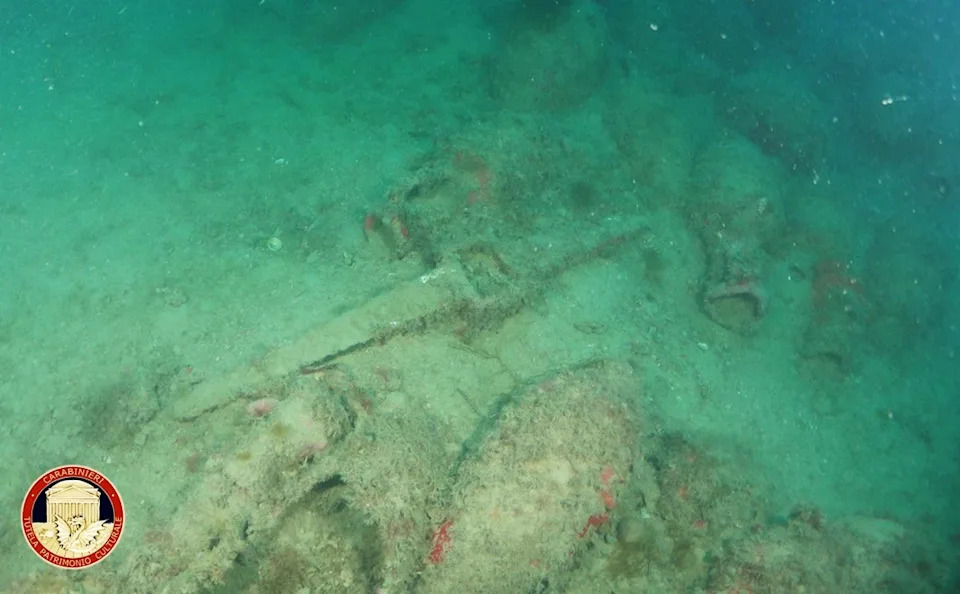
The ministry says it has no plans to raise the entire wreck.Italian Ministry of Culture
Sicilian waters were among the busiest shipping lanes in antiquity. Rome gained control of Sicily in 241 BCE after the First Punic War with Carthage, and the island's surrounding seas became a vital artery of the Roman trade network. The Mazara del Vallo wreck has the potential to refine understanding of trade routes, cargo origins, and the economic links that shaped the ancient Mediterranean.
Expert commentary
Simon Stoddart, Professor of Archaeology at the University of Cambridge, told NBC News the find can help reconstruct trading routes and build an "ancient risk map" of Mediterranean seafaring. Lucy Blue, a maritime archaeologist at the University of Southampton, told CNN the wreck "adds yet more knowledge to our understanding of trade and exchange prior to the Roman Empire," and suggested the amphorae may be protecting an especially well-preserved hull.
Public access and outreach
Italian authorities plan to continue research and share findings with the public as conservation and study progress. The discovery offers a rare, tangible link to Mediterranean commerce more than two millennia ago and will likely prompt further multidisciplinary study involving archaeologists, conservators, historians, and marine scientists.
Help us improve.





















