US courts are increasingly finding Meta liable for harms to children, imposing multimillion-dollar penalties and ordering product changes that could expose the company to billions in liability. Judges have demanded stronger age verification and predictive AI models, though experts warn these tools can misclassify users. Separately, Meta's smart glasses face privacy bans, and Google is navigating senior departures as competition in AI intensifies.
Meta Hit With Massive Child-Safety Penalties — Lawsuits Could Cost Billions
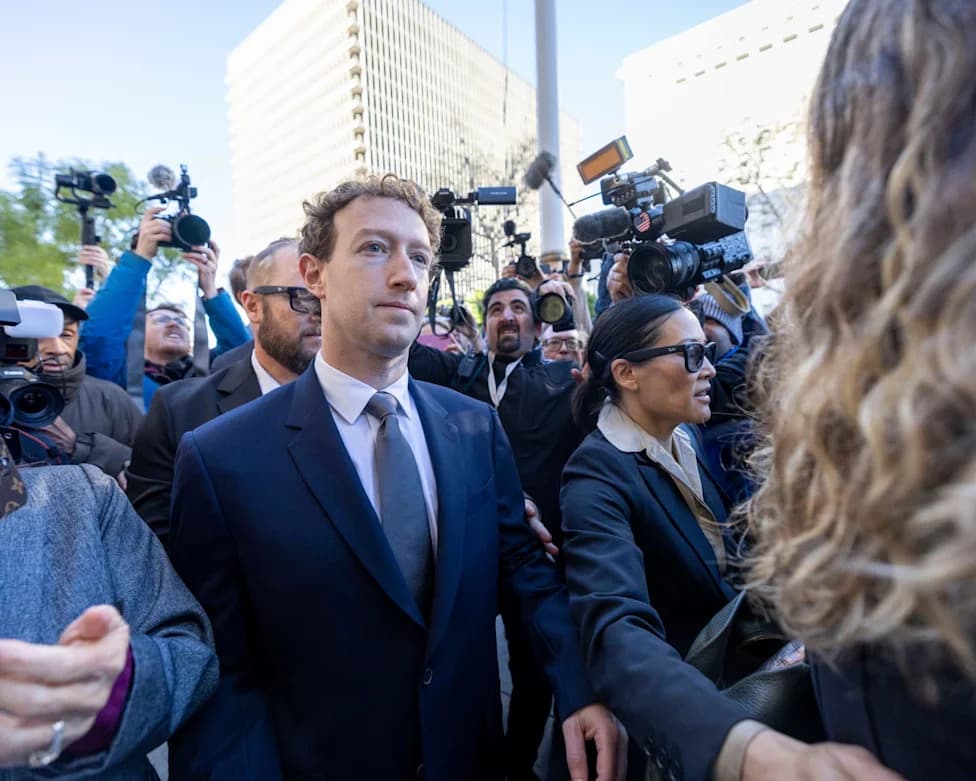
Mark Zuckerberg arrives to the Los Angeles superior court on 18 February 2026 in Los Angeles, California.Photograph: Jill Connelly/Getty Images
Danielle Abril, editor of The Guardian's Reworked series on AI and the future of work, is filling in for Blake Montgomery this week. Major legal fights over child safety at Meta are playing out across U.S. courts — and recent rulings have been costly and consequential for the company. At the same time, Meta's smart glasses are drawing a public privacy backlash, and Google is navigating a leadership shakeup inside its AI division amid fierce competition from OpenAI and Anthropic.
Court Rulings and Growing Legal Exposure
Courts are delivering a string of rulings that could reshape how social platforms operate. A New Mexico court recently ordered Meta to pay $567 million into a teen mental-health fund to address harms tied to its services. That judgment was added to a prior $375 million penalty recorded after a March jury concluded Meta negligently permitted damage to children’s mental health and concealed knowledge about child sexual exploitation on its platforms. In a separate Los Angeles case in March, Meta was held liable for $4.2 million in damages for designing platforms that foster addiction and harm children.
Meta now faces 42 lawsuits filed by states and thousands more complaints, many consolidated alongside claims against YouTube, TikTok and Snap. Plaintiffs are pursuing damages and injunctions aimed at forcing product changes — from stricter age verification to usage limits and clearer safety banners — that they say would reduce child harm.
Age Verification, AI Limits and Enforcement Challenges
Courts have ordered remedies that lean on technology: the New Mexico ruling, for example, requires Meta to improve AI-powered age verification tools and to develop a predictive model to flag likely under-13 accounts. Those measures may identify more underage users and extend protections, but AI systems are imperfect and have a documented history of misclassifying people.
Real-world checks can also fail. Research suggests Australia’s ban on social media for children under 16 has been widely circumvented because age checks are weak — few users were asked for official ID, and many reported evading restrictions with fake accounts or VPNs.
Settlements and Industry Response
Some companies are resolving claims privately rather than facing trials. Last week TikTok settled three lawsuits brought by young plaintiffs who said the app harmed their mental health. Other suits have been dropped after multi-platform settlements, and in June platforms reached a settlement with a Kentucky school district that alleged harm from addictive design features. Still, a federal case brought by attorneys general from 29 states and set for trial in Oakland could set a broader precedent for the many suits pending nationwide.
Smart Glasses and a Privacy Backlash
Meta’s smart glasses have sparked a separate wave of controversy. Reports of people being photographed or filmed without consent prompted restaurants, pubs and theaters to ban the eyewear. Influencers and members of the public have described reputational and safety concerns, branding the devices with nicknames such as "pervert glasses," and fueling demands for stricter privacy rules and business-entry bans.
Google’s AI Shakeup and the Talent War
Meanwhile, Google’s AI division is undergoing leadership changes as labs compete for top talent. DeepMind CEO Demis Hassabis is stepping back from day-to-day leadership while remaining its chair and serving as Alphabet's chief scientist. Google chief scientist Jeff Dean and three colleagues are leaving to form Discovery Loop, a startup Google is backing. These departures coincided with a roughly 4% drop in Google’s stock last week and add to reports of delayed product releases — notably Gemini 3.5 Pro — and internal morale issues.
Market metrics show ChatGPT leading with roughly 1.11 billion monthly users as of May, while Google's Gemini reported about 662 million and Anthropic's Claude about 245 million. Anthropic has focused on coding and technical workloads, earning higher-margin business customers in some markets.
Why This Matters
"This is a cautionary tale of hubris," said Karen North, a University of Southern California professor who studies social media. She warns that what starts as a focus on young users could broaden to vulnerable adults and then to the public at large.
Child safety and privacy issues are no longer peripheral PR challenges for tech giants. They represent material legal and financial risks that could force design changes across social platforms. As courts, regulators and the public press for accountability, tech companies will face hard choices about product design, enforcement, and the limits of AI-driven solutions.
Other headlines: Senator Bernie Sanders urged a pause on AI development; UK children reported more explicit deepfakes of themselves; the White House is developing a vetting process for dangerous AI; Little Rock residents protested planned data centers; scientists reported the first AI-designed viruses, raising safety concerns; and SpaceX beat revenue expectations in a post-IPO report.
Help us improve.