Greek police arrested members of an Italian coral-smuggling ring on Skopelos after seizing red coral valued at roughly €800,000. The case highlights how illegal harvesting feeds luxury markets—particularly in Italy’s Torre del Greco—where raw coral is processed into jewellery. Scientists warn traceability is weak once coral is processed, populations are poorly mapped in Greece, and recovery is slow because colonies can take up to 100 years to form.
Red Coral Smuggling Ring Busted on Skopelos: €800k Seizure Exposes Threat to Mediterranean Populations
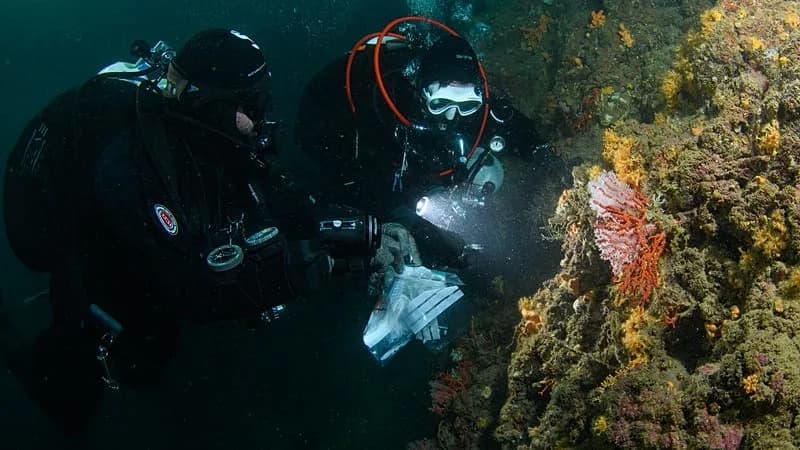
Coral trafficking ring exposed on Aegean island: What is red coral used for and how big is the threat?
Greek authorities have detained members of an Italian smuggling network on the Aegean island of Skopelos after seizing red coral estimated at about €800,000. Officials say the cargo was bound for Italy and the investigation continues to determine the coral’s exact route out of Greek waters.
From Sea To Luxury: How Coral Enters The Market
The operation, led by Greece’s General Directorate of Financial Transactions Control Forces (DEOS), is one visible instance of a much broader trade. Red coral (Corallium rubrum) has been harvested across the Mediterranean for centuries, and Italy — notably the town of Torre del Greco near Naples — remains a major centre for processing and turning raw coral into high-value jewellery and luxury items.
When harvested under national rules and quotas, coral trade can be legal. The problem arises when illegally harvested material enters the same supply chains, becoming difficult to distinguish from legally sourced coral once it is cut and polished.

Bracelets made with turquoise, 925 silver, carnelian, red coral and green aventurine, archive image - AP Photo
Value, Demand And The Illegal Market
Prices for red coral vary widely by quality, size and processing stage; the FAO notes that top-quality coral can fetch up to €5,000 per kilo. Renewed interest from luxury fashion houses has driven demand in recent years, placing this slowly growing marine resource back at the centre of the high-end market.
High value and limited supply have encouraged illegal harvesting and smuggling. Research reported by the Earth Journalism Network suggests that as much as three tonnes of coral may be trafficked illegally from Algeria to Europe each year, with Italy a key destination.
Traceability And Conservation Challenges
One of the biggest enforcement challenges is traceability. Once raw coral reaches processing workshops and is turned into jewellery, determining its geographic origin and whether it was legally harvested becomes far more difficult.
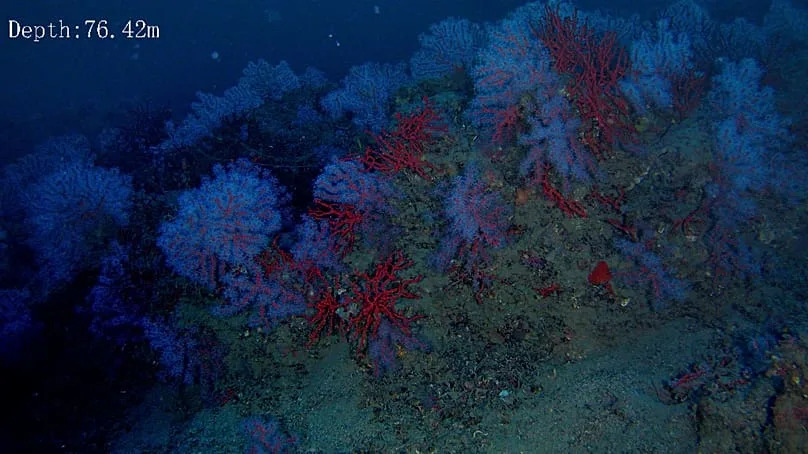
Red coral colonies found at depths of more than 70 m in Greece by the HCMR/FAO survey - ΕΛΚΕΘΕ/FAO
To address these gaps, the General Fisheries Commission for the Mediterranean (GFCM) — part of the FAO — ran a research programme on red coral from 2020 to 2023 involving seven Mediterranean countries. Greece participated through the Hellenic Centre for Marine Research (HCMR), which contributed surveys and population assessments.
“The seabeds of Greece have not been mapped,”
— Maria Salomidi, HCMR researcher and lead investigator
Scientists have located areas with coral formations but lack a comprehensive map of population extent. Meanwhile, seabed habitats face pressure from multiple activities: both professional and recreational fishing can damage coral ecosystems even when coral itself is not the target.
Biology And Cultural Significance
Red coral is not a plant but a marine animal with a hard calcareous skeleton. It grows extremely slowly — a large, mature colony can take decades or up to 100 years to form — making recovery from overharvesting especially slow and difficult. Surveys by HCMR/FAO have documented mature colonies at depths exceeding 70 metres in some Greek waters.
Humans have prized red coral since prehistoric times. Beyond its economic value, coral features in Mediterranean culture and myth — Ovid’s Metamorphoses links coral’s crimson colour to the blood of Medusa — but the modern story is one of urgent conservation and management challenges.
What The Skopelos Arrests Mean
Authorities and scientists warn that the Skopelos arrests are unlikely to be isolated. The GFCM has raised concerns that red coral populations may be overexploited across parts of the Mediterranean. Improved mapping, stronger traceability, and tighter enforcement will be essential if remaining populations are to be protected while legal, sustainable trade continues.
Help us improve.